
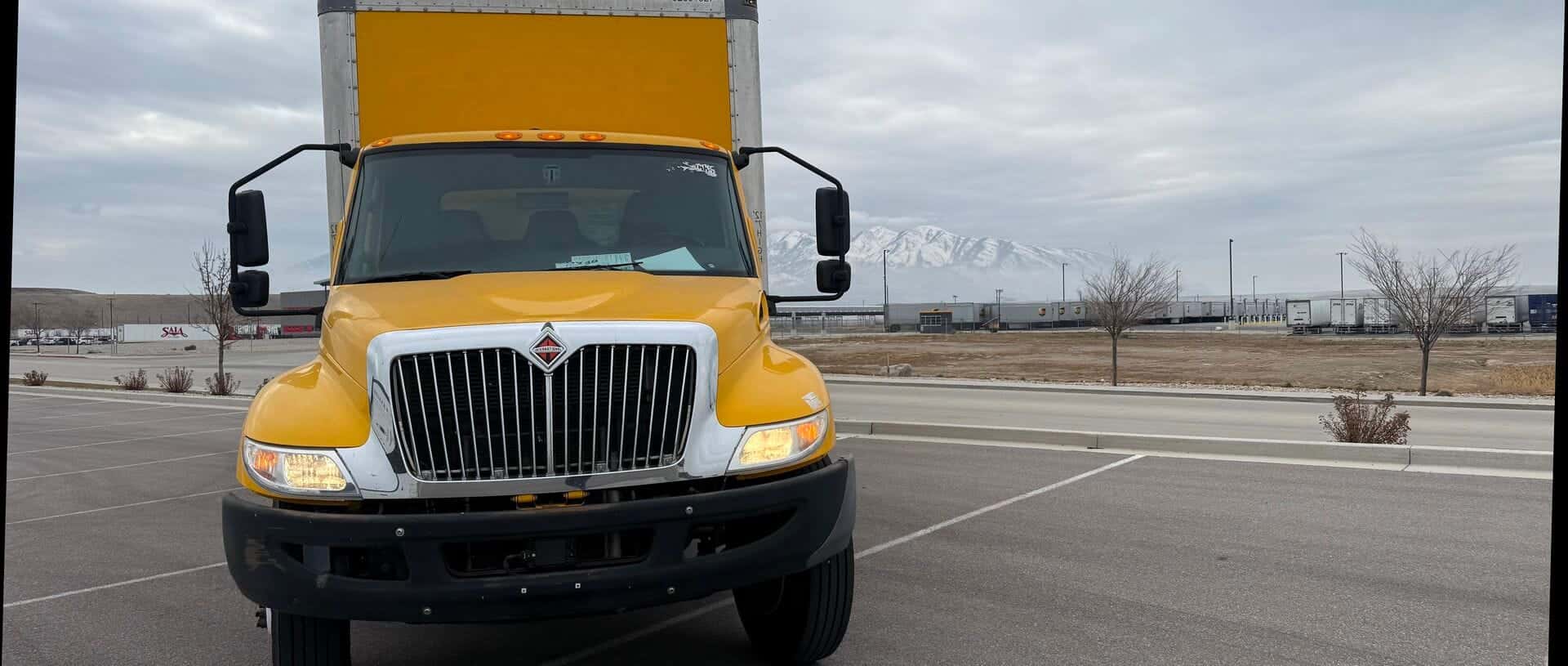
A box truck lease on means you sign a written lease that gives an authorized carrier control of your truck while you haul freight under its MC number, USDOT number and insurance filings. You still own the truck, and usually drive it. The federal Truth-in-Leasing rules in 49 CFR Part 376 decide what that lease must say, from pay to chargebacks to escrow.
This guide is for owners of a 16 to 26 ft straight truck who want to haul freight without running their own authority yet, or who are comparing a lease-on with getting an MC number. It covers the law, the paperwork and the questions to ask. It does not cover pay rates, because those vary by carrier and are yours to negotiate.
Key takeaways
- A lease-on puts your truck under the carrier's authority. The carrier takes exclusive possession, control and responsibility for operating it for the length of the lease.
- The lease must be written and signed, and it must state your pay, every chargeback and how it is calculated, escrow terms and who pays for insurance.
- The carrier must pay within 15 days after you submit the delivery documents, and it cannot hold your pay waiting for a clean bill of lading.
- You still carry the truck's upkeep in practice: maintenance, repairs and, usually, scheduling and paying for the annual inspection.
What does it mean to lease on a box truck to a carrier?
To lease on a box truck to a carrier, you rent your equipment, with you as the driver, to a company that holds interstate operating authority. Under 49 CFR 376.11 (opens in a new tab), a carrier can haul in equipment it does not own only under a written lease, with receipts for the truck and the truck marked as being in the carrier's service.
In practice, the carrier's legal name and USDOT number go on both sides of the truck, dispatch sends you loads, and the bills of lading show the carrier as responsible for the freight. That is the standard way to haul for-hire interstate freight in your own box truck without MC authority of your own.
The paperwork that has to exist under 376.11:
- Receipts. When the carrier takes possession, it gives you a receipt that identifies the truck and states the date and time. A receipt at the end is required only if the lease says so.
- Proof in the cab. A copy of the lease rides in the truck, or a carrier statement naming you as owner, the lease dates, any commodity limits and where the original lease is kept.
- Trip records. For each trip the carrier keeps documents with your name and address, the origin, departure date and time, and final destination.
Box truck lease on vs your own MC authority: what changes
The core difference is whose name is on the authority and the insurance filings. With your own authority, the federal duties sit with your company. On a box truck lease on, most of them sit with the carrier, and you trade some independence for that.
| Item | Leased on to a carrier | Your own authority |
|---|---|---|
| Operating authority (MC) | Carrier's | Yours. FMCSA's filing fee is $300 per authority. FMCSA lists 20 to 25 business days for new applicants, longer if it reviews the file further |
| Process agents (BOC-3) | Carrier's filing | You file one |
| Public liability filing | Carrier files it | You file it. Minimum $750,000 for non-hazmat freight in a truck of 10,001 lb GVWR or more |
| Cargo insurance | Usually through the carrier's policy, sometimes charged back | FMCSA requires no cargo filing for general freight, but brokers usually ask for coverage |
| Door markings | Carrier's name and USDOT | Your name and USDOT |
| Finding freight | Carrier dispatch | You, a dispatcher or load boards |
| Billing and collections | Carrier bills the shipper or broker | You invoice, or use factoring |
| Driver qualification file and safety record | Carrier keeps them | You keep them, plus a new-entrant safety audit |
| Choice of loads and lanes | Limited to what the carrier offers | Yours |
Fees and timing are from FMCSA's page on getting operating authority (opens in a new tab). The liability minimum and the cargo rule are from FMCSA's insurance filing requirements chart (opens in a new tab). Brokers often ask for higher limits than the federal minimum. Neither path is automatically more profitable. That depends on your freight, your costs and the specific lease.
If you already hold authority, you don't have to give it up to lease on. FMCSA's new Motus registration system (opens in a new tab) lets a carrier voluntarily suspend its operating authority to lease onto another carrier for a while, then reinstate it within one year. MC numbers still exist in 2026. FMCSA says retiring docket numbers is still under consideration and would go through a proposed rule first.
What does 49 CFR 376.12 require in a box truck lease?
49 CFR 376.12 (opens in a new tab) lists the provisions every owner operator lease agreement must contain, and the carrier must actually follow them. Use this as a checklist with the lease in front of you.
| Section | What the lease must say | What to check |
|---|---|---|
| (a) Parties | Signed by the carrier and the equipment owner, or their authorized representatives | Your name or company matches the title or registration |
| (b) Duration | Exact start and end, by date and time or by event | It lines up with the equipment receipts |
| (c) Control | Carrier has exclusive possession, control and use, and full responsibility for operating the truck | No "you're on your own" language while under dispatch |
| (d) Compensation | Pay stated on the lease or an attached addendum, delivered to you before the first trip | Percentage, per mile or another method, in writing |
| (e) Cost items | Who pays fuel, fuel taxes, empty miles, permits, tolls, detention and accessorials, plates and licenses, and loading and unloading. Also who removes the carrier's markings at the end | Every item is assigned, with nothing left vague |
| (f) Payment period | Payment within 15 days after you submit the delivery documents | No deadline for turning in paperwork |
| (g) Freight bills | On percentage pay, a copy of the rated freight bill before or at settlement | You can see what the load paid. On any pay method, you may examine the carrier's rate documents |
| (h) Chargebacks | Every deduction listed, with how each amount is calculated | You get copies of the documents behind each charge |
| (i) Forced purchases | You are not required to buy or rent products, equipment or services from the carrier | Any truck payment deductions are spelled out |
| (j) Insurance | The carrier's duty to keep public liability coverage, and who provides any other coverage, such as bobtail | The exact dollar amount of any insurance chargeback |
| (k) Escrow | Amount, uses, accounting, interest and return conditions | Returned within 45 days of termination |
| (l) Copies | Both parties sign. One copy stays in the truck and you keep one | Get your signed copy before you roll |
Pay and settlement rules in section (f)
Section (f) does more than set the 15-day clock. The documents the carrier can require before paying are limited to your logs and the papers it needs to get paid by the shipper. It cannot tie your pay to a bill of lading with no exceptions on it, and it cannot set time limits for sending in delivery documents. Section (e) also makes the lease say who bears detention and accessorial costs, so read that line closely. Our guide to freight accessorial charges explains how those charges show up on a load.
Escrow and cargo claim deductions
If the carrier holds an escrow, it must show every transaction on your settlement sheets or in a monthly statement. It must pay interest at least quarterly, at no less than the 13-week Treasury bill rate, and give you an accounting whenever you ask. Under section (j)(3), any deduction for cargo or property damage needs a written, itemized explanation delivered to you before the money comes out.
Who handles insurance, permits and compliance on a lease-on?
The carrier keeps the public liability insurance that FMCSA requires and files it under its authority. The lease must state that obligation, and it must also say who covers everything else. On a typical box truck lease, the split looks like this:
- Carrier: primary auto liability while you are under dispatch, the federal insurance and process-agent filings, its operating authority, the driver qualification file and its safety record. Cargo coverage often runs through the carrier's policy too, sometimes with a chargeback, so confirm the limit, the deductible and your cost.
- Owner: non-trucking liability (bobtail) for when you are off dispatch, physical damage on the truck itself, and often occupational accident coverage. Any of these bought through the carrier must be listed in the lease with its cost.
- Shared or negotiated: permits, tolls, plates and fuel taxes. Section (e) requires the lease to assign each one.
If you buy insurance through the carrier, section (j)(2) gives you the right to a copy of each policy on request and a certificate showing the insurer, policy number, dates, limits, your cost and your deductible.
Logs are a compliance item too. Hours of service apply to box trucks of 10,001 lb GVWR or more in interstate commerce, and the carrier usually tells you which ELD to run. See our guide to box truck ELD requirements.
What is the owner-operator still responsible for?
Leasing on moves the authority, not the wrench. Under a typical lease, the truck's condition is still your cost and your problem.
- Annual inspection. Under 49 CFR 396.17 (opens in a new tab), a carrier cannot run a commercial vehicle unless it has passed a periodic inspection within the past 12 months and proof is on the vehicle, such as the report or a decal. The legal duty sits with the carrier that controls the truck, but the lease usually makes the owner schedule and pay for it. Keep the report in the cab and a copy in your files.
- Maintenance and repairs. Brakes, tires, lights, and the liftgate if the truck has one. A truck down for repairs earns nothing, and the lease decides whether any chargebacks keep running while it sits.
- Registration, title and plates. The truck stays in your name. Check who pays for plates under section (e).
- Your own business costs. Truck payments, your insurance premiums, fuel if the lease puts it on you, and taxes. Talk to an accountant about how you will be paid and taxed.
- The driver. If you drive, you meet the qualification rules and keep your medical card current. Our guide to non-CDL box truck driver requirements covers what FMCSA expects.
Questions to ask a carrier before you sign a lease
Ask these before the first load, and get the answers in the lease or a signed addendum, not in a text message.
- Exactly how is pay calculated, and on percentage pay, will I get the rated freight bill with each settlement?
- What is every chargeback, and how is each amount calculated? Ask for a sample settlement sheet.
- Is there an escrow? How much, what can it be used for, and how fast does it come back?
- Who pays fuel, tolls, empty miles, permits, detention and loading or unloading?
- What insurance do you provide, and what limits and deductibles apply to me if there is a cargo claim?
- How do settlements work, and how do I submit PODs and other delivery paperwork?
- How do I end the lease, how much notice do I owe, and is there any fee?
- Am I free to turn down a load? What lanes and freight types do you actually run?
- Does any part of the deal require me to buy or rent something from you?
Before you sign, check the carrier itself. Its authority should show as active and its insurance as on file. Our guide on how to verify a trucking company walks through the SAFER check in a few minutes.
What carriers usually require from a box truck and its owner
Requirements vary, but carriers that lease on box trucks tend to ask for a similar packet:
- Truck: a size and model-year cutoff, a dry box in good condition, and often a liftgate and e-track or logistics posts for load securing.
- Documents: title or registration, a current annual inspection, proof of the insurance the lease puts on you, and a W-9.
- Driver: a valid license and medical card, an acceptable driving record (MVR), employment history for the qualification file, and the ability to run an ELD. Federal DOT drug and alcohol testing (Part 382) covers drivers who need a CDL, so on a non-CDL box truck any drug test is the carrier's own policy.
- Operations: a working smartphone for dispatch and photos of BOLs and PODs at pickup and delivery.
Cobra US Cargo operates under its own authority (MC-1645621, USDOT 4247005). For owner-operators, it looks for a 26 ft box truck, 2018 or newer. The full requirements are on our owner operator box truck page. Whatever carrier you talk to, ours included, ask to see the full written lease before the first trip.
Sources
- eCFR — 49 CFR 376.12, Lease requirements (opens in a new tab)
- eCFR — 49 CFR 376.11, General leasing requirements (opens in a new tab)
- eCFR — 49 CFR 396.17, Periodic inspection (opens in a new tab)
- FMCSA — About FMCSA Registration Changes (Motus) (opens in a new tab)
- FMCSA — Get Operating Authority (Docket Number) (opens in a new tab)
- FMCSA — Insurance Filing Requirements (opens in a new tab)