
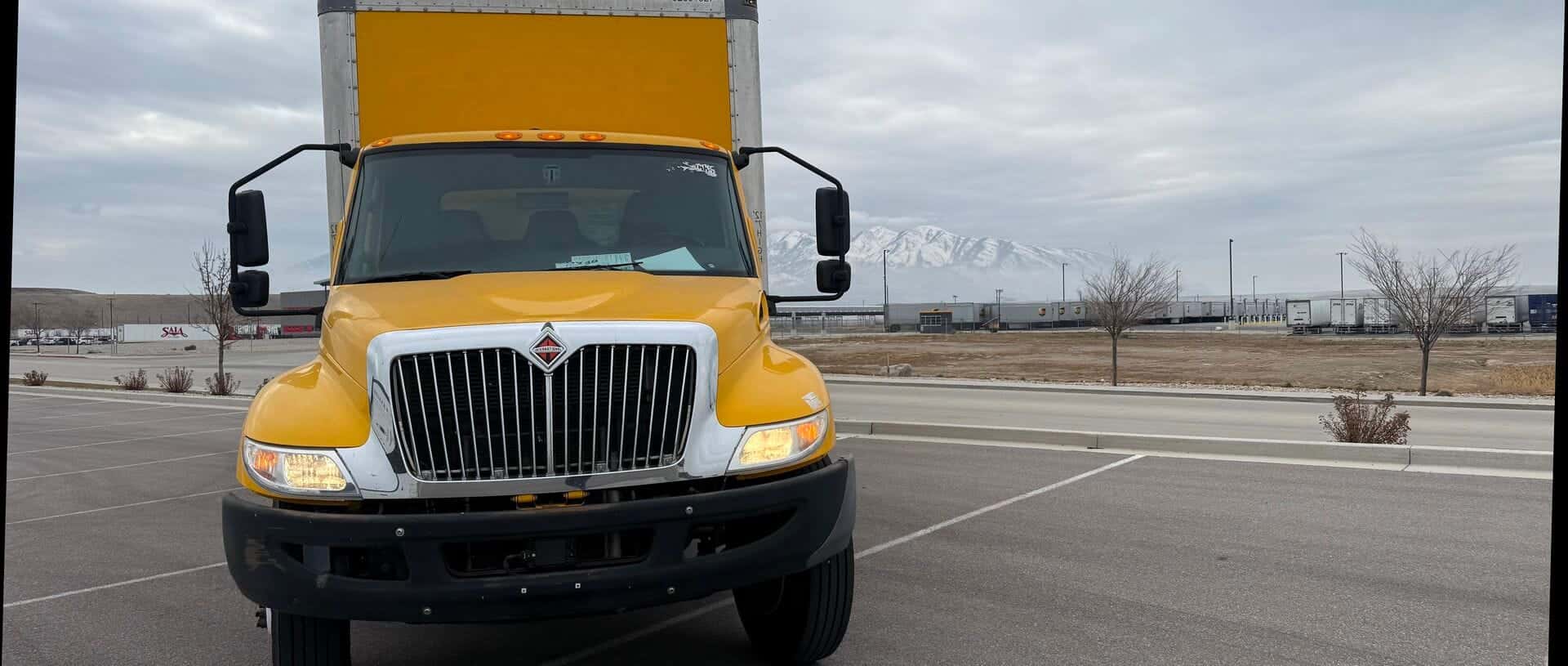
Box truck vs dry van comes down to load size and the delivery address. A 53 ft dry van wins on volume and cost per pallet once you pass 12 pallets, dock to dock. A 26 ft box truck wins for 4 to 12 pallets, liftgate drops and city receivers like New York City, where 53 ft trailers can't deliver. A cargo van fits small, light, urgent freight.
This guide is for shippers, brokers and logistics managers choosing equipment before they post or book a load.
Key takeaways
- Count pallets first: up to about 3 is cargo van territory, 4 to 12 is box truck territory, and 13 or more points to a 53 ft dry van.
- Weight can overrule floor space. A non-CDL 26 ft box truck often carries around 10,000 lb. A 53 ft van can legally carry about four times that.
- A 53 ft dry van usually needs a dock at both ends. A box truck with a liftgate can deliver to a curb.
- In New York City, 53 ft trailers may only pass through on a few interstate segments, so city deliveries need shorter equipment.
- Tractor-trailers need a Class A CDL driver. Many 26 ft box trucks are rated just under the CDL line, so a regular license can qualify.
What is the difference between a box truck, a dry van and a cargo van?
All three are enclosed, dry equipment. The difference is how they are built and who can drive them.
- Box truck (straight truck). The cargo box sits on the same chassis as the cab. No trailer, no fifth wheel. Lengths run from about 10 ft to 26 ft, and 26 ft is the largest common size in the non-CDL class. Most have a roll-up rear door, which takes a few inches off the door opening, and many add a liftgate and e-track.
- Dry van. An enclosed semi-trailer, almost always 53 ft on today's highways, pulled by a separate tractor. It is the standard full truckload trailer in the US. Its floor sits at about dock height. Most have full-width swing doors and no liftgate.
- Cargo van. A van with the seats behind the driver replaced by cargo space. High-roof models, often called sprinters, are the norm for freight. The floor is low and close to the ground, with wheel wells inside the cargo area.
On a load board, "dry van" means the trailer. A box truck is posted as a box truck or straight truck, usually with its length. Mixing them up is how a 53 ft van ends up at a receiver with no dock.
How many pallets and how much weight does each carry?
These are working numbers for standard 48 x 40 in pallets, single layer. Confirm the specific unit with the carrier.
| Equipment | Pallets (48 x 40 in) | Typical freight weight | Floor height | Who can drive it |
|---|---|---|---|---|
| High-roof cargo van | About 2 to 4, by wheelbase | Often around 3,000 lb, depends on the van | Low, below dock height | Regular license |
| 26 ft box truck | Up to 12 | Often around 10,000 lb, depends on the truck | Near dock height on many bodies | Regular license if GVWR is 26,000 lb or less |
| 53 ft dry van | 26 straight, up to 30 turned | Commonly 42,000 to 45,000 lb | Dock height | Class A CDL |
On volume, a high-roof cargo van holds roughly 400 to 530 cubic feet, a 26 ft box about 1,600 to 1,700, and a 53 ft van roughly 3,500 to 4,000, depending on the model.
The weight column is where people get burned. Each vehicle's freight limit is its weight rating minus its real empty weight, with fuel, driver and gear on board. For the 53 ft van, federal rules cap gross weight on the Interstate at 80,000 lb, under 23 CFR 658.17 on vehicle weight (opens in a new tab). Tractor and trailer weight come out of that, which is where the 42,000 to 45,000 lb range comes from.
For a box truck, dense freight runs out of weight before it runs out of floor. Twelve pallets at 1,200 lb each is 14,400 lb, more than a non-CDL 26 ft truck can legally carry. Our 26 ft box truck capacity guide shows the pallet and payload math.
Which trucks need a CDL driver?
Two federal thresholds shape this whole market.
10,001 lb: the truck becomes a commercial motor vehicle. Under 49 CFR 390.5, the FMCSA definitions (opens in a new tab), a vehicle used in interstate commerce is a commercial motor vehicle (CMV) when its weight rating or actual weight is 10,001 lb or more, whichever is greater. A 26 ft box truck is a CMV. That brings FMCSA rules such as hours of service, a medical card for the driver, and vehicle inspections. Many cargo vans are rated under 10,001 lb and fall below that line, unless they haul placarded hazmat.
26,001 lb: the driver needs a CDL. Under 49 CFR 383.5, the CDL vehicle groups (opens in a new tab), a single truck rated or loaded at 26,001 lb or more is a Group B heavy straight vehicle. A combination at 26,001 lb or more, towing a unit over 10,000 lb, is Group A. A tractor pulling a 53 ft dry van is in Group A.
That is why so many 26 ft box trucks are built with a weight rating just under 26,001 lb. The driver can run them on a regular license, as long as the truck stays at 26,000 lb or less and carries no placarded hazmat. For shippers, that means more drivers who can legally run the truck, at the cost of a lower payload ceiling.
When is a 26 ft box truck the right choice?
A box truck is the right call when the load is too big for a van and too small to justify a 53 ft trailer, or when the delivery address won't take a tractor-trailer.
4 to 12 pallets
A load of 4 to 12 pallets fills a 26 ft box well. On a 53 ft van it fills a third to half the floor. You can ship that as LTL, but your pallets then go through terminals and cross-docks. A box truck booked for your load alone keeps the freight on one truck from pickup to delivery. Less handling means fewer chances for damage, the main reason to pick a box truck over LTL for higher-value or fragile pallets.
No-dock pickups and deliveries
A dry van floor sits about 4 ft off the ground and is built to meet a dock. At a retail store, a job site, a restaurant or a small warehouse with no dock, a 53 ft van usually can't unload without a forklift that can reach into the trailer. A box truck with a liftgate lowers each pallet to the ground, and a pallet jack takes it from there. Our liftgate delivery guide covers gate limits and site prep.
New York City and other dense cities
This is the clearest case in the box truck vs dry van decision. Per NYC DOT's truck size and weight rules (opens in a new tab), trucks with 53 ft trailers may only travel on the portions of I-95, I-695, I-295 and I-495 that cross the city between the Bronx-Westchester line and the Queens-Nassau line. They can pass through, but they can't leave those highways to deliver anywhere in the five boroughs.
Tractor-trailer combinations on city truck routes are capped at 55 ft overall, which a tractor and 53 ft trailer can't meet. The same page sets a 35 ft maximum for single unit vehicles such as box trucks. The 26 ft in a box truck's name is the cargo box, not the whole vehicle, so confirm the overall length, cab included, before you book a city delivery. Box trucks still have to follow the city's truck route network, which NYC DOT describes as nearly 1,000 miles of designated roadway on its trucks and commercial vehicles page (opens in a new tab). For a full rundown of routes, tolls and off-hours deliveries, see our NYC truck delivery rules guide.
Urgent loads with no stops
A truck that carries only your freight runs straight from shipper to receiver. A dedicated box truck on a regular lane, or an expedited box truck dispatched for one load, skips the terminal and cross-dock time built into LTL. Transit still depends on distance, traffic, weather and hours-of-service limits, so treat any time estimate as typical, never guaranteed.
When should you book a 53 ft dry van instead?
In a 26 ft box truck vs 53 ft trailer choice, book the trailer when volume or weight is the main problem and both ends have docks.
- 13 pallets or more. Past 12 pallets you would need two box trucks. One 53 ft van carries 26 straight. At 13 to 17 pallets, a dry van booked as a partial load is the usual answer.
- Heavy freight. If the load runs past roughly 10,000 lb, a non-CDL box truck can't carry it legally. A dry van can handle loads several times heavier.
- Dock-to-dock shipping. Distribution centers and big warehouses are built around 53 ft trailers, from dock doors to appointment systems.
- Lowest cost per pallet. When you fill most of the trailer, a dry van usually beats any smaller truck on cost per pallet.
- Drop trailers. A shipper can load a dropped trailer over hours or days. A box truck can't be left behind. The truck and driver wait with it.
The trade-off is access. A 53 ft van needs a dock, room to swing and a receiver legal for its length.
When is a cargo van enough?
A cargo van is enough when the freight is small, light and in a hurry. Think a pallet or two, loose cartons, machine parts, or a production line waiting on one component.
Where a cargo van wins:
- Light loads of a few hundred to a few thousand pounds.
- Same-day or next-day urgency on short and medium runs.
- Tight addresses: parking garages, alleys and streets where even a box truck struggles.
Where it falls short:
- Docks. The van floor sits well below dock height, so it can't back up flush to a dock door. Forklifts can't drive in, and pallets get pulled by hand or by jack.
- Pallets. Wheel wells and a narrow door limit you to a few pallets, and tall pallets may not clear the roof or the rear opening.
- Weight. A few pallets of liquids or metal parts can max out the payload.
For box truck vs cargo van, or sprinter van vs box truck as dispatchers say it, the line usually falls around 3 or 4 pallets or a few thousand pounds. Past that, the box truck gives you more room, a near-dock-height floor and a liftgate for the same address.
Box truck vs dry van vs cargo van: comparison table
Each row shows which vehicle usually fits best, not a rule for every unit.
| Your situation | Cargo van | 26 ft box truck | 53 ft dry van |
|---|---|---|---|
| 1 to 3 pallets, light | Best fit | Works | Overkill |
| 4 to 12 pallets | Too small | Best fit | Pays for empty floor |
| 13 to 26+ pallets | No | Needs two trucks | Best fit |
| Over about 10,000 lb | No | Over a non-CDL truck's limit | Best fit |
| Dock at both ends | Can't meet the dock | Works | Best fit |
| No dock at delivery | Works, hand unload | Best fit with liftgate | Usually can't unload |
| NYC five-borough delivery | Works | Best fit | Not allowed |
| Urgent, no stops | Best for small, light | Best for pallets | Works for full loads |
| Lowest cost per pallet | No | Good at 6 to 12 pallets | Best on full loads |
| Driver license | Regular | Regular if 26,000 lb or less | Class A CDL |
How to choose equipment for your next load
Most box truck vs dry van mistakes start with a missing number. Run through these five questions before you post the load or ask for a quote.
- How many pallets, and what size? Count them and give the real footprint, including overhang. Note if they can be stacked.
- What does it weigh? Get the actual total weight, not an estimate.
- Is there a dock at both ends? If either end has no dock, you need a liftgate box truck or a forklift on site.
- Where is the receiver? New York City and other dense cities rule out 53 ft trailers. Check truck routes, parking and receiving hours.
- How urgent is it? If it can't sit in a terminal, book a dedicated or exclusive-use truck instead of LTL. Ask for a typical transit time, and plan around it.
How Cobra US Cargo handles this
Our truck is a 2021 International MV607 with a 26 ft dry box, a hydraulic liftgate and e-track for load securing. It is ELD-equipped and rated under 26,000 lb GVW, so it runs non-CDL, and it takes up to 12 standard pallets. Our anchor lane is Miami to New York, about 1,280 miles on I-95 with typical transit of 2 to 3 days, and we run loads across the 48 contiguous states. When you request a freight quote, include pallet count, total weight, pallet height and whether each end has a dock, so we can confirm the fit.
Sources
- NYC DOT — Truck Size and Weight Restrictions (opens in a new tab)
- NYC DOT — Trucks and Commercial Vehicles (opens in a new tab)
- eCFR — 49 CFR 390.5, Definitions (commercial motor vehicle, 10,001 lb) (opens in a new tab)
- eCFR — 49 CFR 383.5, Definitions (CDL vehicle groups, 26,001 lb) (opens in a new tab)
- eCFR — 23 CFR 658.17, Weight (80,000 lb gross on the Interstate) (opens in a new tab)