
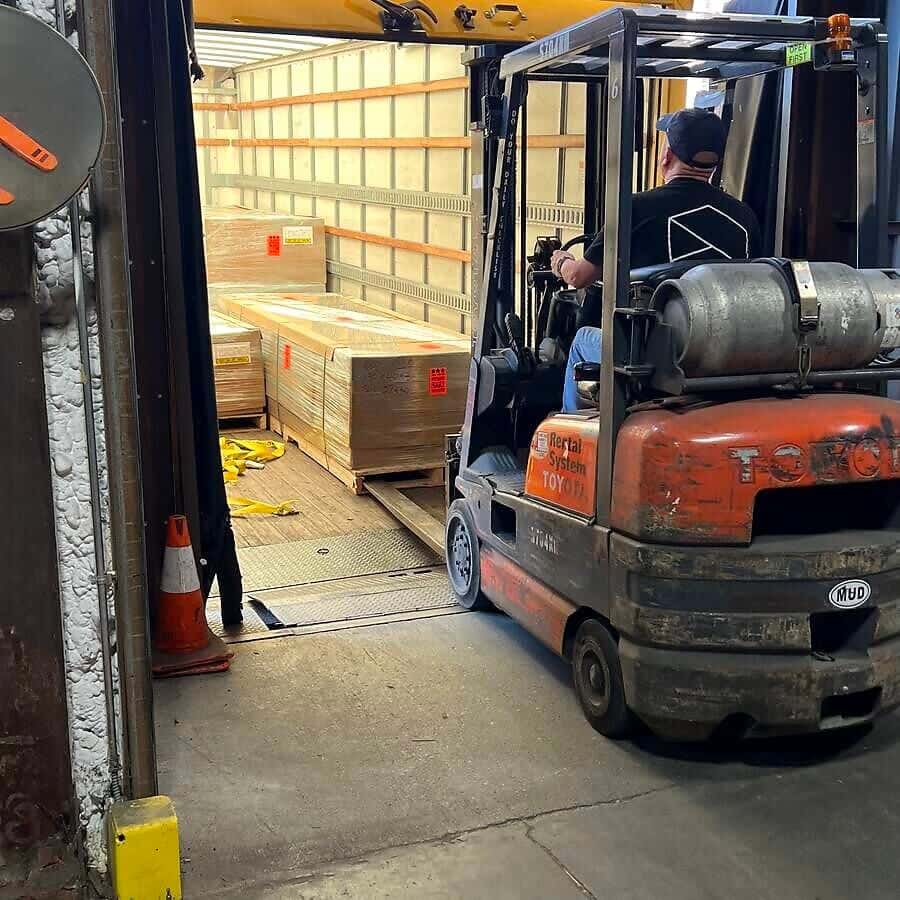
A standard 26 ft box truck fits up to 12 standard 48 x 40 in pallets on the floor in one layer. That is the honest 26 ft box truck capacity number. On weight, a typical non-CDL 26 ft box truck carries around 10,000 lb of freight, but the real limit is the truck's GVWR minus its actual empty weight, and dense freight hits it before the floor fills.
This guide is for shippers, brokers and receivers sizing a 4 to 12 pallet load before they ask for a quote. It covers the pallet math, the inside dimensions, the weight limit, and the two limits most pages gloss over: the door opening and the liftgate.
Key takeaways
- Plan on 12 pallets single layer. Counts of 13 or 14 need more width or length than most boxes have, plus perfect pallets.
- Payload is GVWR minus the truck's real empty weight. The GVWR is on the label in the driver's door frame, not in an ad.
- If your pallets average more than about 800 to 900 lb, weight caps the load before floor space does.
- The rear door opening is lower than the inside height, and the liftgate has its own weight rating.
- Give your carrier pallet count, footprint, height, weight per pallet and stackability before you book.
How many pallets fit in a 26 ft box truck?
Twelve standard pallets, loaded "straight," in six rows of two. In that pattern each pallet goes in 48 in deep with its 40 in face toward the door. A row is 80 in wide and 48 in long, so six rows use 288 in of floor.
A 26 ft body is usually a little shorter inside than 26 ft, once you take off the front wall and the rear door frame. That still leaves around 20 in of slack behind row six. You need that slack. Pallets overhang, stretch wrap bulges, and the load bar or strap at the back takes room too.
Why the 14-pallet number usually fails
Some pages quote 14 pallets. That number comes from "turning" the pallets so the 48 in faces sit side by side. A turned row is only 40 in long, so seven rows fit in 280 in. The catch is width. Two 48 in faces side by side need 96 in of clear width, wall to wall.
Federal rules set the width limit on the National Network at 102 in, per 23 CFR 658.15 on vehicle width (opens in a new tab). That is the outside of the box. Inside, a 102 in body usually measures about 96 to 98 in between the walls, and less between the e-track rails and scuff liners. That leaves zero to two inches for overhang, bulging wrap and forklift play. Being short by an inch is the same as being short by a foot. That is why an honest quote for 26 ft box truck capacity says 12 pallets, not 14.
A "pinwheel" pattern, alternating straight and turned pallets, needs only 88 in of width. But every block of four pallets uses 88 in of floor. In a box with about 25 ft 8 in of usable floor, pinwheel gets you 13 pallets, not 14. You only reach 14 with a full 26 ft (312 in) and pallets with zero overhang.
There is also a handling problem. On a common stringer pallet, a pallet jack only enters from the 40 in ends. The notched 48 in sides take forklift tines, not a jack. Turned pallets can be very hard to pull off at a liftgate delivery with no forklift on site.
| Loading pattern | Pallets (48 x 40 in) | Clear width needed | Floor length used | Real-world note |
|---|---|---|---|---|
| Straight, 2 across | 12 | 80 in | 288 in | Fits almost every 26 ft box with room for overhang |
| Pinwheel (alternating) | 13, sometimes 14 | 88 in | 264 in per 12, plus 1 or 2 more | 14 only with a full 26 ft and perfect pallets |
| Turned, 2 across | 14 | 96 in | 280 in | Most boxes have 96 to 98 in before e-track and liners, so it rarely works |
| Double-stacked, straight | Up to 24 | 80 in | 288 in | Only for stackable freight, and weight still caps it |
What are the inside dimensions of a 26 ft box truck?
There is no single standard for 26 ft box truck dimensions. Bodies vary by builder, model year and options, so measure the actual truck or ask the carrier for the inside numbers. The ranges below are typical for a 102 in wide dry box.
| Measurement | What to expect | Why it matters |
|---|---|---|
| Inside length | Usually a few inches under 26 ft | Six straight rows need 288 in plus slack |
| Inside width | About 96 to 98 in between the walls | Decides if pallets can be turned or loaded 48 x 48 two across |
| Inside height | About 96 to 103 in, depending on the body | Sets the stack height for floor-loaded boxes |
| Rear door opening | Often around 90 to 97 in high and 90 to 94 in wide on a roll-up door | The real limit for tall pallets and double stacks |
| Cargo volume | Roughly 1,600 to 1,700 cubic feet | Matters for light, bulky freight |
| Floor | Flat, no wheel wells inside the box | Unlike a cargo van, pallets sit flat along the whole floor |
| Deck height | Around 46 to 50 in on many trucks, close to dock height | A big gap means you need a dock plate or the liftgate |
When you measure width, measure between the e-track rails or liners at their narrowest, not between the bare walls. That is the number your pallets will actually see.
How much weight can a 26 ft box truck carry?
Payload is simple math: GVWR minus the truck's actual empty weight. GVWR is the gross vehicle weight rating, which 49 CFR 390.5 defines (opens in a new tab) as the maximum loaded weight of the vehicle, as set by the manufacturer.
You do not have to guess the GVWR. A box truck is built in two stages: a chassis maker builds the cab and frame, and a body builder adds the box. Under the federal certification label rules for multi-stage vehicles (49 CFR 567.5) (opens in a new tab), the final-stage manufacturer adds its own label with the GVWR and the gross axle weight rating (GAWR) for each axle. Look in the driver's door frame. When the chassis label and the final-stage label differ, read the final-stage one, since it certifies the finished truck.
The empty weight is where ad numbers for 26 ft box truck payload go wrong. It must include everything that rides on the truck: full fuel, the driver, the liftgate, load bars, straps and the pallet jack. Diesel weighs about 7 lb per gallon. The only reliable empty weight is a certified scale ticket.
A worked example
These numbers are an example only, not a specific truck:
- Door-jamb label GVWR: 25,999 lb
- Scale ticket, empty, with full fuel, driver, liftgate and gear: 15,800 lb
- Legal payload: 25,999 minus 15,800 = about 10,200 lb
Spread that over 12 pallets and you get about 850 lb per pallet. If your freight averages more than that, weight caps the load before the floor fills. For dense freight, 26 ft box truck capacity is a weight number, not a pallet number. A single pallet of bottled water, tile or paper can run well over 1,500 lb, so five or six of those can max out the truck.
Why the box truck weight limit is more than a ticket
Many 26 ft box trucks are built with a GVWR just under 26,001 lb so a driver without a CDL can run them. Under the CDL definitions in 49 CFR 383.5 (opens in a new tab), a single truck is a Group B heavy straight vehicle when its GVWR or its actual gross weight, whichever is greater, is 26,001 lb or more.
So loading a non-CDL truck past 26,000 lb does not just overload it. It also turns it into a vehicle the driver may not be licensed to drive. For more on the license side, read our guide to non-CDL box truck driver requirements.
Axles matter too. A load can be under GVWR and still overload the rear axle if all the heavy pallets sit at the back. Spread heavy pallets along the floor, and keep them off the very rear when you can.
Why door opening height and the liftgate matter more than box length
The box length decides how many pallets fit. The door and the liftgate decide whether they can get in and out.
Door opening height. A roll-up door rolls up into the top of the box, so the clear opening is lower than the inside height, often by 5 in or more. On a body with 96 in inside, a door frame around 90 in high is common. Swing doors keep more of the height, but the frame still takes a few inches. Your tallest pallet, plus a few inches for the forklift to lift it, has to clear the door opening, not the ceiling.
Liftgate rating. At a site with no dock, every pallet rides the liftgate. Tuck-under liftgates on box trucks are commonly rated 2,500 or 3,000 lb. Check the decal on the gate itself. That limit covers everything on the platform at once: the pallet, the pallet jack and anyone riding the gate. Ratings also assume the load sits near the middle of the platform, not out at the tip.
Platform depth. Many tuck-under platforms are only about 50 to 60 in deep. A 48 in pallet with a few inches of overhang, plus the jack handle, can fill that completely. Our guide on what liftgate delivery is and how to prepare covers the receiver side.
Can you double-stack pallets in a box truck?
Yes, if the freight is built for it. Double-stacking can take a 26 ft box from 12 to as many as 24 pallets on paper. In practice, three limits stop most loads well before that:
- Stackability. The bottom pallet has to carry the top one without crushing. Boxes must be square and strong. Mark "do not stack" freight clearly.
- Height. Two pallets together must clear the door opening with room to lift, not just the ceiling.
- Weight. Twenty-four pallets at even 500 lb each is 12,000 lb. That is more than many 26 ft trucks can legally carry.
Stacked loads also need to be held in place. The federal cargo securement rules in 49 CFR Part 393, Subpart I (opens in a new tab) require cargo to be firmly immobilized by structures of adequate strength, dunnage, shoring bars, tiedowns or a mix. In a dry box, that usually means load bars or straps anchored to e-track.
Floor-loaded boxes vs pallets: how 26 ft box truck capacity changes
Floor-loaded freight, cartons stacked by hand with no pallets, uses space that pallets waste. You gain the roughly 5 to 6 in of each pallet deck and the gaps around pallet edges.
To estimate cube, multiply inside length x width x height in feet. For example, a box measuring 25 ft 8 in long, 8 ft wide and 8 ft high inside gives about 1,640 cubic feet. Use your truck's real numbers, and remember that the door opening limits how high you can stack near the rear.
Then check density. With the example payload of 10,200 lb and 1,640 cubic feet, the break-even point is about 6 lb per cubic foot. Freight denser than that runs out of weight before space. Lighter freight, like empty packaging or foam products, fills the box first.
Floor loading has costs. It takes longer to load and unload, it needs more hands, and it can run into detention time at a busy dock. Ask the carrier how they price that labor before you choose it.
What to tell your carrier before you book a box truck
A quote is only as good as the specs behind it. The carrier cannot judge 26 ft box truck capacity for your load without them. Have these ready before you request a freight quote:
| Spec | What to give | Why the carrier needs it |
|---|---|---|
| Pallet count | Exact number | Confirms 12 or fewer fit single layer |
| Footprint | Length x width, including overhang | Turned or odd-size pallets change the count |
| Height | Tallest pallet, in inches | Must clear the door opening |
| Weight per pallet | Actual, not estimated | Payload, axle weights and liftgate rating |
| Total weight | All pieces combined | Keeps the truck under its GVWR |
| Stackable | Yes or no, per pallet | Decides if double-stacking is possible |
| Pickup site | Dock, or liftgate needed | Sets equipment and time on site |
| Delivery site | Dock, or liftgate needed | Same, at the other end |
| Appointment | Window and receiving hours | Avoids waiting and redelivery |
If your load is 4 to 12 pallets, a box truck is often a better fit than a full trailer. See how partial truckload in a box truck works, or compare equipment in box truck vs dry van vs cargo van.
How Cobra US Cargo handles this
Our truck is a 2021 International MV607 with a 26 ft dry box, a hydraulic liftgate and e-track for load securing. It runs at a GVW under 26,000 lb, so it stays in the non-CDL class. It takes up to 12 standard pallets, and we ask for weight, height and dock or liftgate needs at both ends before we quote. Our anchor lane is the dedicated Miami to New York run, and we serve the 48 contiguous states.
Sources
- eCFR — 49 CFR 390.5, Definitions (commercial motor vehicle, GVWR) (opens in a new tab)
- eCFR — 49 CFR 383.5, Definitions (CDL vehicle groups, 26,001 lb) (opens in a new tab)
- eCFR — 49 CFR 567.5, Requirements for manufacturers of vehicles manufactured in two or more stages (opens in a new tab)
- eCFR — 49 CFR Part 393 Subpart I, Protection Against Shifting and Falling Cargo (opens in a new tab)
- eCFR — 23 CFR 658.15, Vehicle width (102 in) (opens in a new tab)