
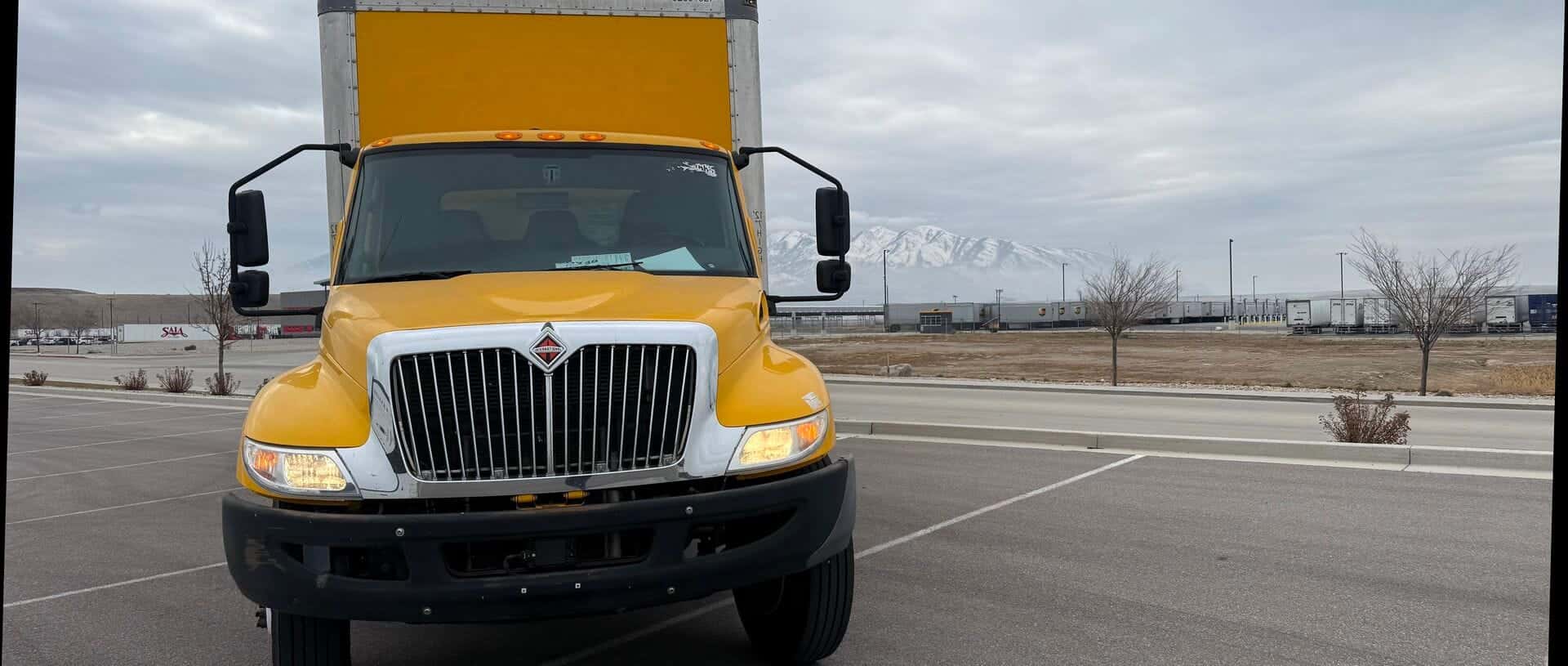
How many miles can a truck drive in a day? A solo driver can legally drive up to 11 hours inside a 14-hour on-duty window, after 10 hours off. At a planning average of 45 to 55 mph, which allows for traffic and slowdowns, that works out to roughly 500 to 600 miles a day. Loading, fueling and waiting at docks often trim that further.
This guide is for shippers, brokers and new drivers who need to turn hours-of-service rules into a realistic transit time, especially on long interstate runs out of Florida. It shows the math with every assumption on the table, so you can rerun it for your own lane.
Key takeaways
- Hours set the daily limit, not miles: 11 hours of driving, a 14-hour window, a 30-minute break after 8 hours of driving, and 10 hours off.
- 500–600 miles is a planning range, not a promise. Every hour spent loading, fueling or waiting at a dock comes out of the same 14-hour window.
- On runs longer than about 4 days, the 60/70-hour weekly limit decides the delivery day. A 34-hour restart can add a day or more.
- Miami to Los Angeles is about 2,730 miles: typically 4 to 6 days with a solo driver.
- A co-driver in a day-cab box truck doesn't double daily miles. Only a team in a sleeper truck gets close.
The rules that set how many miles a truck can drive in a day
Daily miles come straight from the federal hours-of-service limits in 49 CFR 395.3, the maximum driving time rule (opens in a new tab). For property-carrying trucks, four rules shape each day:
- 10 hours off first. A driver can't drive without first taking 10 consecutive hours off duty.
- The 14-hour window. Once the driver comes on duty, no driving is allowed after 14 consecutive hours. The clock keeps running through lunch, fuel stops and detention.
- The 11-hour driving rule. Inside that window, the driver can drive a total of 11 hours.
- The 30-minute break. After 8 hours of driving, the driver needs a 30-minute interruption. It can be off duty or on duty not driving, so a 30-minute fuel stop counts.
These rules apply to more than tractor-trailers. Under 49 CFR 390.5, the commercial motor vehicle definition (opens in a new tab), any truck rated or loaded at 10,001 lb or more and used in interstate commerce is a CMV. That includes a 26 ft box truck that needs no CDL. Logging, ELDs and the short-haul exceptions are covered in our guide to box truck ELD requirements.
How many miles is that in practice?
So how many miles can a truck drive in a day in real traffic? The 11-hour driving rule sets a ceiling, and average speed turns it into miles. A common shortcut is 65 mph times 11 hours, which gives 715 miles. Real trucks don't hold highway speed for 11 straight hours. Metro traffic, construction zones, weigh stations and fuel exits pull the average down.
| Average speed (planning assumption) | Miles in 11 hours of driving |
|---|---|
| 45 mph | About 495 |
| 50 mph | About 550 |
| 55 mph | About 605 |
| 65 mph (theoretical, no slowdowns) | About 715 |
Those speeds are planning assumptions, not statistics. The worked examples below use 50 mph, which leaves room for city traffic on long runs through Atlanta, Houston and the I-95 Northeast. These ranges describe long-haul days. A local delivery route spends most of its window at docks and stops, so its daily miles are far lower.
What eats the 14-hour window
The 11 hours of driving only fit if the rest of the day stays short. Everything else a driver does on the job is on-duty time under 49 CFR 395.2, the on-duty time definition (opens in a new tab). That includes waiting to be dispatched, inspecting the truck, loading and unloading, and handling the paperwork.
- Pre-trip inspection before the first mile.
- Loading at the shipper, plus any detention while the dock catches up.
- Fueling, which often doubles as the 30-minute break.
- Weigh stations and roadside inspections, which can be quick or can take a while.
- Cargo checks. Under 49 CFR 392.9, the cargo inspection rule (opens in a new tab), the driver inspects the load within the first 50 miles, then again at every change of duty status or after 3 hours or 150 miles of driving, whichever comes first. A sealed box the driver has been told not to open is exempt.
- Unloading and the POD at the receiver.
Here is a clean day. The driver comes on duty at 6:00 a.m. and spends 2 hours on the pre-trip and loading. They roll at 8:00 and drive 8 hours. A 30-minute fuel stop covers the break, and 3 more hours of driving end the day at 7:30 p.m. That's 11 hours driven and about 550 miles, with 30 minutes to spare.
Now give the same driver 4 hours at the shipper instead of 2. They roll at 10:00, and the window still closes at 8:00 p.m. After 8 hours of driving and the 30-minute stop, only 1.5 hours remain: 9.5 hours of driving and about 475 miles. Once the window is the binding limit, each extra hour at the dock costs about 50 miles that day. That's why detention at pickup so often pushes the delivery date.
The weekly limit: 60/70 hours and the 34-hour restart
The daily rules decide a single day. The weekly rule decides long trips. Under 395.3(b), a driver can't drive after 60 hours on duty in 7 consecutive days, or 70 hours in 8 days if the carrier runs trucks every day of the week. All on-duty time counts, not just driving. Under 395.3(c), 34 or more consecutive hours off duty restarts the 7- or 8-day period.
A full driving day uses about 12 to 13.5 hours on duty, so a driver can burn through 60 hours in about 4 to 5 days. Runs of 3 days or less rarely hit the limit, unless the driver starts the trip with hours already used. On 5-day and longer runs, it often decides the delivery day.
Worked example: Miami to Los Angeles
Miami to Los Angeles is about 2,730 miles, mostly on I-10. The assumptions: 50 mph average, 1 hour a day for the pre-trip, fuel and paperwork, 1.5 hours to load and 1.5 hours to unload, a 30-minute break off duty, and a driver who starts with a full weekly clock.
| Day | Driving | Miles (cumulative) | On duty that day | On-duty total |
|---|---|---|---|---|
| 1 | 11 h | 550 | 13.5 h (includes loading) | 13.5 h |
| 2 | 11 h | 1,100 | 12 h | 25.5 h |
| 3 | 11 h | 1,650 | 12 h | 37.5 h |
| 4 | 11 h | 2,200 | 12 h | 49.5 h |
| 5 | 10.6 h | 2,730 | 13.1 h (includes unloading) | 62.6 h |
On the 70-hour, 8-day schedule, 62.6 hours fits. The load delivers on the evening of day 5 if the receiver can take it, or the next morning. The window is tight, so any delay pushes delivery to day 6.
On the 60-hour, 7-day schedule, the driver has only 10.5 hours of duty left on day 5. That's enough for about 9.5 hours of driving, which stops the truck about 55 miles short with no hours left to finish or unload. The driver needs a 34-hour restart, and the load delivers on the morning of day 7. Without the restart, the driver would wait until day 8, when day 1's hours roll off.
Push the same math to Seattle, about 3,300 miles, and even a 70-hour driver runs out on day 6, about 175 miles short. After a 34-hour restart, delivery lands on day 8. This is why a cross-country quote should state its assumptions. A driver who is already mid-week when dispatched starts with fewer hours, and the whole schedule shifts.
Cross-country transit time from Miami to major metros
Once you know how many miles a truck can drive in a day, how long freight takes to ship across the country is mostly division. Here is the same planning model applied to common destinations from Miami. Drive time is miles divided by 50 to 55 mph. Transit counts elapsed time from pickup to delivery for a solo driver: on a 2–3 day lane, a Monday-morning pickup usually delivers Wednesday, or Thursday if the pickup runs late or the appointment falls the next morning.
| From Miami to | Main route | Approx. miles | Drive time (planning) | Typical solo transit | Weekly limit a factor? |
|---|---|---|---|---|---|
| Atlanta, GA | Florida's Turnpike, I-75 | 660 | 12–13 h | 1–2 days | Rarely |
| Charlotte, NC | I-95, I-26, I-77 | 730 | 13–15 h | 1–2 days | Rarely |
| Houston, TX | I-75, I-10 | 1,190 | 22–24 h | 2–3 days | Rarely |
| Philadelphia, PA | I-95 | 1,190 | 22–24 h | 2–3 days | Rarely |
| New York / North Jersey | I-95, NJ Turnpike | 1,270–1,280 | 23–26 h | 2–3 days | Rarely |
| Dallas–Fort Worth, TX | I-75, I-10, US-49, I-20 | 1,310 | 24–26 h | 2–3 days | Rarely |
| Chicago, IL | I-75, I-24, I-65 | 1,350–1,380 | 25–28 h | 2–3 days | Rarely |
| Denver, CO | I-75, I-24, I-64, I-70 | 2,070 | 38–41 h | 3–4 days | Sometimes |
| Los Angeles, CA | I-75, I-10 | 2,730 | 50–55 h | 4–6 days | Often, on a 60-hour schedule |
| Seattle, WA | I-75, I-70, I-29, I-90 (one common routing) | 3,300 | 60–66 h | 5–7 days | Usually; plan a 34-hour restart |
Mileage depends on the exact pickup and delivery ZIPs, and these are planning ranges, not guarantees. Weather, closures, detention and appointment times move every one of them. Short, mostly open runs like Miami to Atlanta can beat the model, so a pre-dawn pickup sometimes delivers the same day.
Do team drivers double the miles?
In a sleeper tractor, they come close. One driver rests in the sleeper berth while the other drives, and the truck can roll most of the day. That's how team freight covers coast-to-coast lanes in roughly half the solo time.
A day-cab box truck is different. Under the on-duty definition in 395.2, all time in or on a truck counts as on duty. The exceptions are resting in a parked vehicle, resting in a sleeper berth, and up to 3 hours in the passenger seat right before or after at least 7 consecutive hours in the berth. With no berth, the co-driver riding along is on duty. The sleeper-berth options in 49 CFR 395.1(g) (opens in a new tab) don't apply either, because the truck has no berth to rest in.
What that means on the road:
- When both drivers start the day together, their 14-hour windows run at the same time, so the truck can drive roughly 13 hours a day instead of 11.
- Swapping seats does satisfy the 30-minute break, because on-duty not-driving time counts.
- Neither driver can take their 10 hours off while the truck rolls, so the truck stops every night anyway.
- Riding hours count toward the 60/70-hour limit for both drivers.
At the same 50 mph, that's about 650 miles a day, not 1,100. If a box truck load truly can't wait, the levers that work are an early pickup, a firm delivery appointment, no detention, and exclusive use of the truck so it runs direct. That's what expedited box truck service means in practice.
Planning a coast-to-coast box truck load
A cross-country load fails on details more often than on miles. Before you tender it, settle these:
- Appointments across time zones. Miami to Los Angeles spans four time zones. Write the time zone next to every pickup and delivery time on the rate confirmation and the BOL.
- Weather and mountains. I-10 avoids the high passes of the northern routes. The Seattle routing in the table crosses Montana on I-90 and the Cascades at Snoqualmie Pass, and both see real winter weather. The adverse-conditions rule only helps with conditions nobody could have known at dispatch, so build a buffer day into winter loads.
- Fuel budget. The EIA Gasoline and Diesel Fuel Update (opens in a new tab) publishes on-highway diesel prices by region every week. For the week of September 28, 2026, the U.S. average was $6.382 a gallon, against $5.953 in the Lower Atlantic and $8.181 in California. On a run to California, the last tanks cost the most. Budget by region, not on one national number.
- Tolls and routing. Toll roads like Florida's Turnpike and the NJ Turnpike save time but add cost. Agree on the route assumption when you price the load.
- Check-calls and ELD records. Ask for updates at pickup, in transit and at delivery. The ELD keeps the driver's hours on record, which helps when you need to show why a delivery slid by a day.
- POD at delivery. Get the signed POD with any shortage or damage noted on the BOL before the truck leaves.
If the same coast-to-coast freight repeats every week, treat it as a lane, not a series of one-off loads. A dedicated lane for brokers lets the carrier plan driver hours around the run, so restarts fall on the home end instead of in the middle of the trip.
How Cobra US Cargo plans long interstate runs
We're a Miami-based interstate carrier. Miami ⇄ New York is our target lane, and we run interstate box truck freight across the 48 contiguous states. Our fleet of 26 ft box trucks, plus a growing owner-operator program, runs ELD-equipped, and we're fully insured to industry standard. Every quote comes with a typical transit range built on the hours-of-service math above, never a guarantee. Send ZIPs, dates and pallet details to request a freight quote.
Sources
- eCFR — 49 CFR 395.3, Maximum driving time for property-carrying vehicles (opens in a new tab)
- eCFR — 49 CFR 395.2, Definitions (on-duty time, adverse driving conditions) (opens in a new tab)
- eCFR — 49 CFR 395.1, Scope of rules (adverse driving conditions, sleeper berths) (opens in a new tab)
- eCFR — 49 CFR 390.5, Definitions (commercial motor vehicle) (opens in a new tab)
- eCFR — 49 CFR 392.9, Inspection of cargo, cargo securement devices and systems (opens in a new tab)
- EIA — Gasoline and Diesel Fuel Update (opens in a new tab)