
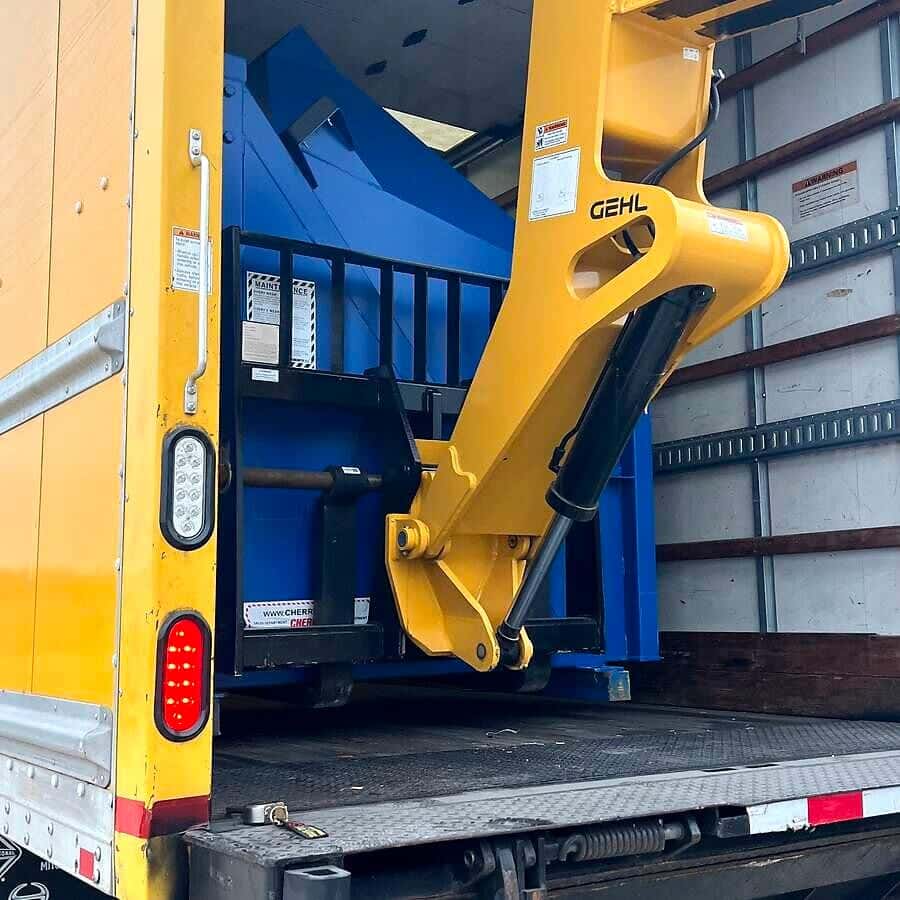
What is liftgate delivery? It means the truck uses a powered platform at its rear door to lower freight from the cargo floor to the ground. It stands in for a loading dock. You need it when the receiver has no dock or forklift and the freight is too heavy to unload by hand. Once the pallet is on the ground, the receiver rolls it away on a pallet jack.
This guide is for receivers who don't have a dock and for brokers and shippers booking a delivery without a loading dock. It explains what a liftgate can and can't lift, what the delivery site needs, and how to flag the service so the truck shows up with the right equipment.
Key takeaways
- A liftgate moves freight between truck floor and ground. It does not move freight into the building.
- The gate has its own rated capacity and platform size. A pallet can be legal for the truck and still too heavy or too deep for the gate.
- The site needs level, hard pavement, clear space behind the truck, a pallet jack and a smooth path to the door.
- Request liftgate when you book and make sure it is on the bill of lading. If it isn't, the truck that shows up may have no gate at all.
What is liftgate delivery?
A liftgate is a hydraulic platform mounted under or across the rear of a box truck or trailer. An electric motor drives a hydraulic pump that raises and lowers it, and the driver runs it from a switch box on the truck body or a hand-held control. At the delivery, the driver sets the platform level with the cargo floor, rolls the load onto it, lowers it to the ground, and the freight rolls off.
In practical terms, liftgate delivery is a dock in a box. A standard dock puts the truck floor level with the warehouse floor so a forklift or pallet jack can drive straight in. A liftgate creates that level surface for one load at a time, wherever the truck can park.
Gates come in a few styles. Tuck-under gates fold beneath the truck body. Rail gates ride vertical rails at the rear of the box. Fold-up gates stand upright behind the doors. For a receiver, the style matters less than two numbers: how much the gate can lift and how big the platform is.
When do you need a liftgate (and when you don't)?
You need liftgate service when the delivery site has no dock and no forklift, and the freight is too heavy or bulky to carry by hand. Typical commercial stops that need one:
- Retail stores and restaurants in strip centers or on city streets
- Offices, clinics and schools without a receiving dock
- Construction and renovation sites
- Small shops and warehouse bays with a roll-up door at ground level
- Event and trade-show venues where the dock is booked or unavailable
You probably don't need a liftgate when:
- The receiver has a dock at truck-floor height. The truck backs in and freight rolls straight off.
- The receiver has a forklift and a level yard. The forklift can unload from the side of the truck bed or from the rear.
- The shipment is light boxes that the driver and receiver can safely hand-carry.
The last point deserves care. OSHA's materials handling and storage guide (opens in a new tab) tells workers to get help when a load is too bulky to grasp, blocks their view, or is more than they can safely handle. A 400 lb crate on a truck floor 3 to 4 feet off the ground is a liftgate job, not a "we'll manage" job.
How much weight can a liftgate handle?
Liftgate weight capacity is set by the manufacturer and shown on the gate's decals and in its operation manual. Gates sold for box trucks and vans are commonly rated from about 1,500 lb to 3,000 lb, and heavy-duty models go higher. Ask the carrier for the actual rating on the truck that will run your load. Don't assume.
Here is the part most guides skip: the gate's capacity and the truck's payload are two different limits. A 26 ft box truck can carry several thousand pounds spread across the floor. The gate lifts one load at a time, and that load must fit within both its weight rating and its platform.
| Limit | What it controls | What breaks it |
|---|---|---|
| Truck payload | Total weight of all freight in the box | Too many heavy pallets in one load |
| Gate rated capacity | Weight on the platform in one lift, including the pallet jack and anyone riding it | One very heavy pallet, crate or machine |
| Platform depth and width | The footprint that fits on the gate | Oversized crates, long skids, pallets that overhang |
| Load position | Where the weight sits on the platform | Heavy end toward the outside edge |
Three practical rules follow from that table:
- Count everything on the platform. The pallet, the pallet jack under it, and the operator if they ride the gate all count toward the rating.
- Keep the load close to the truck. Manufacturer manuals tell operators to place loads as close as possible to the inboard edge, with the heaviest part toward the truck body. The rating assumes the weight sits near the truck. Weight out at the tip of the platform puts far more strain on the gate.
- Nothing hangs over the edge. A load should never extend past the platform edges. A 48 x 40 in pallet can fit a platform that a 96 in crate never will.
Example: if the gate is rated at 2,500 lb and you ship a 2,400 lb pallet of floor tile, the pallet plus the jack is already over the limit. The truck can carry that pallet without trouble. The gate can't lower it safely. Break the load into two pallets, or plan for a dock or forklift at delivery.
For how weight and pallet count work across the whole box, see our guide to 26 ft box truck capacity.
What does the delivery site need for a liftgate drop?
This is where no-dock deliveries really succeed or fail. The gate needs a flat landing zone, and the freight needs a way from the gate to the door. Walk the site with this checklist before you book.
| Site item | What "ready" looks like | Why it matters |
|---|---|---|
| Surface | Level concrete or asphalt | A pallet jack won't roll on gravel, grass, sand or broken pavement |
| Slope | Flat or nearly flat behind the truck | On a slope the platform lands unevenly and a loaded jack can run away |
| Clear space behind the truck | Room for the platform to unfold and lower, plus room to pull the pallet off it | The platform reaches several feet behind the doors when it's down |
| Overhead clearance | No low awning, sign or branch over the parking spot | The box and an open rear door need height |
| Pallet jack on site | A working jack rated for the heaviest pallet | Most liftgate service ends at the ground, and the jack is how freight moves from there |
| Path to the door | Smooth, hard path with no steps, curbs or gaps | A curb or a single step can stop a 1,000 lb pallet cold |
| Doorway | Wide enough for the pallet and the jack | Measure it against your widest pallet |
| Parking spot | Legal place for a large truck to stop, close to the door | The truck can't lower its gate in a moving traffic lane |
OSHA's same guide says workers moving materials mechanically must allow sufficient clearance through doorways and wherever turns must be made, so the load doesn't hit an obstruction or pin someone against a wall. That applies to the path from the gate to your stockroom as much as to a warehouse aisle.
If something on the list is missing, say so at booking. A driver can work around a lot when they know ahead of time. They can't fix a gravel lot on arrival.
City curbs and tight streets
Urban stops add their own problems. The platform needs clear pavement behind the truck, so a spot with a car parked right behind it, a hydrant or a tree pit can block the gate. In New York City, NYC DOT truck loading zones (opens in a new tab), marked "Truck Loading Only," give commercial vehicles curb access in front of businesses during peak delivery times. Commercial vehicles also pay to park at metered spots, and the city's commercial vehicle parking rules (opens in a new tab) allow up to three hours on a single block unless a sign says otherwise.
Practical tips for urban drops:
- Tell the carrier which side of the street the entrance is on and where a truck can legally stop.
- Have the receiver ready with the jack when the truck arrives, so the curb time goes to unloading, not waiting.
- Ask about early-morning delivery when curb space is easier to find.
More on routing, tolls and curb rules in NYC truck delivery rules.
Who moves the freight off the liftgate?
In most cases the driver operates the gate and brings the freight down to the ground at the back of the truck. Moving it from there into the building is the receiver's job, unless inside delivery was booked separately.
That split matters for staffing. Plan for at least one person on site who can run a pallet jack and knows where the freight goes. For a full load of pallets, two people and two jacks speed things up and cut curb time.
If your team plans to unload with a forklift instead, remember that forklifts are regulated equipment. OSHA's powered industrial truck standard (opens in a new tab) requires employers to make sure each operator is trained and evaluated as competent. Never drive a forklift onto a liftgate platform. Gate manufacturers prohibit it, and a loaded forklift weighs more than most gates are built to lift.
Why you must request a liftgate when you book
Most tractor-trailers don't have liftgates, and LTL terminals usually run a limited number of gate-equipped trucks. Dispatchers assign those trucks to the stops that requested liftgate service. If your shipment isn't flagged, the delivery gets built onto a truck that can't lower it.
Here is what typically happens when liftgate isn't on the order:
- The driver arrives, sees no dock and no forklift, and can't unload safely.
- The attempt is marked refused or failed, and the freight goes back on the truck.
- The carrier re-dispatches it on a gate-equipped truck, often a day or more later.
- The bill grows: a liftgate charge, plus possible redelivery and storage charges, depending on the carrier's terms.
Put it on paper. Federal rules at 49 CFR 373.101 (opens in a new tab) require the carrier's bill of lading to show the consignor and consignee, origin and destination, number of packages, a description of the freight, and its weight, volume or measurement where that affects the rate. The rule says nothing about liftgate, so list it yourself in the special instructions on the BOL and on the rate confirmation. Include the heaviest single piece and its dimensions so the carrier can check it against the gate. If you also want a call before the truck arrives, ask for it at booking. That way someone with a jack is waiting.
For how liftgate fits alongside detention, layover and other add-ons, read freight accessorial charges explained.
How to prepare pallets and crates for a liftgate delivery
Good packaging makes a liftgate drop quick and safe. Bad packaging turns it into a balancing act on a moving platform.
- Use a solid pallet. Standard 48 x 40 in pallets with sound deck boards roll cleanly on a jack. Broken boards catch the forks.
- Keep it within the platform. No overhang past the pallet edges. Ask about platform size before shipping anything longer than 48 in.
- Keep it low and stable. Tall, top-heavy stacks tip when the platform starts or stops. Stretch-wrap tight and band heavy items to the pallet.
- Mark the heavy end. Label it so the driver can put it toward the truck body.
- Leave fork openings clear. The pallet jack needs open entry on the side facing the truck doors.
- Split very heavy loads. If one pallet is near the gate's rating, split it into two before pickup.
- Put the real weight and size on the BOL. Guessing low is how loads end up too heavy for the gate.
Proper packaging also helps in transit. 49 CFR 393.106 (opens in a new tab) requires cargo to be firmly immobilized or secured on or within the vehicle. A tight, square pallet is easier to strap, ships without shifting, and arrives in the condition it needs to roll off the gate.
How Cobra US Cargo handles liftgate freight
Our truck is a 2021 International MV607 with a 26 ft dry box, a hydraulic liftgate and e-track for load securing, so dock and no-dock stops can be run on the same trip. We haul commercial dry freight only, up to 12 standard pallets per load, with Miami to New York as our anchor lane and service across the 48 contiguous states. Send the heaviest piece, its dimensions and the site details with your liftgate delivery request, and we'll confirm the fit before pickup. You can also request a freight quote directly.
Sources
- OSHA — Materials Handling and Storage (OSHA 2236) (opens in a new tab)
- OSHA — Powered Industrial Trucks (Forklifts) Overview (opens in a new tab)
- eCFR — 49 CFR 373.101, For-hire, non-exempt motor carrier bills of lading (opens in a new tab)
- eCFR — 49 CFR 393.106, General requirements for securing articles of cargo (opens in a new tab)
- NYC DOT — Loading Zones (opens in a new tab)
- NYC Business — Commercial Vehicle Parking Information (opens in a new tab)