
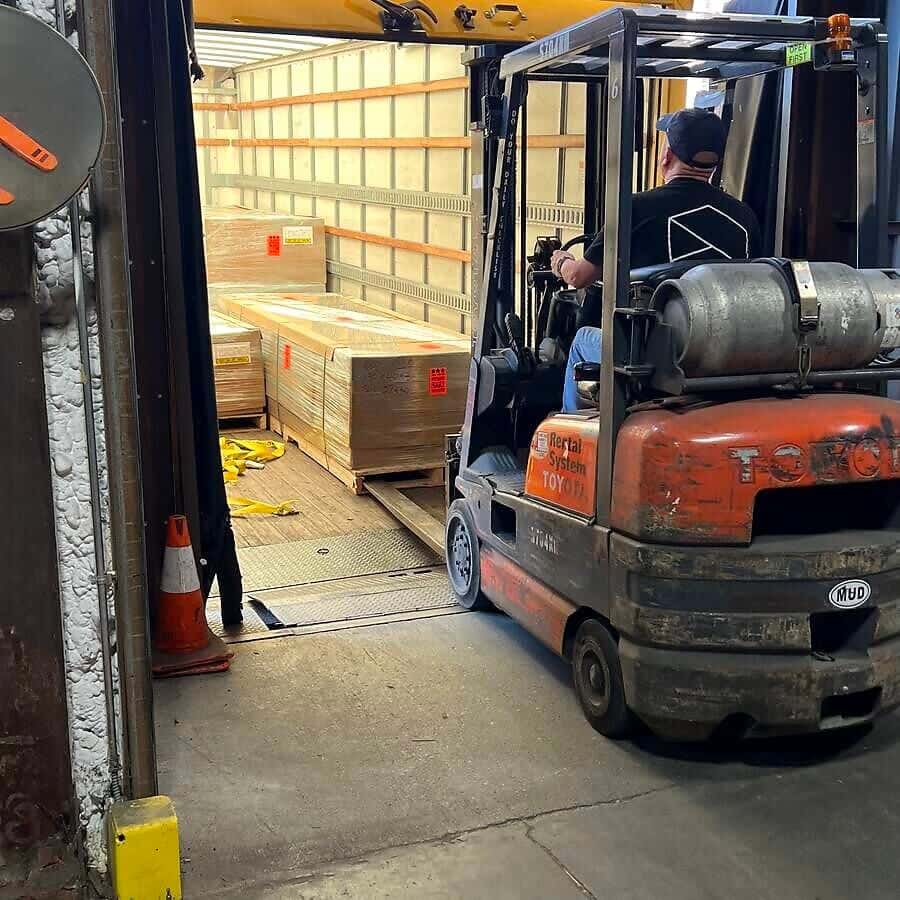
Miami to Charlotte truck transit time is typically 1 to 2 days. The run is about 730 miles up I-95, then I-26 and I-77 into Charlotte, North Carolina. That is more than one driver can legally cover in a single shift, so the driver takes a 10-hour break on the way and the truck delivers the next day. A late pickup or a tight appointment pushes delivery to the day after that.
This guide is for shippers, brokers and receivers planning Miami to Charlotte box truck freight, in either direction. It covers the route, a legal driving day hour by hour, the places trucks lose time, and how docks and liftgate stops work around Charlotte.
Key takeaways
- Miami to Charlotte truck transit time is typically 1 to 2 days. About 730 miles is more than the 11 hours one driver may drive in a shift.
- A morning pickup usually delivers the next morning. An afternoon pickup usually delivers the next afternoon or the morning after.
- The standard route is I-95, I-26 and I-77. Its regular lanes are toll-free, and it turns north before downtown Columbia.
- Trucks lose the most time in South Florida, at Jacksonville, at the Savannah River and on the last 11 miles of I-77.
- Charlotte-area distribution centers receive by appointment. Stores, offices and job sites usually need a liftgate.
How far is Miami from Charlotte by truck?
The Miami to Charlotte driving distance is about 730 miles. Charlotte here means Charlotte, North Carolina. Port Charlotte is a different place, on Florida's Gulf coast, so put the state and ZIP code on every quote request and bill of lading.
The standard route uses three interstates: I-95 north past Jacksonville and Savannah, I-26 west from Exit 86 toward Columbia, then I-77 north from I-26 Exit 116 through Rock Hill into Charlotte. State mileage comes from the FHWA Interstate Route Log and Finder List (opens in a new tab), and South Carolina numbers its exits by mile.
| Segment | Highway | Approx. miles | Notes |
|---|---|---|---|
| Miami to the Georgia line | I-95 | 380 | All of I-95 in Florida. Jacksonville is near mile 350 |
| Georgia coast | I-95 | 112 | Brunswick, Savannah. At least three lanes each way |
| Georgia line to the I-26 turn | I-95 | 86 | Hardeeville, Walterboro. Two lanes each way |
| I-95 to the I-77 turn | I-26 | 53 | Orangeburg. The turn comes before downtown Columbia |
| I-26 to the North Carolina line | I-77 | 91 | Columbia's east side, Rock Hill, Fort Mill |
| State line to uptown Charlotte | I-77 | 11 | The slowest miles at rush hour |
| Total | about 730 | 13 to 15 hours of driving |
Dispatchers plan a loaded box truck at 50 to 55 mph on average once traffic, fuel and work zones are counted. That puts the Miami to Charlotte drive time for a truck at 13 to 15 hours behind the wheel. Pickups farther north are shorter: about 525 miles from Orlando and about 385 from Jacksonville.
Miami to Charlotte truck transit time: next day or the day after?
A 26 ft box truck that hauls freight across state lines is a commercial motor vehicle. Its driver works under federal hours-of-service rules, even when the truck is light enough to drive without a CDL. Under 49 CFR 395.3, the federal driving-time limits (opens in a new tab), a property-carrying driver:
- Needs 10 consecutive hours off duty before starting a shift.
- May not drive after the 14th hour since coming on duty. Loading, fueling and waiting all use up that window.
- May drive 11 hours in total inside the window.
- Must take a 30-minute break from driving once 8 hours of driving have built up.
At a steady 65 mph with no stops at all, 730 miles still takes more than 11 hours, and no loaded truck holds that pace through city traffic. One driver cannot finish this run in a single legal shift, however early the day starts. That is why Miami to Charlotte truck transit time is quoted as 1 to 2 days and not as same day.
Which day depends on when the truck rolls and when the driver's clock started:
| Pickup in Miami | How the run plays out | Likely delivery |
|---|---|---|
| Early morning, fresh driver | Eleven hours of driving end around 6 p.m. in South Carolina, with 130 to 185 miles left for the morning | Next morning |
| Midday, fresh driver | The driver runs until late evening, takes 10 hours off, then drives the last leg | Next day, midday to early afternoon |
| Afternoon, driver on duty since morning | On duty at 7 a.m., rolling at 3 p.m. into South Florida's rush hour. The 14-hour window closes at 9 p.m., between Daytona Beach and St. Augustine. Roughly 8 to 9 hours of driving remain | Next day, late afternoon, or the following morning |
| Friday afternoon | The same math, but many distribution centers don't receive on weekends | Monday |
Miami to Charlotte truck transit time depends more on the pickup time than on the miles. Slow loading costs the same way: every hour at the shipper's dock comes out of the 14-hour window. From Jacksonville, and sometimes from Orlando with a pre-dawn pickup, the same math allows same-day delivery.
For any other lane, see how many miles a truck can drive in a day.
What does a legal solo driving day look like on this run?
Here is the early-pickup case, hour by hour.
| Clock time | What happens | Hours-of-service effect |
|---|---|---|
| 5:00 a.m. | Driver comes on duty and inspects the truck | The 14-hour window opens. It closes at 7 p.m. |
| 5:15 to 6:00 a.m. | Loading at the Miami shipper | On duty, not driving. It uses the window, not the 11 hours |
| 6:00 a.m. | Rolling north on I-95 | Driving time starts |
| About 12:30 to 1 p.m. | Jacksonville, about 350 miles in. Fuel and a 30-minute break | The break must come before 8 hours of driving build up |
| About 5:30 to 6 p.m. | Parked between Walterboro and Orangeburg, South Carolina | 11 hours used. The 10-hour break starts |
| About 4 a.m. | Back on duty and rolling | A new window and a new 11 hours |
| About 7 to 8 a.m. | Check-in at the Charlotte-area receiver | About 3 hours of driving used |
A real day often comes out a little shorter. Truck parking along I-95 in Georgia and South Carolina fills up at night, so drivers stop early to be sure of a legal space.
Which route do trucks take, and what are the alternatives?
The standard Miami to Charlotte truck route, I-95 to I-26 to I-77, is the shortest all-interstate option, and it stays in the Eastern time zone from dock to dock. None of the three interstates charges a toll on its regular lanes between Miami and Charlotte. The alternatives fit specific situations:
- Florida's Turnpike to Fort Pierce. The tolled Turnpike runs beside I-95 as far as Fort Pierce. Drivers use it to skip I-95 traffic through Broward and Palm Beach counties.
- I-295 around Jacksonville. The beltway skips downtown and the I-10 interchange.
- I-20 in place of I-26. If I-26 is shut, the detour stays on I-95 to Florence and takes I-20 west to I-77 at Columbia. It adds roughly 70 miles.
- I-75 and I-85 through Atlanta. About 900 miles, so it fits only a load that also stops in Georgia. See Miami to Atlanta truck transit time for that leg.
Where do trucks lose time between Miami and Charlotte?
South Florida. I-95 through Miami-Dade, Broward and Palm Beach counties is slow in both rush hours. A 6 a.m. departure gets ahead of most of it. A 4 p.m. departure sits in it.
Jacksonville and the Florida line. I-95 crosses the St. Johns River downtown and meets I-10 just past the bridge. North of the city, the state runs two FDACS agricultural inspection stations on I-95 at Yulee (opens in a new tab), numbered 16A and 16B and open around the clock. Trucks, rental trucks, vans and trailers must stop, and that includes a box truck of dry freight. A carrier enrolled in a state-approved bypass service can be cleared to keep rolling when the truck carries no farm products and is not refrigerated. Everyone else makes a short stop with the bill of lading ready.
Savannah and the South Carolina line. Port trucks join I-95 at I-16 and the exits north of it. Then Georgia's three lanes each way narrow to two at the Savannah River. SCDOT's I-95 widening project in Jasper County (opens in a new tab) broke ground there in August 2025. It covers the first 10 miles and a new river bridge, and it is set to be complete by 2030.
The I-26 turn and Columbia. The interchange of I-95 and I-26 is under reconstruction too, on a schedule that runs into 2027. The good news: the turn onto I-77 comes before Columbia, so Charlotte freight never reaches the I-20 and I-26 interchange that locals call Malfunction Junction.
The I-77 approach. The last stretch is the least predictable, because I-77 carries Rock Hill and Fort Mill commuters over the state line. According to NCDOT's I-77 South project page (opens in a new tab), travel times on the 11 miles of I-77 from the South Carolina line to uptown Charlotte range from 10 minutes to nearly an hour, depending on the time of day and direction.
Where does freight deliver in the Charlotte area?
Charlotte sits where I-77 crosses I-85, with I-485 circling the city. Most freight does not go uptown. It goes to distribution parks along those three roads, on both sides of the state line, and the park decides how much Charlotte traffic the truck has to cross.
| Area | Main highways | For a truck coming from Miami |
|---|---|---|
| Rock Hill and Fort Mill, SC | I-77 | Reached first, before the state line. No Charlotte traffic to cross |
| Southwest Charlotte: Westinghouse Boulevard, Steele Creek | I-77, I-485 | Just past the state line |
| Airport area | I-485, I-85 | Around on I-485, without going uptown |
| Gastonia, Belmont, Mount Holly | I-85 west | I-485 west side to I-85 |
| Concord, Kannapolis, Harrisburg | I-85 northeast | The far side of the metro. Allow extra time at rush hour |
| Huntersville, Mooresville | I-77 north | Through uptown, or around on I-485 |
| Uptown and South End | I-277 loop | Street-level stops: liftgate, loading zones, building dock rules |
The I-77 Express Lanes are 26 miles of tolled lanes that run north from uptown Charlotte through Huntersville. Under the North Carolina Turnpike Authority's I-77 Express Lanes rules (opens in a new tab), vehicles with more than two axles may not use them. A two-axle vehicle of 22 feet or more may, as an "extended vehicle", at 2.7 to 4.0 times the standard toll depending on the time of day. A standard 26 ft box truck has two axles, so it can take lanes that a tractor-trailer cannot.
How do Charlotte dock appointments and liftgate stops work?
Distribution centers around Charlotte receive by appointment. The broker or carrier books a slot, and the appointment number travels on the paperwork with the PO numbers. Four habits keep a Miami load out of trouble:
- Send the appointment number with the tender. A truck that shows up without one usually waits or gets turned away.
- Book from the pickup time. A morning pickup supports a next-morning slot. Don't book a 7 a.m. slot for a truck that loads at 3 p.m.
- Ask about the receiving cutoff. A truck that reaches a first-come, first-served dock after its cutoff delivers the next morning.
- Plan for a live unload. A box truck has no trailer to drop, so the driver waits at the door. Waiting past the free time on the rate confirmation is billed as detention.
Stores, showrooms, offices and job sites are a different kind of stop. Most have no dock and no forklift, so the truck needs a liftgate:
- Give the heaviest piece. Each pallet or crate has to fit the liftgate platform and stay under its rated capacity.
- Decide who takes it inside. A liftgate lowers freight to the ground. Rolling it into the building takes a pallet jack and a smooth, paved path. A gravel job site needs its own forklift.
- Ask about clearance and curb space. Many uptown buildings have dock height limits, and some storefronts have only a posted loading zone.
Flag these stops when you book, so liftgate delivery is on the order.
Charlotte to Miami: what changes southbound?
Charlotte to Miami drive time for a truck is the same 13 to 15 hours over the same 730 miles, so typical transit is again 1 to 2 days. Two things differ:
First, the day starts in the hard part. A truck that loads in Concord or Huntersville has to cross Charlotte before it reaches open road.
Second, capacity. Florida takes in more freight than it ships, so trucks heading south fill up sooner. Book southbound loads earlier, above all before holidays and in the winter season. The Florida freight imbalance explains why.
Pickups along I-85 fit the same run: a load from Greenville–Spartanburg joins I-26 on the way down.
How Cobra US Cargo handles Miami to Charlotte freight
We're an interstate box truck carrier based in Miami, and Miami to Charlotte freight is a corridor we run in both directions, with a typical transit of 1 to 2 days. We plan each delivery from the real pickup time and the driver's hours, so the appointment we ask you to book is a realistic one. Our fleet of 26 ft box trucks, plus a growing owner-operator program, runs on ELD with hydraulic liftgates and e-track, and each truck takes up to 12 standard pallets, weight permitting. We're fully insured to industry standard. Ship this corridor every week? Charlotte is close enough to run on repeat as one of our dedicated lanes for brokers. To price a load, request a freight quote with both ZIP codes, the pickup window, the pallet count and weight, and the receiver's appointment rules.
Sources
- eCFR — 49 CFR 395.3, Maximum driving time for property-carrying vehicles (opens in a new tab)
- FHWA — Interstate Route Log and Finder List, Table 1: Main Routes (opens in a new tab)
- FDACS — Agricultural Inspections (inspection stations and who must stop) (opens in a new tab)
- SCDOT — Groundbreaking for the I-95 Widening and Improvements Project in Jasper County (opens in a new tab)
- NCDOT — I-77 South Express Lanes, project overview (opens in a new tab)
- North Carolina Turnpike Authority (NC Quick Pass) — I-77 Express Lanes (opens in a new tab)