
The difference in interstate vs intrastate trucking comes down to where the freight's whole trip starts and ends. A load is interstate when it crosses a state line, or when its journey started or will end outside the state, even if your truck never leaves Florida. It is intrastate only when the origin, the route and the freight's entire trip stay inside one state.
This guide is for shippers and freight brokers deciding which carrier a load needs, and for new box truck operators deciding which registrations to file. It works from the regulation text and uses Florida examples, because that is where the gray areas show up most.
Key takeaways
- Federal rules define interstate commerce three ways. The third one catches loads that never leave the state, such as imports trucked inland from a Florida port.
- A USDOT number is a safety ID. An MC number is the authority to haul other people's freight for hire across state lines. Interstate for-hire carriers need both.
- On interstate loads, a non-CDL 26 ft box truck is a federal commercial motor vehicle (10,001 lb and up), but it usually sits below the IFTA and IRP line (over 26,000 lb).
- When the freight's origin is unclear, ask the shipper where it came from before you book a carrier with no authority.
What counts as interstate commerce in trucking?
Federal safety rules give a three-part definition. Under 49 CFR 390.5T (opens in a new tab), the section FMCSA currently applies, interstate commerce is trade, traffic or transportation in the United States:
- Between a place in a state and a place outside it, including outside the country. Miami to Atlanta is the plain case.
- Between two places in one state, through another state or country. A run between two Florida points that uses a road through Georgia or Alabama counts.
- Between two places in one state, as part of a trip that started or will end outside the state or the US. This is the one most guides skip.
Intrastate commerce is simply everything that doesn't fit one of those three clauses.
Clause 3 is why the state line alone doesn't settle the question. Take a pallet of imported tile that arrived at PortMiami and is trucked to a retailer's distribution center in Orlando. The truck never leaves Florida. But the freight's journey started overseas, so that Orlando run can be interstate commerce. The same goes for goods arriving by rail from the Midwest and delivered across town, or for a load picked up in Miami that is headed to a cross-dock and on to New Jersey.
FMCSA's regulatory guidance on interstate vs intrastate commerce (opens in a new tab) explains how this gets decided. It looks at the essential character of the movement, shown by the shipper's fixed and persistent intent when the freight shipped, and at all the facts around the trip. When that intent is interstate, the federal rules apply even if the route stays inside one state.
Interstate vs intrastate trucking: the rules side by side
Here is how the two sides compare for a for-hire carrier hauling general dry freight in a truck of 10,001 lb GVWR or more. Intrastate rules vary by state, so that column shows the pattern, not a promise.
| Requirement | Interstate (for-hire, property) | Intrastate only |
|---|---|---|
| Main regulator | FMCSA, under the federal safety and registration rules | The state (DOT, highway patrol or a state commission) |
| USDOT number | Required at 10,001 lb GVWR or more | Required in many states, at thresholds each state sets |
| MC number (operating authority) | Required to haul regulated freight owned by others for pay | Not required federally; some states have their own authority |
| BOC-3 process agents | Required with the authority, covering each state you operate in or through | Not a federal requirement |
| Federal insurance filing | Liability filing kept on record with FMCSA (minimums in 49 CFR Part 387) | State insurance rules apply |
| UCR | Annual registration and fee | Not required |
| Hours of service and ELD | Federal Part 395 rules; ELD unless an exception applies | State rules, often based on the federal ones |
| DOT medical card | Required for drivers of trucks at 10,001 lb or more | Depends on the state and the truck's weight |
| Minimum driver age | 21, under the federal driver qualification rules | Set by the state; Florida waives the age-21 rule for intrastate drivers without placarded hazmat |
The pattern behind interstate vs intrastate trucking is simple. Interstate carriers answer to one national rulebook and carry a stack of registrations. Intrastate carriers answer to their state, and the rules shift with every state line.
USDOT vs MC number: what each one does
These two numbers get mixed up all the time, but they do different jobs.
The USDOT number is a safety identifier. FMCSA's page on who needs a USDOT number (opens in a new tab) says it's required for companies running commercial vehicles in interstate commerce, including any truck with a GVWR of 10,001 lb or more. FMCSA uses it to track a company's inspections, crashes, audits and compliance reviews. Private carriers hauling their own goods across state lines need one too.
The MC number is operating authority. FMCSA's operating authority page (opens in a new tab) says companies that move federally regulated commodities owned by others, for pay, in interstate commerce need authority in addition to the USDOT number. It's often identified as an MC docket number. The same page lists who doesn't need it: private carriers hauling their own cargo, for-hire carriers that only haul exempt commodities, and carriers that stay inside certain federally exempt commercial zones.
Authority comes with paperwork that a USDOT number alone doesn't need. The carrier files a BOC-3 naming process agents in the states it serves, and its insurer files proof of liability coverage with FMCSA. If that filing lapses, the authority can be revoked. FMCSA is transferring registration to its new Motus system, and its authority page still identifies authority by MC, FF or MX number.
On FMCSA's SAFER Company Snapshot you can read both at once:
- USDOT Status should say Active.
- Operating Authority Status should read AUTHORIZED FOR a motor carrier of property, with an MC number listed.
- Carrier Operation shows Interstate, Intrastate Only (HM) or Intrastate Only (Non-HM).
- Operation Classification should have Auth. For Hire checked.
A carrier marked Intrastate Only, or one with a USDOT number and no active authority, isn't set up to haul your load across state lines for pay. Our step-by-step guide on how to verify a trucking company walks through the full snapshot and the insurance check.
Where a 26 ft box truck fits: 10,001 lb vs 26,000 lb thresholds
Most box truck guides blur this part. Federal and state programs each draw their line at a different weight, and a typical non-CDL 26 ft box truck falls between them.
| Weight line | What it triggers | Where a non-CDL 26 ft box truck lands |
|---|---|---|
| 10,001 lb GVWR or more | Federal commercial motor vehicle in interstate commerce: USDOT number, driver qualification and medical card, hours of service, inspection and maintenance rules | Inside. These rules apply on interstate loads |
| 26,001 lb GVWR or more | Commercial driver's license (CDL) | Outside when the truck is rated at 26,000 lb or less, so a regular license can qualify |
| Over 26,000 lb (two axles), or three or more axles | IFTA fuel tax licensing and IRP apportioned plates | Usually outside on a two-axle truck registered at 26,000 lb or less |
| 55,000 lb taxable gross weight | Federal heavy vehicle use tax (IRS Form 2290) | Outside |
The IFTA line comes straight from the IFTA Articles of Agreement (opens in a new tab). Definition R245 makes a qualified motor vehicle a truck with two axles and a gross or registered gross weight over 26,000 lb, a truck with three or more axles regardless of weight, or a combination over 26,000 lb. IRP apportioned registration uses the same kind of weight and axle test.
So a 26 ft box truck rated under 26,001 lb on interstate loads needs a USDOT number, authority if it's for hire, a medically qualified driver, logs or an ELD unless an exception applies, and UCR. It usually does not need a CDL, IFTA decals, apportioned plates or Form 2290. Two cautions. Pulling a trailer can push the combination over 26,000 lb. And states run their own weight taxes: New York's highway use tax covers trucks over 18,000 lb gross weight, so a box truck delivering into New York usually needs a HUT certificate and decal. For the logbook side, see our guide to box truck ELD requirements.
Does a Florida-only load need an interstate carrier?
It depends on the freight's trip, not the truck's trip. FMCSA calls it the essential character of the movement. In plain words, a load stays interstate as long as it stays on a continuous journey that crosses a state or national border, even through a short in-state leg. That is the part of interstate vs intrastate trucking that trips up most Florida bookings.
Here are examples a broker sees on Florida boards:
- An import from PortMiami or Port Everglades to an Orlando DC for a customer the importer already had lined up. The freight's trip started abroad, so the Florida leg is usually interstate.
- A load from a Doral warehouse to a store in Tampa made of goods that sat in inventory before they were sold in Florida. When the interstate trip clearly ended at the warehouse, the next move can be intrastate. It depends on the facts.
- Miami to Jacksonville freight that the shipper plans to cross-dock onto a truck to Savannah. It's part of an interstate trip from the first mile.
- A Miami manufacturer shipping its own product to a Fort Myers customer. That's intrastate, unless the product is headed out of state later as part of the same shipment.
Florida's own rules matter for the truly intrastate loads. Under Florida Statutes s. 316.302 (opens in a new tab), the state applies most federal safety rules to intrastate commercial trucks, with Florida-specific limits on hours and driver age. A truck under 26,001 lb running solely in Florida, without placarded hazmat, is exempt from most of them. It still has to follow the federal driving rules (Part 392), the equipment and cargo-securement rules (Part 393) and basic inspection and repair rules, among others.
When you can't tell, ask the shipper two questions: where did this freight come from, and where is it going after this delivery? If either answer is another state or another country, book a carrier with active interstate authority. This is general information, not legal advice. For a borderline program, check with a transportation attorney or your state's commercial vehicle enforcement office.
How brokers and shippers confirm a carrier is authorized for interstate loads
A five-minute check before you tender saves a claim fight later. Run it on every new carrier and repeat it on carriers you haven't used in a while.
- Authority is active. SAFER shows authority for a motor carrier of property, and the authority history shows no recent revocation or pending reinstatement.
- The operation matches the load. Carrier Operation reads Interstate, not Intrastate Only, and the classification includes Auth. For Hire.
- Insurance is on file. FMCSA's licensing and insurance record shows the required liability filing. Then get the certificate of insurance from the carrier's agent to confirm cargo coverage, which most general freight carriers don't have to file.
- Identity matches. The legal name, address and phone on the FMCSA record match the person quoting you. Call the number on the record, not the one in the email signature.
- UCR is current. UCR is due before January 1 of each registration year and states enforce it, so ask for proof for the current year if you aren't sure.
Red flags: a USDOT number with no MC on an interstate quote, authority granted last week with a different phone than the one calling you, an email domain that doesn't match the company, or a carrier that pushes back on a COI request.
How Cobra US Cargo runs interstate
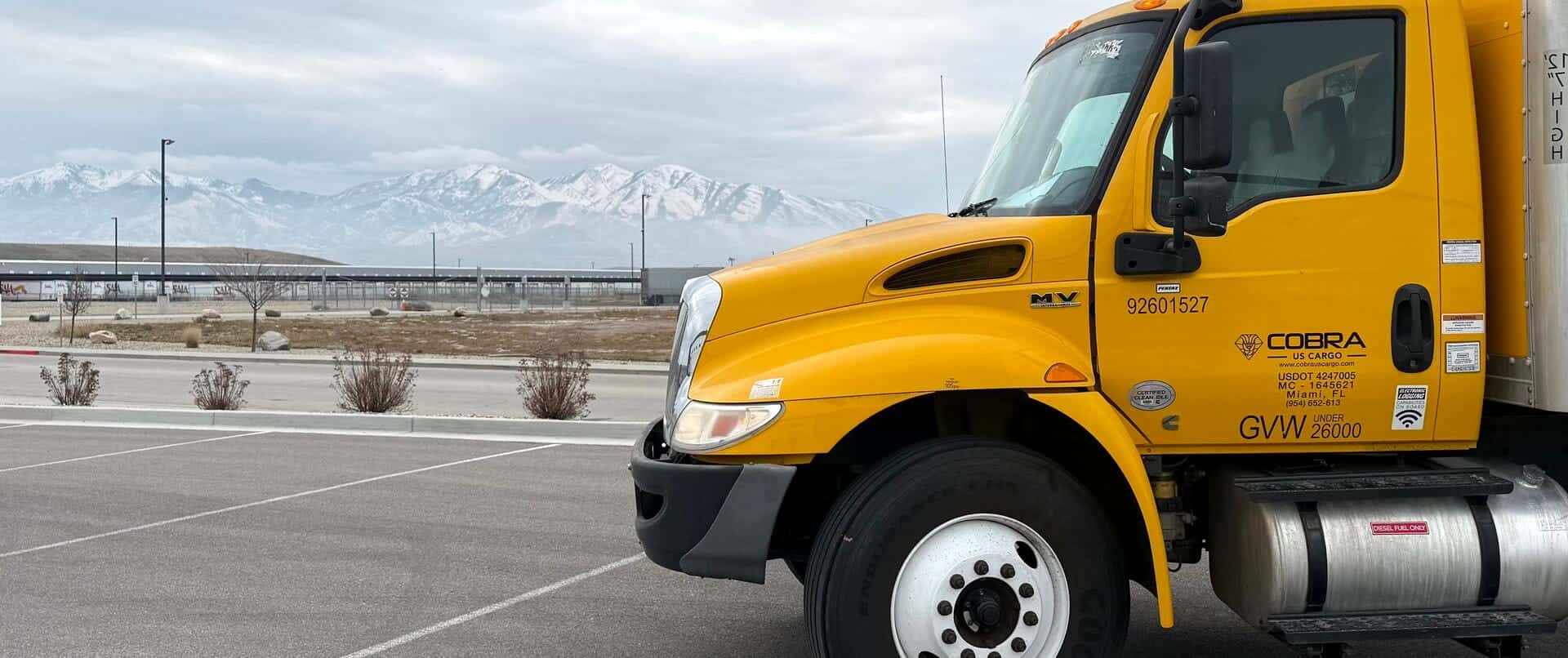
Cobra US Cargo is an interstate common carrier of property based in Miami (USDOT 4247005, MC-1645621). We run a fleet of 26 ft liftgate box trucks, plus a growing owner-operator program. The trucks are non-CDL, under 26,000 lb and ELD-equipped, and they carry our name and USDOT number on the doors, so a receiver can match the truck to the carrier on the BOL. We're fully insured to industry standard, with a certificate of insurance on request.
Miami ⇄ New York is our target lane. Beyond it, we run interstate box truck freight across the 48 states and set up dedicated lanes for brokers with recurring freight, on corridors like Miami to Atlanta. When you're ready, request a freight quote with the origin, destination and pallet count.
Sources
- eCFR — 49 CFR 390.5T, Definitions (interstate commerce, intrastate commerce, commercial motor vehicle) (opens in a new tab)
- FMCSA — Regulatory guidance: How does one distinguish between intra- and interstate commerce? (opens in a new tab)
- FMCSA — Do I Need a USDOT Number? (opens in a new tab)
- FMCSA — Get Operating Authority (Docket Number) (opens in a new tab)
- IFTA, Inc. — IFTA Articles of Agreement (R245, Qualified Motor Vehicle), August 2025 (opens in a new tab)
- The Florida Senate — 2026 Florida Statutes s. 316.302, Commercial motor vehicles; safety regulations (opens in a new tab)