
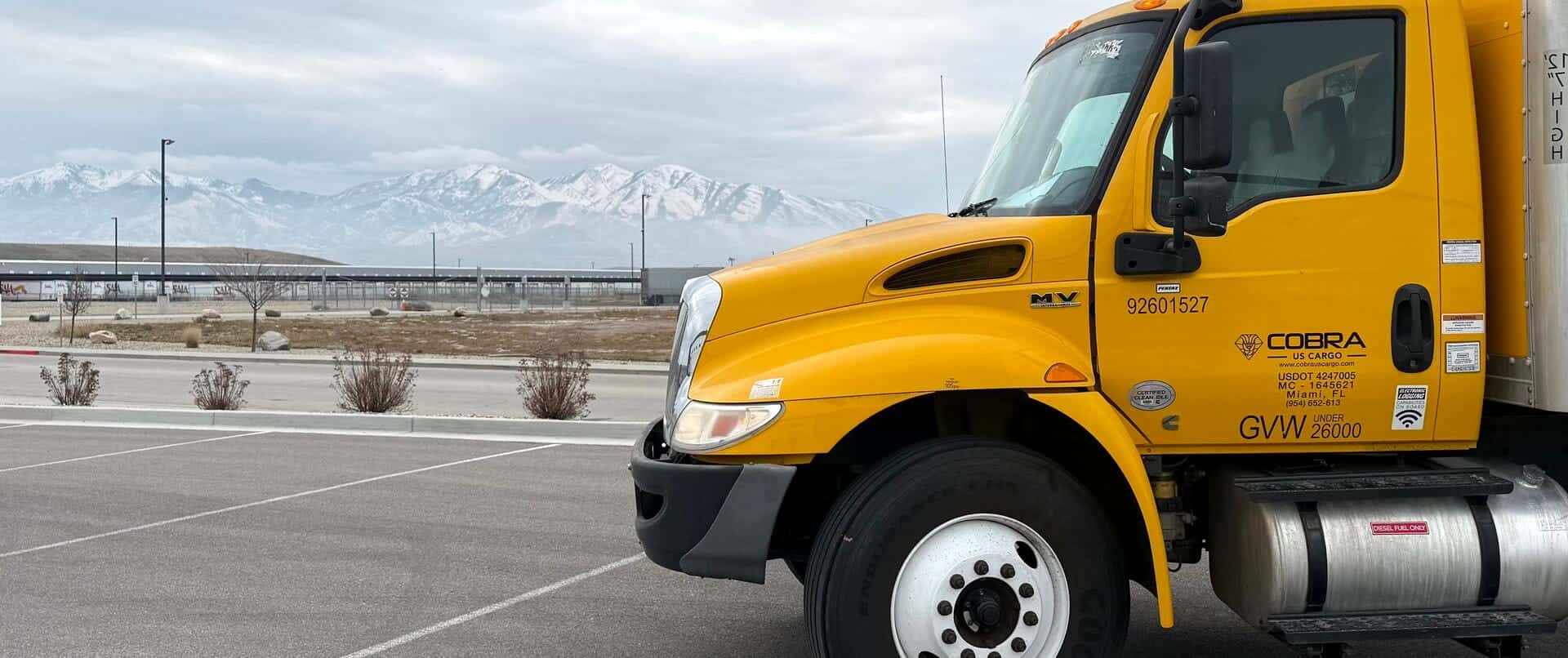
Box truck authority means two federal registrations: a USDOT number, which identifies your company for safety, and operating authority (an MC number), which lets you haul other people's freight for pay across state lines. In 2026 you apply for both in FMCSA's Motus system. Your authority goes active only after your insurer files proof of liability coverage and your BOC-3 process agent filing is on record.
This guide is for owners of a 16 to 26 ft box truck who want to run under their own name. It cites the regulations, lists only official fees and covers what a non-CDL box truck does not need, where most guides go wrong. It explains federal rules, not your legal, tax or insurance situation. Confirm those with an attorney, accountant or licensed insurance agent.
Key takeaways
- Hauling for-hire freight across state lines in a truck rated 10,001 lb GVWR or more takes a USDOT number and MC operating authority. Most 16 to 26 ft box trucks fall in that range.
- New applications go through Motus, FMCSA's new registration system. It checks your identity with a photo of your government ID plus a selfie, and issues randomized USDOT and docket numbers.
- The authority activates only once a BMC-91 or BMC-91X liability filing and a BOC-3 are on file. The federal liability minimum for general freight is $750,000.
- A two-axle box truck at 26,000 lb GVWR or less generally skips the CDL, Part 382 drug testing, IFTA, IRP plates and Form 2290. It does not skip medical cards, hours of service, annual inspections or the new entrant safety audit.
- Government fees are small: $300 for the authority and $55 for 2027 UCR at 0 to 2 trucks. Insurance is the big cost, and the market sets it, so get quotes from licensed agents.
What authority does a box truck need to haul freight across state lines?
FMCSA requires a USDOT number for any company running a vehicle with a GVWR or gross weight of 10,001 lb or more in interstate commerce. Hauling federally regulated freight owned by others for pay also takes interstate operating authority. FMCSA's page on getting operating authority (opens in a new tab) explains that for a property carrier this is the "MC" docket number, and that the authority type you pick sets the insurance you must carry.
The same page lists who does not need authority: private carriers hauling their own goods, for-hire carriers hauling only exempt commodities, and carriers working only inside certain commercial zones. Palletized retail goods, building materials and e-commerce freight are regulated, so hauling them for brokers takes authority.
Before you apply, read the certification label on the driver's door or pillar. Many 26 ft box trucks are rated 26,000 lb GVWR or less so a regular license can drive them, but some are rated higher, and that number changes the license, testing and tax rules. Our guide to non-CDL box truck driver requirements covers the driver side.
How do you apply for box truck authority in Motus?
First-time applicants apply in Motus (motus.dot.gov), which is replacing FMCSA's older registration systems:
- Set up the business first. Form your company with your state and get a free EIN from the IRS. Use the exact legal name and address from your state filing everywhere, because your insurance filing and BOC-3 must match the application. Ask an accountant which business structure fits you.
- Create your user profile. You sign in through Login.gov and complete identity verification the first time you log in. FMCSA's process uses your mobile device: you photograph a valid government ID, then take a selfie.
- Apply for the USDOT number and operating authority. Describe the operation honestly: interstate, for-hire, general freight, trucks and drivers. Request only the authority you need. FMCSA does not refund fees, and each authority type carries its own insurance requirement.
- Pay the $300 filing fee for each authority you request.
- Line up the filings before your docket number arrives. Have your insurance agent and BOC-3 company ready to file as soon as you have it.
Motus also changed the numbers. FMCSA's Motus registration changes page (opens in a new tab) says newly issued USDOT and docket numbers are randomized to fight fraud, and each new authority gets its own docket number. The MC prefix stays, and existing numbers don't change. Eliminating docket numbers is only under consideration and would go through a proposed rule first.
What filings activate your box truck authority?
A docket number is not permission to haul. Each next step has a clock:
- FMCSA Register notice. FMCSA publishes your application as a preliminary grant. Anyone has 10 days to protest (49 CFR 365.115).
- Insurance filing. Within 20 days of publication, your insurer files proof of public liability coverage on Form BMC-91 or BMC-91X (49 CFR 365.109T). For for-hire, non-hazardous property in a truck of 10,001 lb GVWR or more, the federal minimum in 49 CFR 387.9 (opens in a new tab) is $750,000.
- BOC-3. In the same window, a process agent filing must be on record. A carrier needs an agent in every state it operates in or crosses (49 CFR 366.4T), so most new carriers use a blanket company that files one BOC-3 covering every state.
- Grant. With both filings on record and no protest standing, the authority becomes effective (49 CFR 365.115). Late filings hold up the grant, which is why you line them up before you apply.
Two practical points. First, $750,000 is a floor. Brokers often ask for higher liability limits and for cargo coverage, which federal rules don't require for general freight. Ask a licensed agent what fits your lanes, and see our guide to box truck insurance for owner-operators. Second, don't haul a for-hire load until your authority shows as active in FMCSA's records.
What are the official government fees for box truck authority?
| Item | Who charges it | Official fee | Notes |
|---|---|---|---|
| USDOT number | FMCSA | No fee | Issued through your Motus application |
| Operating authority, property carrier | FMCSA | $300 per authority | Non-refundable, one fee per authority type |
| Reinstating authority | FMCSA | $80 | For example, after a revocation for an insurance lapse |
| Notice of name change | FMCSA | $14 | Markings and filings must change too |
| UCR, 2027 registration year | Unified Carrier Registration Plan | $55 for 0 to 2 trucks | Set by FMCSA rule. The 2026 fee was $46 |
| EIN | IRS | Free | Apply on irs.gov, not through a paid look-alike site |
| BOC-3 filing and insurance | Private companies | Market price | Not government fees. Get several quotes |
FMCSA lists its fees on the operating authority page (schedule: 49 CFR 360.3T). The UCR amounts come from the Federal Register final rule on 2027 UCR fees (opens in a new tab), effective October 1, 2026. Collections for each registration year open the October 1 before it. State formation fees vary.
What doesn't apply to a non-CDL box truck under 26,001 lb?
Many guides copy semi-truck checklists. Here is what applies to a two-axle box truck rated 10,001 to 26,000 lb GVWR hauling for-hire general freight across state lines.
| Requirement | Applies? | Why |
|---|---|---|
| CDL | No | The CDL threshold is 26,001 lb GVWR, unless the truck hauls placarded hazmat |
| DOT drug and alcohol testing (Part 382) | No | Part 382 covers drivers who need a CDL (49 CFR 382.103). A broker or carrier may still ask for its own test |
| IFTA fuel tax license | No | IFTA covers two-axle trucks over 26,000 lb, or three or more axles |
| IRP apportioned plates | Usually no | IRP uses the same over-26,000 lb test for two-axle trucks. Confirm plate rules with your base state |
| IRS Form 2290 | No | The heavy vehicle use tax starts at 55,000 lb taxable gross weight |
| USDOT number, MC authority, UCR | Yes | For-hire interstate freight at 10,001 lb or more. UCR renews every year |
| Liability filing and BOC-3 | Yes | Both must stay on file, or the authority is revoked |
| Medical card and driver qualification file | Yes | A current medical certificate, and a file for each driver |
| Hours of service and ELD | Yes | Unless a short-haul or other ELD exception applies |
| Annual inspection and markings | Yes | Inspection within the past 12 months. Legal or trade name and USDOT number on both sides, readable from 50 feet (49 CFR 390.21T) |
| MCS-150 biennial update | Yes | Every 24 months on a schedule set by your USDOT number (49 CFR 390.19T), or the number can be deactivated |
| New York highway use tax | Yes, if you run New York | Trucks over 18,000 lb gross weight, or over 8,000 lb unloaded |
The Florida HSMV IFTA page (opens in a new tab) spells out the test: two axles and a gross or registered weight over 26,000 lb, three or more axles, or a truck and trailer combined over 26,000 lb. Pulling a trailer can push you over.
New York is the one most guides miss, and it matters on the I-95 corridor. The New York tax department's introduction to the highway use tax (opens in a new tab) requires a certificate of registration and a decal for each qualifying truck before it runs on New York public highways, or a trip certificate for limited trips. The tax is based on New York miles, excluding toll-paid Thruway miles. Gross weight counts the truck plus its maximum load, so most 26 ft box trucks qualify. Ask a tax professional how to report it. For logs, see our guide to box truck ELD and hours-of-service rules.
If your next truck is rated 26,001 lb or more, the CDL, IFTA, IRP and Part 382 testing all arrive at once. Under 49 CFR 382.103(b), an owner who is the only driver must still sit in a random testing pool of two or more covered drivers, which in practice means joining a consortium.
What is the new entrant safety audit?
Under 49 CFR 385.307, a new carrier is monitored for 18 months once it starts operating. FMCSA watches your roadside inspections and runs a safety audit once you have enough records, generally after at least 3 months. Have these ready from the first load:
- Driver qualification files, with the application, MVRs, road test or equivalent and a current medical certificate.
- Hours-of-service records: ELD data plus supporting documents such as fuel receipts and BOLs.
- Maintenance records, including the annual inspection report for each truck.
- Proof of insurance that matches your FMCSA filing.
- An accident register for any DOT-recordable crash.
Under 49 CFR 385.308, some events can bring an expedited audit or a demand for corrective action: running a truck that was placed out of service without fixing it, operating without the required insurance, or an out-of-service rate of 50 percent or more over at least three inspections in 90 days. Ignore a written demand for 30 days and FMCSA revokes your registration.
Why do brokers hesitate with a new box truck authority?
Brokers set their own vetting rules, and many screen out carriers below a minimum authority age. The cutoff varies and often isn't published.
Much of the caution is about fraud. FMCSA built Motus with identity checks and randomized numbers for the same reason, and brokers run their own checks, so new carriers get asked for more paperwork. Since a new number no longer shows how old an authority is, brokers check the grant date in your FMCSA authority history.
What helps a new authority get set up:
- A complete carrier packet: authority letter, certificate of insurance and W-9, ready to send.
- Matching details everywhere: the same legal name, address, phone and email on your state filing, FMCSA record, insurance and invoices. Mismatches look like fraud.
- The coverage brokers ask for, often liability above the federal minimum plus cargo. Ask before you buy the policy.
- Clean roadside inspections, because your record starts at zero.
Own authority or lease on first?
Neither path is automatically better. It depends on your cash, experience and appetite for the business side.
- Your own authority gives you full choice of loads, lanes and customers. You also carry the whole stack: premiums, filings, the audit, broker setup from zero, billing and collections.
- Leasing on puts your truck under a carrier's MC, insurance filings and broker relationships, under a written lease that federal Truth-in-Leasing rules control. Our guide to the box truck lease on covers what that lease must say.
- Already have authority but not enough loads? Motus lets a carrier voluntarily suspend its authority to lease onto another carrier, then reinstate it within one year. See how to keep your MC while leased on.
- Not ready to own yet? Some people drive for a carrier first and learn the work before they buy.
How Cobra US Cargo works with new box truck owners
Cobra US Cargo LLC is a Miami-based interstate carrier running under its own authority (MC-1645621, USDOT 4247005), fully insured to industry standard. Our fleet of 26 ft box trucks, plus a growing owner-operator program, runs Miami to New York as its target lane and hauls interstate freight across the 48 states. If you'd rather not build an authority from scratch, the lease-on alternative puts your truck under our MC, with dispatch that finds and books the loads, help getting the right insurance in place, startup guidance, ELD and compliance support, a fuel card with fuel discounts, and weekly pay. We want to be your first carrier partner. Owner-operators from anywhere in the US are welcome with a 26 ft box truck, 2018 or newer, and fleet owners can put a hired driver in the truck. No trucking experience is needed to start the conversation (whoever drives must still qualify), and dispatch speaks English and Spanish. If you already hold your own MC, or want to know how pay and insurance work under the lease, contact us for details. Still shopping for a truck? Talk to us before you buy.
Sources
- FMCSA — About FMCSA Registration Changes (Motus) (opens in a new tab)
- FMCSA — Get Operating Authority (Docket Number) (opens in a new tab)
- eCFR — 49 CFR 387.9, Financial responsibility, minimum levels (opens in a new tab)
- Federal Register — Fees for the Unified Carrier Registration Plan and Agreement (Sep 1, 2026) (opens in a new tab)
- Florida HSMV — International Fuel Tax Agreement (opens in a new tab)
- New York State Department of Taxation and Finance — An Introduction to Highway Use Tax (opens in a new tab)