
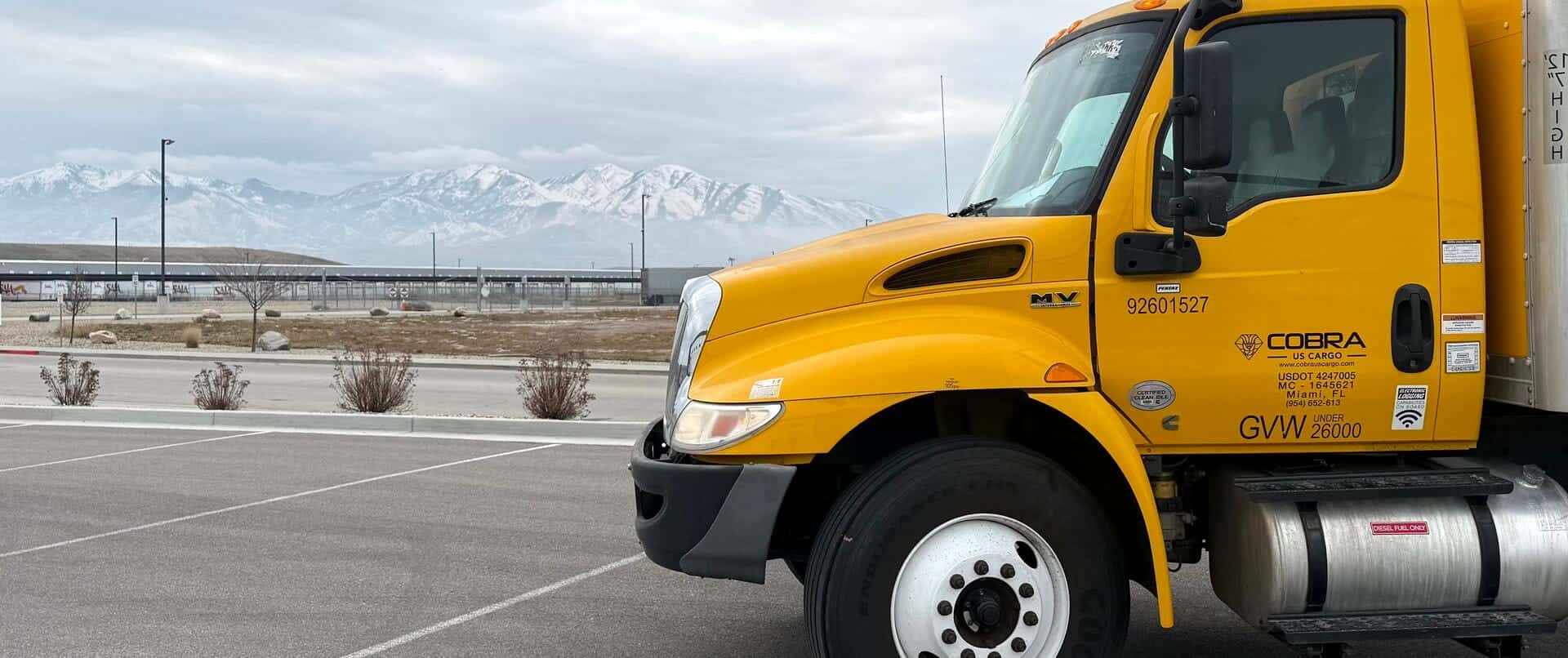
If you just bought a box truck, what comes next is one decision and a short stack of paperwork. First, read the GVWR on the door-frame label to confirm the truck is non-CDL. Then choose your path: lease on to a carrier and haul under its authority, or get your own USDOT and MC authority. That choice decides your insurance, your filings and how soon the first load comes.
This guide is for new owners of a 16 to 26 ft straight truck who want to haul freight for pay. It covers the decision, the truck and driver rules, insurance in each path and a 30-day checklist to the first load.
Key takeaways
- Check the GVWR on the certification label before you spend money. "26 ft" is the box length, not the weight rating.
- Decide lease on or own authority before you buy insurance or file anything. The answer changes both.
- For interstate work, every path needs a current annual inspection, a qualified driver with a DOT medical card and, on a model-year 2000 or newer truck, usually an ELD.
- A two-axle, non-hazmat box truck rated, registered and loaded at 26,000 lb or less doesn't need a CDL, IFTA, Form 2290 or federal drug testing, and usually not IRP plates.
What should you do first after buying a box truck?
Don't start with a filing service or a load board. Start with the truck itself and the one decision that shapes everything else.
- Protect the truck. Ask your agent about physical damage coverage from day one. If you have a loan on the truck, the lender usually requires it. Don't haul for pay until the commercial coverage for your path is in place.
- Read the labels and write down the specs. GVWR, VIN, model year, box length, door type and liftgate capacity. Carriers and brokers will ask for all of them.
- Gather the truck file. Title or signed-over title, bill of sale, registration, any maintenance records and the last inspection report, if the seller has one.
- Pick your path before you file. If you pay for your own authority and then lease on, you've paid for filings you won't use yet. If you lease on first, you can still apply for authority later.
Lease on or get your own authority?
Leasing on means a carrier takes your truck under its operating authority with a written lease. You still own the truck, and usually drive it. With your own authority, your company holds the USDOT and MC numbers and every federal duty that comes with them. The real question is how much setup you want to carry before the first paid mile.
| What changes | Leased on to a carrier | Your own authority |
|---|---|---|
| Whose authority and USDOT | The carrier's | Yours, after FMCSA activates it |
| Insurance filings with FMCSA | Carrier files them | Your insurer files them for you |
| Finding loads | Carrier dispatch | You, a dispatcher or load boards |
| Billing and collections | Carrier bills the broker or shipper | You invoice, or use factoring |
| Driver file, safety record, audits | Carrier keeps them | You keep them, plus a new-entrant safety audit |
| What slows the first load | Carrier onboarding: documents, inspection, lease | Authority activation, then broker setups, often with a minimum authority age |
| Control of lanes and freight | What the carrier runs | Yours |
The federal Truth-in-Leasing rules (49 CFR 376.12) require a written lease signed by you and the carrier that states your pay, every chargeback and how it's computed, and who provides each kind of insurance. If you go the other way, our guide to getting box truck authority covers the USDOT, MC, BOC-3 and UCR steps.
Is your box truck really non-CDL? Check the GVWR label
"26 ft" describes the box, not the chassis. The same box can sit on a chassis rated under 26,001 lb or well above it. Only the gross vehicle weight rating (GVWR) decides whether the driver needs a CDL.
Most box trucks are built in stages: a chassis maker builds the cab and frame, then a body builder adds the box. Under 49 CFR 567.5, the final-stage manufacturer must label the GVWR (opens in a new tab) on the completed truck. You may find more than one label on the driver's door edge or door-latch post. Read the final-stage one: it describes the finished truck.
Then compare it with the thresholds that matter:
- 10,001 lb GVWR or more, in interstate commerce: the truck is a commercial motor vehicle, so the safety rules apply. That means a medical card, hours of service, the annual inspection and the driver file.
- 26,001 lb or more: the federal CDL definition in 49 CFR 383.5 (opens in a new tab) counts a heavy straight truck by its GVWR or its actual gross weight, whichever is greater. So overloading a 25,999 lb truck past 26,000 lb is more than a weight ticket. It puts the driver in CDL territory.
- Placarded hazmat: a CDL is required at any weight, under the same definition.
What does and doesn't apply under 26,001 lb
This is where new owners get the most bad advice. For a two-axle, non-hazmat box truck rated and registered at 26,000 lb or less, hauling interstate:
| Requirement | Applies? | Why |
|---|---|---|
| CDL | No | The CDL threshold for a straight truck is 26,001 lb |
| DOT drug and alcohol testing (Part 382) | No | Part 382 covers CDL drivers. A carrier may still test under its own policy |
| IFTA fuel tax license | No | IFTA starts at two axles over 26,000 lb, by GVW or registered GVW |
| IRP apportioned plates | Usually no | Required over 26,000 lb, like IFTA. Lighter trucks can opt in, so check with your base state |
| Form 2290 heavy vehicle use tax | No | It starts at 55,000 lb taxable gross weight |
| DOT medical card | Yes | 10,001 lb or more in interstate commerce |
| Hours of service and ELD | Yes, with narrow exceptions | See the next section |
| Annual inspection | Yes | 49 CFR 396.17 |
| Driver qualification file | Yes | Kept by whoever holds the authority |
| Carrier name and USDOT on both sides | Yes | The operating carrier's, not necessarily yours |
Florida's motor vehicle agency spells out the IFTA qualified-vehicle test (opens in a new tab), and it counts registered weight too. Register at a weight that covers how you actually load. A registered weight over 26,000 lb, or a trailer that pushes the combination past it, brings IFTA and IRP back in.
What paperwork does the truck need before it hauls freight?
Four items cover most of it.
Title and registration. Put them in the name that will run the business, you or your LLC, and use the same name on the insurance. Your state sets registration rules and fees; in Florida, that's the Department of Highway Safety and Motor Vehicles.
Annual inspection. Under 49 CFR 396.17 (opens in a new tab), a commercial truck can't be operated unless it passed a periodic inspection in the past 12 months and proof is on the vehicle, either the report or a decal. A qualifying state inspection counts. Even with the seller's recent report, a carrier may want its own, so plan one early.
ELD. Hours of service apply to a box truck of 10,001 lb or more in interstate commerce, and most drivers log them on an ELD. The FMCSA ELD exceptions list (opens in a new tab) excuses trucks and engines older than model year 2000, so a 2018-or-newer truck won't qualify for that one. The others are narrow, such as needing logs on no more than 8 days in any 30, or the non-CDL short-haul rule for drivers who stay within 150 air miles and return to the same work location each day. Our box truck ELD guide covers who qualifies.
Markings. The operating carrier's legal name and USDOT number go on both sides of the truck. Leased on, that's the carrier's. Don't letter the doors with your own name until you've chosen a path.
What does the driver need?
The truck being non-CDL doesn't make the driver unregulated. Whoever drives, you or a hired driver, needs:
- Age 21 or older for interstate driving under 49 CFR 391.11. Carriers may set a higher minimum.
- A valid driver's license, and a driving record (MVR) that a carrier and its insurer will accept.
- A current DOT medical examiner's certificate, carried while on duty.
- Enough English to talk with officers, read road signs and fill in records. Inspectors can place a driver out of service for failing it.
- A road test certificate, or an equivalent the carrier accepts, plus employment history and the other records for the driver qualification file.
Our guide to non-CDL box truck driver requirements covers each item. The same list applies to a hired driver.
What insurance do you need in each path?
For your own authority, the floor is federal. Under 49 CFR 387.9 (opens in a new tab), a for-hire interstate carrier hauling non-hazardous property in a truck of 10,001 lb GVWR or more needs at least $750,000 in public liability coverage, and your insurer files proof with FMCSA. Brokers often ask for more, and cargo limits come from the broker contract, not FMCSA.
| Coverage | Own authority | Leased on |
|---|---|---|
| Primary auto liability | You buy it. Your insurer files it with FMCSA | The carrier's. The lease must say so, and whether any cost is charged back to you |
| Cargo | You buy it to meet broker contracts | Often through the carrier. The lease says who pays |
| Physical damage on the truck | Your choice, or your lender's requirement | Usually yours |
| Non-trucking liability (bobtail) | Usually not needed. Your primary policy covers the truck | Usually yours, for time off dispatch |
| Occupational accident | Your choice | Often required by the carrier |
| General liability | Sometimes required by shippers or brokers | Ask the carrier |
Leases differ, so get the split in writing and have a licensed insurance agent read it before you buy anything. This guide is general information, not insurance or legal advice. Our guide to box truck insurance for owner-operators goes deeper on each policy.
How do you get the truck ready for broker and carrier specs?
Brokers book box trucks by spec, not by name. Have these answers ready before anyone asks:
- Door opening and inside length. Measure them yourself, not from a brochure. A crate can fit the box and still miss the door.
- Liftgate. Read the capacity and platform size off its data plate, and get it serviced. A gate that fails at delivery stops the load.
- Securement. E-track or logistics posts, ratchet straps and load bars, so pallets stay put through braking and turns.
- Pallet jack. Many liftgate deliveries need the driver to move pallets to the gate and onto the dock.
- A dry box. Stand inside with the door shut in daylight. Light through the roof or seams means water will get in too.
- Photos. All four sides, the open box and the VIN plate. Carriers ask for them.
Bought a box truck, what next? Your 30-day checklist
Use this as an order of work, not a deadline. Paperwork, inspections and FMCSA processing set the real pace, and the own-authority column can easily run past day 30.
| Days | Leased-on path | Own-authority path |
|---|---|---|
| 1–3 | Read the GVWR label, build the truck file, put physical damage coverage on the truck | Same |
| 4–7 | Talk to carriers, check them on SAFER, ask for the full written lease | Pick a business structure with an accountant; get insurance quotes before you file |
| 8–14 | Medical card, MVR, annual inspection; send the carrier your documents | Apply for USDOT and MC, file the BOC-3, insurer files proof of coverage |
| 15–21 | Sign the lease, carrier markings, ELD and dispatch app | Inspection, ELD, markings, UCR, broker setup packets |
| 22–30 | First dispatched load | First loads from brokers that take new authorities; set up invoicing |
What to expect on your first load
Arrive early with the pickup number from dispatch. Before you sign the bill of lading, count pallets and pieces against it and check that the seal number matches. Write any damage or shortage on the BOL. Strap and bar the load, and take photos. At delivery, get the proof of delivery (POD) signed with a printed name, then send the BOL and POD to dispatch the same day. Under a lease, those documents start the pay clock: Truth-in-Leasing rules require the lease to set payment within 15 days after you submit the delivery paperwork.
How Cobra US Cargo works with new box truck owners
Cobra US Cargo LLC is a Miami-based interstate carrier (MC-1645621, USDOT 4247005), fully insured to industry standard. We run our fleet of 26 ft box trucks plus a growing owner-operator program, with Miami to New York as our target lane and freight across the 48 states. We want to be the first carrier partner for new owners. The only truck requirement is a 26 ft box truck, 2018 or newer, so you can find out if your truck qualifies before anything else. You lease on to our MC, and we bring dispatch that finds and books the loads, help getting the right insurance in place, ELD and compliance support, a fuel card and fuel discounts, startup guidance and weekly pay.
Owner-operators anywhere in the US are welcome, and dispatch speaks English and Spanish. No trucking experience is needed to start the conversation: contact us and we'll walk you through it. Driver qualification rules still apply to whoever drives. Fleet owners can put a hired driver in their truck, as long as that driver meets our driver requirements. The figure we share is $6K–$10K a week in gross. Gross revenue before fuel, insurance and other expenses. Results vary by truck, availability and lanes. For pay structure, deductions and the insurance split, contact us for details. Shopping for a second truck? Talk to us before you buy.
Sources
- eCFR — 49 CFR 567.5, Requirements for manufacturers of vehicles manufactured in two or more stages (opens in a new tab)
- eCFR — 49 CFR 383.5, Definitions (commercial motor vehicle for CDL purposes) (opens in a new tab)
- eCFR — 49 CFR 396.17, Periodic inspection (opens in a new tab)
- FMCSA — ELD Exceptions and Exemptions FAQ (opens in a new tab)
- eCFR — 49 CFR 387.9, Financial responsibility, minimum levels (opens in a new tab)
- Florida HSMV — International Fuel Tax Agreement (IFTA) (opens in a new tab)