
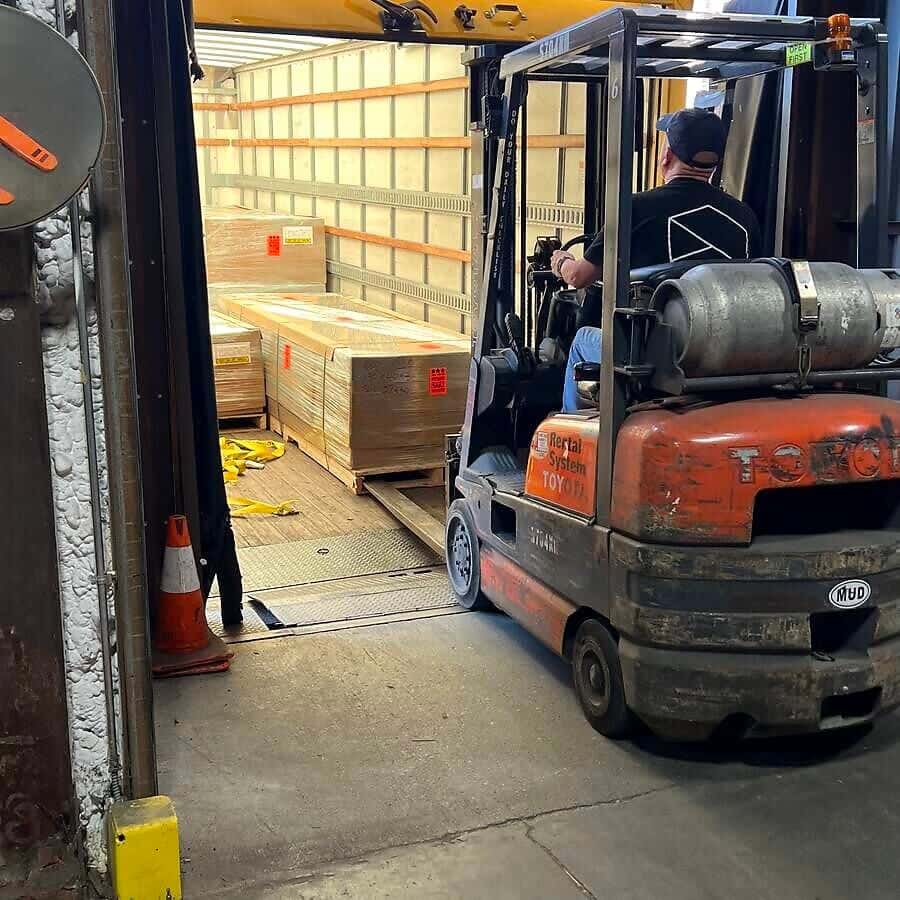
If you want to know how to find box truck loads, there are four channels: load boards filtered for straight trucks, direct relationships with freight brokers, freight from shippers you sign yourself, and leasing on to a carrier whose dispatch books the loads. The app matters less than people think. What decides whether you roll is whether a broker can say yes to your authority, your insurance and your truck's specs.
This guide is for owners of a 16 to 26 ft straight truck who have empty days on the calendar, whether the authority is brand new or a few years old. It takes the carrier's side of the desk: why box trucks get turned down, what brokers check, and how to fix it before the next call.
Key takeaways
- Every channel runs through the same gate: brokers and shippers vet your authority, insurance and equipment before they tender a load.
- Load boards work for 26 ft box trucks if your filters match your real payload and you compare loads per total mile, empty miles included.
- Most turn-downs have fixable causes: a thin carrier packet, unclear specs, insurance that doesn't match the broker contract, or an authority that is too new for that broker.
- Under FMCSA's 2023 guidance, a dispatcher who works for several carriers and decides which one gets each load is acting as a broker and needs broker authority.
- Leasing on skips the new-authority problem because you haul under a carrier's MC, its insurance filings and its broker setups.
How to find box truck loads: the four channels
There are four real ways to find box truck loads, and most owner-operators mix two of them. Here is what each demands.
| Channel | Who gives you the load | What you need first | Speed to a first load | Main risk |
|---|---|---|---|---|
| Load boards | Brokers posting spot freight | Your own authority, a carrier packet, a board subscription | Fast once you are set up with brokers | Low rates, long deadhead, fake postings |
| Direct broker relationships | A handful of brokers on repeat lanes | A track record with each broker and fast communication | Slow to build, steady once built | Losing the freight if a broker's customer moves |
| Direct shippers | Warehouses, distributors, retailers, 3PLs | Your own authority, a contract, credit checks, invoicing | Slowest | Slow-paying customers and no backup freight |
| Leasing on to a carrier | The carrier's dispatch | A truck that meets the carrier's requirements and a signed lease | Usually fast after onboarding | Less choice of loads, and the lease terms you accept |
The first three need your own authority. The fourth doesn't, which is why it matters most to new owners. All four still depend on a clean, legal truck and a driver who meets the qualification rules.
Do load boards work for a 26 ft box truck?
Yes, if you search the way brokers post. Many posts are written for dry vans and tractors, so set the equipment type to straight or box truck and enter your maximum weight and length. Use your real legal payload: the GVWR on the door label minus the truck's scale weight with fuel, driver, liftgate and gear. If you enter the GVWR instead, you will call on loads you can't legally carry.
Still, don't skip van posts. A light dry-van load of a few pallets can fit a 26 ft box if the weight, pallet count and dock setup work, so ask the broker to confirm with the shipper and receiver before you pass on it.
Partials are where a box truck earns its keep. A broker with four pallets for a store that has no dock often can't use a 53 ft trailer economically. So filter for partials, check whether a liftgate is needed, and post your truck with its location and specs so brokers can find you instead of only the other way around.
Compare loads per total mile, not per loaded mile
Posted rates hide the empty miles to the pickup. Here is the math with made-up numbers.
Hypothetical example only, not a quote or a Cobra rate. Assumed inputs: the pay and mileage below.
| Load A | Load B | |
|---|---|---|
| Load pays | $1,000 | $900 |
| Loaded miles | 500 | 450 |
| Empty miles to the pickup | 150 | 20 |
| Total miles driven | 650 | 470 |
| Pay per loaded mile | $2.00 | $2.00 |
| Pay per total mile | about $1.54 | about $1.91 |
Both loads look the same per loaded mile. Load B pays $100 less but earns more for every mile the truck actually turns, and it leaves 180 fewer miles of fuel, tires and hours on the clock. Run this check on every offer, and add the next likely load out of the delivery area before you accept.
Before you book, check the broker too. Look up its MC on the FMCSA SAFER Company Snapshot (opens in a new tab) and confirm the authority is active for brokerage. Call the phone number on its FMCSA record, not only the number in the email. Boards that show broker credit scores and days-to-pay are worth reading.
Why do brokers turn down box trucks and new authorities?
A broker who tenders a load is putting its customer relationship on your truck. When something goes wrong, the broker answers to the shipper, so it screens for risk. The common reasons a box truck hears no:
- The authority is too new. Many brokers want to see some months of active authority, and the cutoff varies by broker. Some shipper platforms publish theirs. Amazon Relay, which lists 26 ft and 16 ft box trucks with a tuck-under liftgate among its accepted equipment, says a carrier's interstate authority must have been active for at least 180 days. Freight fraud has also made many brokers screen new MCs harder, not softer.
- The insurance doesn't match the contract. Federal law sets a floor. 49 CFR 387.9 (opens in a new tab) requires at least $750,000 in public liability for for-hire carriers of non-hazardous property in interstate commerce in vehicles of 10,001 lb GVWR or more. Many broker contracts ask for more liability, plus cargo coverage, and want the certificate to name them as the certificate holder. Ask your insurance agent to read the broker's insurance clause before you sign it.
- The packet is incomplete. A missing W-9, an expired certificate or a mismatched legal name stops onboarding cold.
- The truck doesn't fit the freight. A rear door opening too low for tall pallets, a liftgate rated below the heaviest pallet, or a payload that only works on paper.
- Nobody answers the phone. Box truck loads go fast, and a missed call often means the load is gone.
Most of these are fixable quickly. Authority age is the one you can't speed up, which is where leasing on comes in.
What do brokers check before they give a box truck a load?
Brokers vet carriers the same way smart shippers do. Our guide on how to verify a trucking company walks through the checks from the shipper's side, and it is worth reading from yours. Expect this list.
| What brokers check | Where they look | What to have ready |
|---|---|---|
| Operating status | FMCSA SAFER and the broker's monitoring service | Active authority, current MCS-150 |
| Authority age | FMCSA records | Your grant date. If it is new, say so up front |
| Insurance | Your certificate of insurance and the insurer's filings | A current COI naming the broker as certificate holder, with limits that match its contract |
| Tax ID | W-9 | A signed W-9 matching your legal name exactly |
| Authority letter | FMCSA grant letter | A PDF ready to email |
| ELD | Your ELD provider and its data transfer | The provider name and a working account |
| Door opening | Your spec sheet | Rear door height and width, measured |
| Liftgate | The liftgate's capacity plate | Type and rated capacity in pounds |
| Load securement | Your spec sheet | E-track or logistics posts, load bars, straps |
| Payload | Scale ticket and door GVWR label | GVWR minus scale weight, in pounds |
| Payment setup | The broker's agreement | Bank details, or your factoring company's notice of assignment |
A one-page truck spec sheet that wins callbacks
Send this with your packet and paste it into load board notes.
- Legal name, MC and USDOT numbers, dispatch phone and email
- Truck year and make, box length, measured inside length, width and height
- Rear door type (roll-up or swing) and the measured door opening
- Liftgate type and rated capacity, or "no liftgate"
- Legal payload in pounds, from a scale ticket
- Pallet capacity in one layer. For a 26 ft box, see our 26 ft box truck capacity guide for the honest count
- Load securement on board: e-track, load bars, straps, blankets, pallet jack
- ELD provider, insurance agent name and phone
- Home base and the lanes you want
How do you land direct shipper freight with a box truck?
Go where a 26 ft box solves a real problem. That means stores and job sites with no dock, distributors with recurring partial loads, trade show freight, 3PLs with overflow, and furniture and fixture deliveries to businesses. These customers care about the liftgate, a driver who calls ahead and a clean POD, not only the rate.
Direct freight needs your own authority, because you contract with the shipper. Expect to sign a transportation agreement, provide your COI, and invoice on the shipper's terms, which can be slower than a broker's. Run a credit check on any new customer before you haul, and keep signed BOLs and PODs for every stop.
There is one legal line to watch. 49 CFR 371.2 (opens in a new tab) defines a broker as anyone who, for compensation, arranges transportation of property by an authorized motor carrier. Carriers are excluded only for shipments they are authorized to haul and have legally bound themselves to transport. If you pass a shipper's extra freight to another carrier for a cut, whether that is brokering depends on the facts, and many broker-carrier agreements forbid re-brokering. Ask a transportation attorney first. Brokers, for their part, must keep a $75,000 surety bond or trust fund under 49 CFR 387.307 (opens in a new tab), so check an unfamiliar broker's authority and bond status on its FMCSA record before you haul.
Should you pay a dispatcher to find box truck loads?
A dispatcher can save you hours on the phone. A good one searches boards, calls brokers, negotiates, handles setup packets and books your loads while you drive. A dispatcher can't fix the underlying problems, though. If your authority is too new for a broker, or your insurance doesn't match its contract, the answer is still no.
Check how the dispatcher works before you sign. In its 2023 final guidance on brokers and bona fide agents (opens in a new tab), FMCSA said the test is discretion. A dispatch service that represents more than one carrier and decides which carrier gets a load is "allocating traffic", so it is not a bona fide agent, and it needs broker authority to do that work. The guidance isn't binding law, but it shows how FMCSA reads the rule. Ask any dispatcher:
- Do you work only for carriers, and do you hold broker authority if you need it?
- How is your fee calculated, and is it in a written agreement I can cancel?
- Will I see every rate confirmation, the broker's name and the full rate?
- Who signs broker agreements, and in whose name?
Our comparison of box truck dispatch service vs lease on puts the two models side by side, including who holds the authority, the insurance and the compliance in each.
When does leasing on to a carrier make more sense?
Leasing on makes sense when the bottleneck is your authority, not your truck or your driving. Your truck runs under the carrier's MC, its insurance filings and its existing broker setups, and the carrier's dispatch books the loads. The broker vets the carrier, not your six-week-old MC. For a new owner, that can be the difference between weeks of waiting and a first load.
The trade-off is control. You run the freight the carrier has, under the lease's terms. Federal Truth-in-Leasing rules protect you here. 49 CFR 376.12 (opens in a new tab) requires a written lease that states your pay, every chargeback and how it is calculated, and who pays for insurance. It also requires payment within 15 days after you turn in the delivery documents. Have an attorney review any term you don't understand before you sign.
If you already hold an MC and simply can't keep the truck busy, you may not have to give the authority up. Our guide to leasing on with your own MC authority covers that path.
How Cobra US Cargo handles this
Cobra US Cargo LLC is a Miami-based interstate carrier (MC-1645621, USDOT 4247005), fully insured to industry standard. We run our fleet of 26 ft box trucks plus a growing owner-operator program, with Miami to New York as our target lane and interstate freight across the 48 states. If you are tired of chasing loads, you can lease on with a carrier whose dispatch books the loads: you lease on to our MC, and we provide dispatch that finds and books freight, help getting the right insurance in place, ELD and compliance support, a fuel card and fuel discounts, startup guidance and weekly pay.
The only truck requirement is a 26 ft box truck, 2018 or newer, and owner-operators anywhere in the US are welcome. Fleet owners can put a hired driver in their truck, as long as that driver meets the driver requirements. Dispatch speaks English and Spanish. The figure we share is $6K–$10K a week in gross: gross revenue before fuel, insurance and other expenses. Results vary by truck, availability and lanes. For pay structure and the rest of the terms, contact us for details. No trucking experience is needed to start the conversation. If you haven't bought a truck yet, talk to us before you buy. When you are ready, apply to lease on.
Sources
- FMCSA — SAFER Company Snapshot (opens in a new tab)
- eCFR — 49 CFR 387.9, Financial responsibility, minimum levels (opens in a new tab)
- eCFR — 49 CFR 371.2, Definitions (broker, bona fide agent) (opens in a new tab)
- eCFR — 49 CFR 387.307, Property broker surety bond or trust fund (opens in a new tab)
- Federal Register — FMCSA final guidance, Definitions of Broker and Bona Fide Agents (June 16, 2023) (opens in a new tab)
- eCFR — 49 CFR 376.12, Lease requirements (opens in a new tab)