
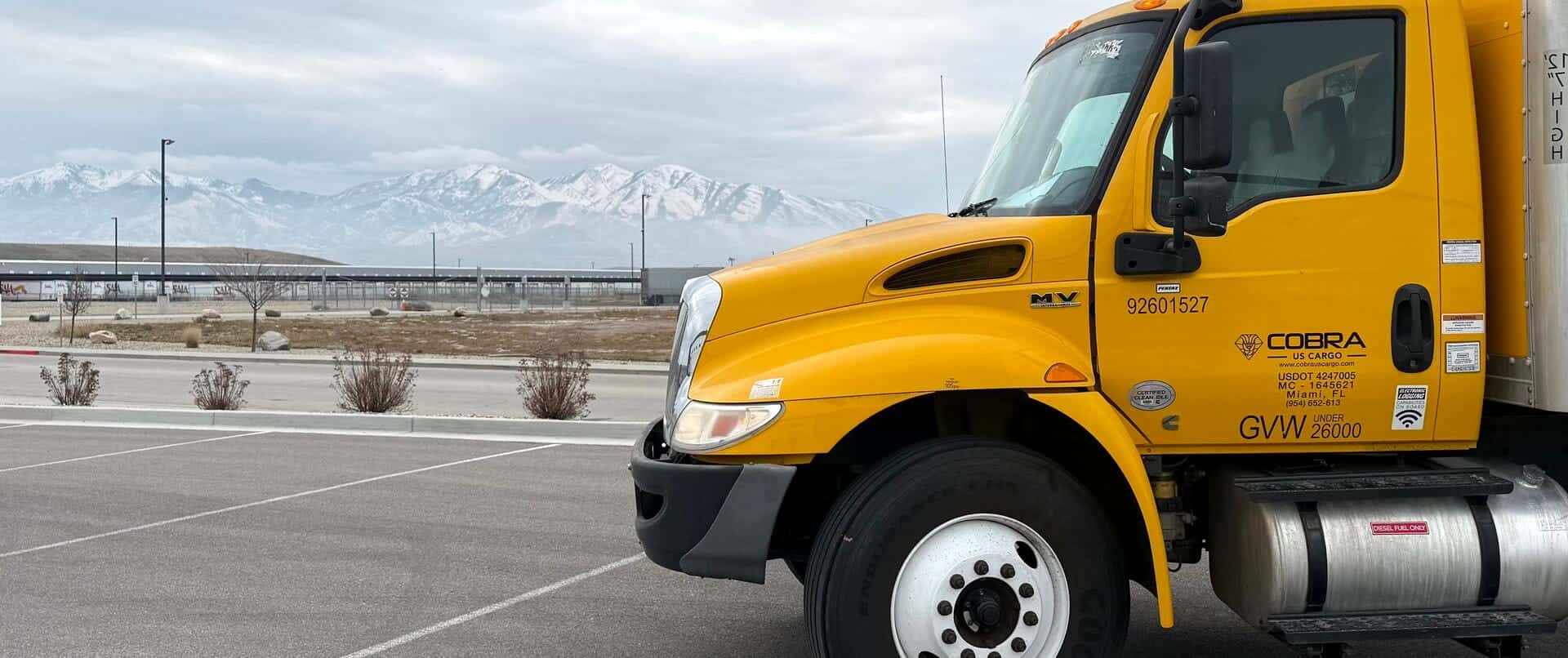
Non-CDL box truck driver requirements come down to this: you can drive a box truck rated 26,000 lb or less on a regular license, but if it is rated 10,001 lb or more and hauls freight across state lines, federal rules still apply to you. You must be at least 21, carry a DOT medical card, read and speak English, pass a road test, and follow hours-of-service rules.
This guide is for drivers in Miami and South Florida who want interstate box truck work without a CDL, and for anyone comparing job posts that list very different requirements. It separates what federal law requires from what each carrier adds on its own.
Key takeaways
- The CDL line is 26,001 lb. The federal "commercial motor vehicle" line is 10,001 lb. A 26 ft box truck sits between the two, so you skip the CDL but not the federal rules.
- Non-CDL drivers still get a paper DOT medical card and must carry it while on duty.
- Since June 25, 2025, a driver who fails an English proficiency check at a roadside inspection is placed out of service.
- The federal minimum age for interstate driving is 21. Many carriers set their own minimum higher, often for insurance reasons.
- A long-haul run like Miami to New York needs hours-of-service logs, normally on an ELD.
Can you drive a 26 ft box truck without a CDL?
Usually, yes. A commercial driver's license is required for a single truck with a gross vehicle weight rating (GVWR) of 26,001 lb or more. Most 26 ft box trucks are built and rated just under that line, so a standard state license covers them. Check the weight label on the driver's door jamb. If the GVWR reads 26,000 lb or less, the truck alone does not need a CDL.
Three things can push you over the line:
- Towing. A combination rated 26,001 lb or more, pulling a trailer rated over 10,000 lb, needs a Class A CDL.
- Hazmat. Hazardous materials in placarded quantities need a CDL with an endorsement, on a truck of any size.
- Overloading. The federal CDL definition in 49 CFR 383.5 uses the rating or the actual weight, whichever is greater. A truck rated 25,999 lb that scales at 27,000 lb is overweight, and at that weight it falls inside the CDL definition.
Here is the part most job posts blur. Skipping the CDL does not mean skipping federal rules. Under the FMCSA definition of a commercial motor vehicle in 49 CFR 390.5 (opens in a new tab), a truck of 10,001 lb or more used in interstate commerce is a CMV. That brings in driver qualification, medical, hours-of-service and inspection rules. The same section defines interstate commerce broadly: a Miami-to-Orlando leg of a shipment that started or ends in another state counts. To see what that weight rating means for cargo, read how much a 26 ft box truck can carry.
| Truck and use | CDL needed? | FMCSA driver rules apply? |
|---|---|---|
| Under 10,001 lb (cargo van, small box), no placarded hazmat | No | No |
| 10,001–26,000 lb GVWR, intrastate only | No | State rules apply instead, and they vary |
| 10,001–26,000 lb GVWR, interstate commerce | No | Yes: age 21, medical card, English, road test, DQ file, HOS |
| 26,001 lb or more, or placarded hazmat | Yes | Yes, plus DOT drug and alcohol testing |
What are the FMCSA non-CDL box truck driver requirements?
The core of the federal non-CDL box truck driver requirements is in 49 CFR 391.11, the general qualifications of drivers (opens in a new tab). To drive a CMV in interstate commerce, you must:
- Be at least 21 years old.
- Read and speak English well enough to talk with the public, understand road signs, answer officers' questions, and fill out reports and records.
- Be able to safely operate the type of truck, through experience, training or both.
- Be physically qualified, shown by a current medical examiner's certificate.
- Hold one valid license, issued by only one state.
- Not be disqualified. A suspended or revoked license disqualifies you until it is restored. So do convictions for certain offenses committed on duty, such as driving a CMV under the influence, leaving the scene of an accident while driving a CMV, or a felony involving a CMV.
- Pass a road test with the carrier, or show an accepted equivalent.
The road test is practical, not a DMV exam. A person the carrier designates evaluates you in the type of truck you will drive: pre-trip inspection, use of controls, driving in traffic, turning, braking, and backing and parking. A carrier can accept a road test certificate issued to you in the last three years instead, but it can still make you take its own.
Notice what is not on the list: a CDL, a minimum number of years of experience, or a trucking school certificate. Those come from carriers, not from the federal rules.
Do non-CDL box truck drivers need a DOT medical card?
Yes. Every driver of a CMV in interstate commerce needs a medical examiner's certificate, CDL or not. The exam must be done by a medical examiner listed on FMCSA's National Registry of Certified Medical Examiners. Not every clinic qualifies, so check the registry before you book.
One difference trips up non-CDL drivers. Since June 23, 2025, CDL holders' exam results are sent electronically to their state licensing agency, and the paper card is no longer their official proof. Non-CDL drivers have no CDL record to send it to. Per the FMCSA National Registry driver FAQs (opens in a new tab), the examiner still issues you the paper certificate, Form MCSA-5876, and you must carry a copy whenever you drive a CMV.
What that means day to day:
- Keep the original or a copy on you while on duty, and a photo on your phone as a backup.
- Give the carrier a copy. It goes in your qualification file, and before you drive, the carrier must verify that your examiner was on the National Registry on the date the certificate was issued.
- Bring a list of your medications and any notes from your treating doctors to the exam. Conditions like sleep apnea, diabetes or high blood pressure don't automatically disqualify you, but missing paperwork can delay the decision or shorten your card.
What is the English proficiency rule for truck drivers?
The English requirement is not new. FMCSA says its English proficiency requirement dates back to 1936, and it applies to every interstate CMV driver, including non-CDL box truck drivers. What changed is enforcement.
Under a 2016 FMCSA policy, inspectors cited English proficiency violations but did not place drivers out of service for them. On May 20, 2025, FMCSA rescinded that policy with a new enforcement memo. The Commercial Vehicle Safety Alliance's out-of-service criteria were updated to match, effective June 25, 2025, so state inspectors apply it too. On August 10, 2026, FMCSA published a proposed rule to codify English proficiency as an out-of-service violation (opens in a new tab), with comments due October 9, 2026. It is a proposal, not a final rule, and it does not change the English standard in 391.11(b)(2). The out-of-service enforcement already in place since June 2025 continues either way.
How the roadside check works, as the proposal describes FMCSA's enforcement memo:
- The inspector starts the inspection in English.
- If you seem not to understand the inspector's instructions, the inspector interviews you to see whether you can answer official questions.
- If you pass the interview, you take a highway traffic sign recognition test, including electronic message signs.
The stakes are real. The same Federal Register notice reports 19,045 English proficiency out-of-service orders between June 25, 2025 and March 19, 2026. An out-of-service order stops you from driving on the spot, and an English proficiency problem can't be fixed at the roadside. In practice, the carrier has to get a qualified driver to the truck to move the freight.
Practical preparation: be able to explain your load, origin, destination and hours in English, read your bill of lading, and know US warning and regulatory signs. "Basic English" in a job post means this level, not fluency.
What carriers usually require beyond the federal minimum
Carriers are responsible for every driver they put in a truck, and their insurers set conditions too. So most job posts stretch non-CDL box truck driver requirements beyond what the regulation says. These are company rules, and they vary:
- Higher minimum age. Federal law says 21. Many carriers set a higher minimum, such as 25, because commercial auto insurers price or restrict younger drivers.
- Clean driving record. Each carrier sets its own limits on tickets and accidents. The federal application asks about the last three years, so expect at least that much scrutiny.
- Verifiable experience. Some want a year or more on a box truck. Others will train.
- Physical work. Most box truck jobs include loading and unloading, running a liftgate and a pallet jack, and moving freight by hand at docks and back doors. Posts often list a lifting requirement. Our guide to liftgate delivery shows what that work looks like.
- Drug screen. Not federally required for non-CDL drivers, but common as company policy.
- Work authorization. Employers must verify that you can legally work in the US.
- Equipment standards for owner-operators. Truck age, liftgate and ELD requirements. The box truck lease-on guide covers how that arrangement works.
When you read non-CDL box truck jobs, sort each requirement into "federal" or "this company's policy". It tells you which doors stay closed everywhere and which ones another carrier might open.
Do hours-of-service and ELD rules apply without a CDL?
Yes. Property-carrying hours-of-service limits apply to CMV drivers whether or not they need a CDL. The main ones: 11 hours of driving inside a 14-hour window after 10 consecutive hours off duty, a 30-minute break after 8 hours of driving, and the 60-hour/7-day or 70-hour/8-day on-duty limit.
Non-CDL drivers get one extra exception. Under the non-CDL short-haul rule in 49 CFR 395.1(e)(2) (opens in a new tab), you can skip logs if you stay within 150 air miles of your normal work reporting location and return there at the end of each duty tour. The 14-hour window and the 30-minute break don't apply, but you can't drive after the 14th hour on duty except on 2 days in any 7, when you can stretch to the 16th hour. The 11-hour and 60/70-hour limits still apply, and the carrier keeps time records for 6 months instead of logs.
That exception fits local delivery routes. It does not fit long-haul runs. Miami to New York freight covers roughly 1,280 miles, so a driver on that lane keeps a record of duty status every day, normally on an electronic logging device. Paper logs are allowed only in narrow cases, such as logging 8 days or fewer in any 30-day period, or a truck built before model year 2000. For the full breakdown, read box truck ELD requirements and hours of service.
How to prepare your application for a box truck driving job
The paperwork side of non-CDL box truck driver requirements is the driver qualification file, which the carrier must build and keep. The contents are set by 49 CFR 391.51 on driver qualification files (opens in a new tab). Have these ready and you will get through hiring faster:
| What to bring | Why the carrier needs it |
|---|---|
| Valid driver's license (one state only) | Federal qualification; number and expiration go on the application |
| Addresses for the last 3 years | Required on the federal application form |
| Employers for the last 3 years, with dates and reasons for leaving | Application, plus a safety history check with past DOT-regulated employers |
| List of accidents and moving violations, last 3 years | Required on the application |
| Consent for MVR pulls | Carrier must request your record from each state where you held a license in the last 3 years, within 30 days of hire, then pull and review it every 12 months |
| Medical examiner's certificate (MCSA-5876) | Must be current, from a National Registry examiner |
| Road test certificate from the last 3 years, if you have one | May be accepted instead of a new road test |
| Proof of work authorization | Employment eligibility check |
Two tips that save days. First, request your own Florida driving record before you apply, so nothing on it surprises you. Second, list every employer and gap honestly. The safety history check contacts past DOT-regulated employers, and mismatches stall applications.
How Cobra US Cargo handles this
Our truck is a 2021 International MV607 with a 26 ft dry box, rated under 26,000 lb GVW, so the job is non-CDL. Our driver requirements sit on top of the federal rules above: 25 years or older, a clean MVR, valid US work authorization, and basic English as the FMCSA rule requires. The truck is ELD-equipped and runs the Miami to New York lane plus loads nationwide. Owner-operators need a 26 ft box truck, 2018 or newer. Details are on our box truck driver jobs in Miami page.
Sources
- eCFR — 49 CFR 390.5, Definitions (commercial motor vehicle, interstate commerce) (opens in a new tab)
- eCFR — 49 CFR 391.11, General qualifications of drivers (opens in a new tab)
- FMCSA National Registry — Driver FAQs (May 2025) (opens in a new tab)
- Federal Register — English Language Proficiency; Out of Service Criteria (FMCSA proposed rule, Aug. 10, 2026) (opens in a new tab)
- eCFR — 49 CFR 395.1, Scope of rules (short-haul exceptions) (opens in a new tab)
- eCFR — 49 CFR 391.51, General requirements for driver qualification files (opens in a new tab)