
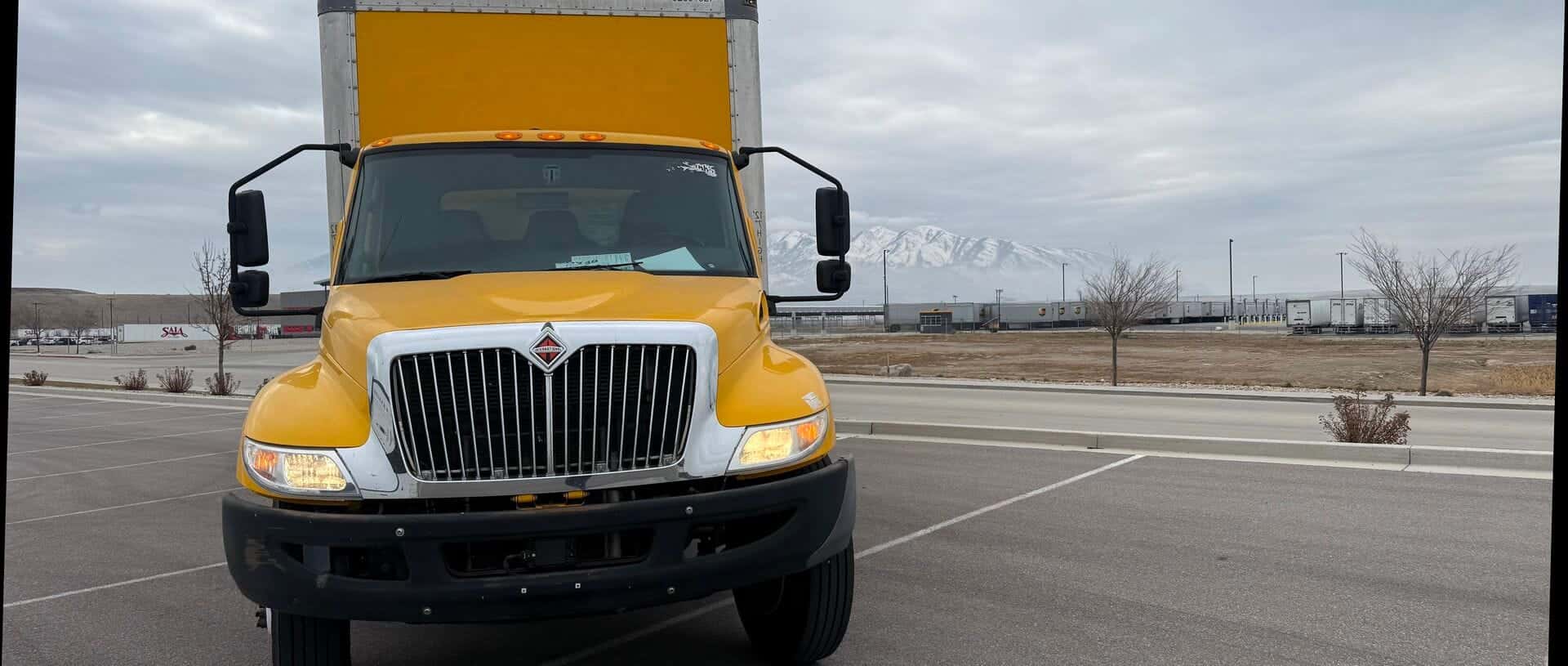
Box truck business startup costs fall into two groups. The government fees are small and fixed: FMCSA charges $300 for operating authority, UCR registration is $55 for a carrier with 0 to 2 trucks for the 2027 registration year, and an EIN from the IRS is free. The big numbers, the truck, insurance and working capital, depend on you, so you price them with real quotes, not averages.
This guide is for anyone pricing a box truck freight business before buying a truck. It is written by a carrier that leases on box truck owner-operators, so it also shows which lines disappear when you run under a carrier's authority.
Key takeaways
- The federal fees are known and small. The truck, insurance and the cash to last until the first payment decide your budget.
- Your authority isn't active until your insurer files proof of coverage, and the federal liability minimum for for-hire, non-hazardous interstate freight in a truck of 10,001 lb GVWR or more is $750,000. The first insurance payment comes before the first load.
- Working capital is the line most startup lists skip. Budget for the weeks you pay running costs before money comes in.
- Leasing on to a carrier usually removes the authority, filing and load board lines. The truck stays yours.
How much does it cost to start a box truck business?
There is no honest single number. Any guide that gives one is guessing about your truck, your driving record and your state. What you can do is sort the budget by how well you can know each line before you spend.
| Cost group | Examples | How to price it |
|---|---|---|
| Government fees | FMCSA authority, UCR, EIN, state business filing | The agency's own fee page |
| The truck | Purchase, loan or lease payments, title, plates | Real listings and a lender's written terms |
| Insurance | Down payment and installments | Written quotes from licensed agents on the exact truck |
| Setup and equipment | ELD, load securing, phone and apps, inspection, repairs | Vendor prices and a mechanic's estimate |
| Working capital | Running costs until the first payment, plus a repair reserve | The formula below, with your inputs |
Only the first group costs the same for everybody. The rest of this guide shows how to fill in the other four.
What are the official government fees?
These fees are set by agencies, not vendors. Check each one on the day you file, because FMCSA is shifting registration to its new Motus system.
| Fee | Amount | Notes |
|---|---|---|
| FMCSA operating authority (MC) | $300 per type of authority | No refunds for mistaken applications. FMCSA lists 20 to 25 business days for new applicants, longer if it reviews the file |
| UCR registration | $55 for 0 to 2 trucks (2027), $46 (2026) | Due every registration year |
| EIN (federal tax ID) | $0 | The IRS never charges for an EIN. Sites that charge are selling an optional service |
| State business filing and annual report | Set by your state | In Florida, Sunbiz lists the fees |
| Truck registration and plates | Set by your state | Usually depends on the truck's weight |
The authority fee and timing are from FMCSA's page on getting operating authority (opens in a new tab). The UCR amounts are from the UCR Plan fee bracket table (opens in a new tab), which says the 2027 fees took effect October 1, 2026.
Two more lines aren't government charges but still belong on the list. A BOC-3 names your process agents in each state, and for a motor carrier it's usually filed by a blanket process agent company that sets its own price. Your proof of insurance is filed with FMCSA by your insurer. Your authority doesn't go active until both are on file. Our guide on how to get box truck authority walks through the filings in order.
The truck: buy, finance or lease?
The truck is the largest line in most box truck business startup costs. Its price depends on model year, mileage, the box, the liftgate and the engine's condition, so we don't publish truck prices. Price the exact truck you would buy, with these lines next to it:
- Purchase or down payment, plus sales tax, title and registration.
- Loan or lease payments, a weekly running cost in your working capital math.
- A pre-purchase inspection by a mechanic who knows medium-duty trucks.
- The first repairs the inspection finds: tires, brakes, liftgate service.
One public financing option is the SBA microloan program (opens in a new tab). It lends up to $50,000 through nonprofit intermediary lenders, for uses that include equipment and working capital, with a maximum term of seven years. Each lender sets its own rates and decides whether to finance a truck, so ask several, and compare any loan or lease on the total paid over the term. Have an accountant or attorney review the terms before you sign.
Buy the truck your future customers will accept. Carriers and brokers set model-year and equipment limits, and "26 ft" describes the box, not the weight rating that decides whether a driver needs a CDL. Our guide to buying a used box truck for freight covers the checks before you pay.
Insurance: what you pay before the first load
With your own authority, insurance is one of the biggest checks you write before you haul anything. Your authority doesn't activate until your insurer files proof of liability coverage, and under 49 CFR 387.9 (opens in a new tab) the federal minimum for for-hire, non-hazardous interstate freight in a truck of 10,001 lb GVWR or more is $750,000. That is a floor. Brokers often ask for higher limits, and many also want cargo coverage.
The startup line usually has three parts:
- Down payment. Commercial auto policies are often paid in installments, with the first due when the policy is bound.
- Installments. A running cost for your working capital.
- The coverages. Auto liability, cargo, physical damage on the truck, and whatever your customers or lender require.
The price depends on the driver's record and experience, the truck's value, where it's garaged, the freight, your limits and deductibles, and how new your authority is. Get written quotes on the exact VIN before you buy the truck, and ask a licensed insurance agent which coverages your customers and lender will require. Our guide to box truck insurance for owner-operators compares what you carry with your own authority and when you lease on.
Setup costs people forget
Small lines, but together they can break a tight budget. Get a price for each:
- ELD. Hours-of-service rules apply to interstate trucks of 10,001 lb GVWR or more, and many need an electronic logging device. Count the device and the plan.
- DOT medical card. Interstate drivers of these trucks need one.
- Periodic inspection. Required every 12 months, with proof carried on the truck.
- Load securing. Straps, load bars and blankets, plus e-track if the box lacks it.
- Liftgate service, if the truck has one.
- Phone, data and apps for dispatch, BOL and POD photos, and the ELD.
- Load board subscription, if you'll find your own freight.
- Bookkeeping and tax help. An accountant at the start costs less than untangling a year of mixed spending.
Costs you can usually leave off the list
Several startup guides add costs that don't apply to a typical box truck. Check your own truck, but these usually stay off:
- Heavy vehicle use tax. IRS Form 2290 (opens in a new tab) covers vehicles with a taxable gross weight of 55,000 lb or more. A two-axle box truck rated at or under 26,000 lb GVWR is far below it.
- IFTA and IRP. The fuel tax agreement and apportioned plates apply to two-axle trucks over 26,000 lb, trucks with three or more axles, or a truck and trailer combined over 26,000 lb. Confirm with your base state's IFTA and IRP office.
- A CDL. Not needed for a single truck under 26,001 lb GVWR with no placarded hazmat. Federal DOT drug and alcohol testing covers drivers who must hold a CDL, so on a non-CDL truck any testing is a customer's or carrier's own policy.
- Paid filing services. They charge for filings you can make yourself with the IRS, FMCSA and your state. Optional.
Tax and registration rules have exceptions, so check your own setup with a tax professional before you leave a line off.
How much working capital do you need?
Working capital is the cash that keeps the truck running between your first expense and your first payment. Many startup lists leave it out, and running short can park a truck that would otherwise earn. Use this formula:
Working capital = (weeks before money arrives × weekly running costs) + repair reserve
- Weeks before money arrives: setup weeks before the first load, plus the payment terms on your first loads. With your own authority, that's the broker's terms unless you pay for quick pay or factoring. Leased on, it's the carrier's settlement schedule.
- Weekly running costs: fuel, insurance installments, truck payments, ELD and phone, tolls, and what you need to live on.
- Repair reserve: cash for a breakdown, because a truck in the shop still has payments due.
For fuel, use public data. The U.S. Energy Information Administration's weekly diesel price survey (opens in a new tab) showed a U.S. average on-highway diesel price of $6.382 per gallon for the week of September 28, 2026, and $5.953 in the Lower Atlantic region, which includes Florida. Prices include taxes and update weekly, so pull the latest for your region. If your truck runs on gasoline, use EIA's gasoline price instead.
Hypothetical example. Example only, not a quote, a typical figure or a Cobra US Cargo rate. Every input except the EIA price is assumed, and living costs are left out to keep the math simple.
| Input | Value |
|---|---|
| Miles per week (assumed) | 1,500 |
| Fuel economy (assumed) | 10 mpg |
| Diesel (EIA U.S. average, week of Sep 28, 2026) | $6.382 per gallon |
| Fuel per week (150 gallons) | $957.30 |
| Insurance, truck payment, ELD and apps, tolls (assumed placeholders: $600 + $500 + $100 + $200) | $1,400 |
| Weekly running costs | $2,357.30 |
| Weeks before money arrives (assumed: 2 setup + 4 payment terms) | 6 |
| Repair reserve (assumed placeholder) | $5,000 |
| Working capital: (6 × $2,357.30) + $5,000 | $19,143.80 |
Your own quotes will change the result, maybe a lot. The structure is the point: the longer you wait for the first payment, the more cash you need on day one. For the ongoing math after startup, read is a box truck business profitable.
Box truck business startup costs worksheet
Copy this into a spreadsheet. Fill in only numbers you got in writing or from an official source.
| Line item | One-time or recurring | Your quote |
|---|---|---|
| FMCSA operating authority | One-time | |
| BOC-3 process agent filing | One-time, kept current | |
| UCR registration | Every registration year | |
| State business filing and annual report | One-time, then yearly | |
| Truck purchase or down payment | One-time | |
| Sales tax, title, registration and plates | One-time, then yearly | |
| Pre-purchase inspection and first repairs | One-time | |
| Insurance down payment | Each policy term | |
| ELD device and plan | One-time, then monthly | |
| DOT medical exam | When the card expires | |
| Load securing gear | One-time | |
| Phone, apps and load board | Monthly | |
| Bookkeeping and tax help | Monthly or yearly | |
| Working capital | Cash reserve | |
| Total before the first load |
How leasing on changes the startup budget
Leasing on means your truck runs under an authorized carrier's MC number, USDOT number and insurance filings, under a written lease. No other choice changes the startup list as much.
| Line item | Your own authority | Leased on to a carrier |
|---|---|---|
| FMCSA authority fee and BOC-3 | You pay and file | Not needed |
| UCR registration | You register | Usually the carrier's, confirm in the lease |
| Federal liability filing | Your policy, filed by your insurer | The carrier's, while you're under dispatch |
| Cargo, physical damage, off-dispatch coverage | You buy them | Split set by the lease |
| The truck, repairs and inspections | Yours | Still yours |
| Finding loads | You, a dispatcher or load boards | The carrier's dispatch |
| Getting paid | Broker terms, or a factoring fee | The carrier's settlement schedule |
The truck, its upkeep and a cash reserve stay on your list either way. What usually goes away are the filings, the load board and the hurdle of a brand-new authority that brokers haven't vetted yet. Read every line of the lease, because it decides who pays for what, and have an attorney review it if anything is unclear.
Cobra US Cargo LLC is a Miami-based interstate carrier with its own authority (MC-1645621, USDOT 4247005), fully insured to industry standard, and we want to be the first carrier partner for new box truck owners. Leased on to our MC, you get dispatch in English and Spanish that finds and books the loads, help getting the right insurance in place, ELD and compliance support, a fuel card with fuel discounts, startup guidance and weekly pay. The figure we share is $6K–$10K a week in gross. Gross revenue before fuel, insurance and other expenses. Results vary by truck, availability and lanes. For the pay structure, deductions and the insurance split, contact us for details.
We look for a 26 ft box truck, 2018 or newer, and owner-operators anywhere in the US are welcome. Fleet owners can put a hired driver in their truck if that driver meets our driver requirements. No trucking experience is needed to start the conversation, so if you're still pricing trucks, talk to us before you buy: see how leasing on cuts the startup list.
Sources
- FMCSA — Get Operating Authority (Docket Number) (opens in a new tab)
- Unified Carrier Registration Plan — Fee Brackets (opens in a new tab)
- eCFR — 49 CFR 387.9, Financial responsibility, minimum levels (opens in a new tab)
- IRS — About Form 2290, Heavy Highway Vehicle Use Tax Return (opens in a new tab)
- U.S. Small Business Administration — Microloans (opens in a new tab)
- U.S. Energy Information Administration — Gasoline and Diesel Fuel Update (opens in a new tab)