
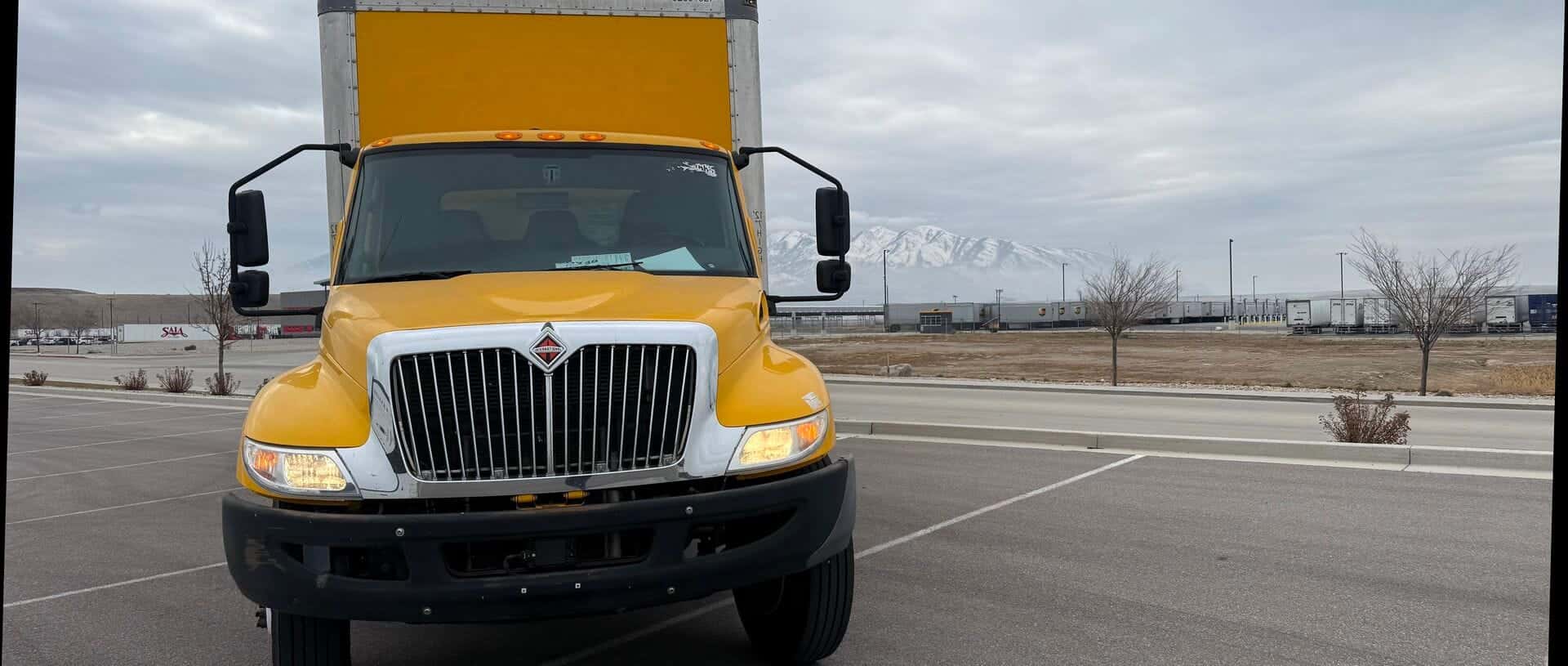
Buying a used box truck for freight comes down to three checks before you pay. The truck must match what your carrier and its brokers accept: box length, a usable door and a model year inside the carrier's cutoff. The GVWR on its certification label must keep it non-CDL, if that is your plan. And the box, liftgate, engine, title and recall record must hold up to a real inspection.
This checklist is for anyone buying a first or second straight truck to haul commercial freight, leased on to a carrier or under their own authority. It quotes no truck prices, since those change by unit and week. It is general information, not legal, tax or insurance advice; confirm those with an attorney, accountant or licensed insurance agent.
Key takeaways
- Get your carrier's equipment requirements in writing before you shop.
- "26 ft" is the box length, not the weight rating. The GVWR on the final-stage label, plus what the truck weighs loaded, decides whether the driver needs a CDL.
- Inspect the box, floor, roll-up door and liftgate as carefully as the engine. They decide what freight the truck can take.
- Run the VIN for open recalls and title brands, and use the federal annual inspection list as your mechanic's checklist.
Buying a used box truck: what do carriers and brokers accept?
Start with the buyer of your service, not the seller of the truck. A sound truck is still the wrong truck if your carrier won't take it or brokers keep turning it down. Carriers that lease on box trucks set their own equipment rules, from just a box length and model-year cutoff to a liftgate and more. Brokers book by spec and commonly ask about box length, door height, liftgate, pallet count and payload.
| Spec | Why it matters | How to check it on a used truck |
|---|---|---|
| Box length | Postings often name a length, and 26 ft is a common ask. A shorter box loses pallet positions | Tape-measure the inside floor, front wall to rear door frame |
| GVWR | Rated 26,000 lb or less, and loaded within that, keeps a straight truck under the CDL weight line | Final-stage certification label on the driver's door frame |
| Model year | A carrier may set a cutoff for leased equipment | Title and registration, and the model-year character in the VIN |
| Rear door opening | A pallet or crate can fit the box and still miss the door | Measure the clear opening height and width yourself |
| Liftgate | Opens up deliveries to places without a dock | Data plate (capacity and platform size), then run it |
| Load securing | Pallets have to stay put through braking and turns | E-track or logistics posts, solid anchor points |
| Logging | A model-year 2000 or newer truck needs an ELD when its interstate driver must keep logs, unless an exception such as short-haul fits (see our box truck ELD requirements) | Ask what the seller ran; plan for your carrier's device |
| Title | Salvage or flood brands can make financing, insurance and carrier approval harder | Federal title database search by VIN |
For pallet math and inside dimensions, see our guide to 26 ft box truck capacity.
Is a used box truck really non-CDL? Read the GVWR label
"26 ft" describes the box. The chassis under it can be rated at 25,999 lb or well above 26,000 lb, and "no CDL" in a listing is the seller's claim, not proof. The gross vehicle weight rating (GVWR) on the label settles it.
Most box trucks are built in stages: a chassis maker, then a body builder. Under 49 CFR 567.5 (opens in a new tab), the final-stage manufacturer must put its own certification label on the finished truck, without covering the earlier labels. That label names the final-stage manufacturer and shows the month and year the truck was completed, its GVWR, each axle's weight rating and the VIN. Look on the driver's door-latch post, hinge pillar or door edge, or on the left side of the dash if none of those works. Read the final-stage label, not the chassis maker's.
The commercial motor vehicle definition in 49 CFR 383.5 (opens in a new tab) puts a straight truck in Group B when its GVWR or its actual gross weight is 26,001 lb or more, whichever is greater. Two traps follow from that wording:
- Overloading a non-CDL truck. A truck rated at 25,999 lb that scales at 26,500 lb counts as a CDL vehicle on that trip, and it is over its rating besides.
- Towing. Hook a trailer rated over 10,000 lb to a box truck and the combination can land in Group A, which takes a Class A CDL.
If a seller says the truck was "derated" to get under 26,001 lb, ask for the paperwork and the label. Under 49 CFR 567.7 (opens in a new tab), whoever alters a certified vehicle must leave the original label in place and add their own, showing who altered it, when, and any changed GVWR. No alterer's label is a reason to walk away. Even with one, ask your carrier and insurance agent whether they accept a re-rated truck.
Work out the real payload
GVWR is the limit for truck plus everything in it, not the cargo allowance. Weigh the truck on a certified scale with full fuel, the driver and your gear aboard, then subtract.
Hypothetical example, not a real truck: assume a label GVWR of 25,999 lb and a scale ticket of 16,500 lb with fuel, driver and gear. Payload is 25,999 − 16,500 = 9,499 lb. That number, not "26,000," is what you can offer a broker. For the driver side, see our non-CDL box truck driver requirements.
How to inspect the box, floor, roll-up door and liftgate
When buying a used box truck, inspect the box as hard as the engine. It earns the money, and it hides the most wear. Bring a flashlight, a tape measure and someone to run the liftgate while you watch.
- Roof and walls. Stand inside with the door closed in daylight. Pinholes of light mean water will reach the freight. Look for patches and delaminating panels.
- Floor. Walk the full length, especially the rear third, where pallet jacks do the most damage. Price soft spots, broken boards, rot and fresh plywood laid over old damage.
- Roll-up door. Cycle it several times. It should run smoothly, stay up on its own and seal at the bottom. Check rollers, track, springs and lock.
- Rear frame. Check the door header, corner posts and bumper for impact damage. A bent header shrinks the door opening.
- Securement. E-track rails should be solidly bolted, not pulling out of the wall. Count the straps and load bars that come with the truck.
- Liftgate. Read the data plate for rated capacity and platform size. Run several full cycles, loaded if the seller allows. Look for hydraulic leaks, a platform that drifts when stopped, cracked welds and a slow motor. Ask whether parts are still available.
Engine, transmission and maintenance records
Photos tell you little; records and a cold start tell you a lot. Ask the seller not to run the truck before you arrive.
- Cold start and idle. Listen for knocks and ticks. Watch the exhaust: heavy smoke on startup or under load needs explaining.
- Warning lights and codes. Lights should come on at key-on, then go out. Have a mechanic scan for stored fault codes, including emissions codes.
- Odometer vs engine hours. A low-mileage truck with very high engine hours spent a lot of time idling, and idling wears an engine too.
- Transmission. On the test drive, shifts should be smooth, with no slipping, flare or delayed engagement. Check the fluid color and smell.
- Records. Oil, brake, transmission and emissions work with dates and mileage, plus the latest annual inspection report. No records should lower your offer or end the deal.
Then pay for a pre-purchase inspection by a shop that works on medium-duty trucks, not a car shop. It can catch problems that would cost far more to fix than the inspection itself.
Recall, title and history checks before you pay
Run the VIN before you travel.
Open recalls. NHTSA's recall lookup (opens in a new tab) shows unrepaired safety recalls by VIN for vehicles from certain manufacturers. It doesn't show recalls more than 15 years old, unless the manufacturer offers more coverage, or recalls by small vehicle manufacturers and specialty applications. So the chassis can come back clean while a body or liftgate maker's campaign doesn't appear. Ask who built the box and the gate, and check those makers too.
Title brands and odometer. The Department of Justice's National Motor Vehicle Title Information System (NMVTIS) (opens in a new tab) shows a vehicle's title brand history, such as "junk," "salvage" or "flood," its latest reported odometer readings and any insurer salvage or total-loss determination. Once a state brands a vehicle, the brand stays on its NMVTIS record even if it is retitled elsewhere. Two limits matter for trucks: not every state brands floods, and states only have to report common automobiles, so a clean report is not proof. Ask for the state's full title record too. In hurricane states, take any flood history seriously: water damages wiring, sensors and liftgate electrics long after the truck looks dry.
Ownership. The name on the title should match the seller's ID or business, with no lienholder listed unless you get a lien release at closing. The VIN on the title, the chassis plate and the certification label should all match.
Will it pass the annual DOT inspection?
Under 49 CFR 396.17, any truck rated at 10,001 lb or more that hauls freight interstate must have passed a periodic inspection within the past 12 months, with proof on the truck. The minimum items are listed in Appendix A to 49 CFR Part 396 (opens in a new tab), which older guides still call "Appendix G." It's a ready-made pass-or-fail list for buying a used box truck, so have your mechanic follow it.
| Appendix A item | A box truck fails if, for example | What it means for a buyer |
|---|---|---|
| Brakes | Missing or broken parts, a visible hydraulic fluid leak or an audible air leak at a chamber, or linings below the minimum thickness | Price any brake work before you agree on a number |
| Exhaust | A leak forward of or directly below the cab | Fumes in the cab, and often a sign of other neglect |
| Fuel system | A visible leak, a missing filler cap or a loose tank | Often a simple fix, but it has to pass before the truck works |
| Lighting | Any required light or reflector not working | Check the box marker lights too, not just the cab |
| Steering and suspension | Too much steering-wheel free play, cracked or welded steering parts, or broken or missing spring leaves and U-bolts | Costly, and they affect handling when loaded |
| Frame | Cracked, broken, loose or sagging frame members, or the body touching a tire | Frame damage on a box truck can end the deal |
| Tires | Steering-axle tires under 4/32 in of tread, other tires under 2/32 in, or exposed belts and separations | Measure tread, because a full set is a big line item |
| Wheels, windshield, wipers | Cracked wheels, loose or missing wheel fasteners, windshield damage beyond the allowed limits, or a dead wiper | Small items that still fail the truck |
Passing doesn't make a truck a good buy. Failing several items shows what the last owner skipped.
Buy, finance or lease the truck?
Paying cash for a used box truck means no payment, but it can drain the money you need for the first weeks and the early repairs a used truck often needs. Financing keeps cash in the bank but adds a fixed payment, and lenders typically require physical damage coverage on the truck, so ask your insurance agent what it costs. Compare offers on the total paid over the term, not the weekly payment.
"Lease" means two things here. An equipment lease or lease-purchase is a way to pay for the truck: a leasing company owns it while you make payments, sometimes with a balloon at the end and mileage limits. A lease on is the agreement that puts a truck you control under a carrier's operating authority. You can have both, with separate paperwork. In an equipment lease, read who maintains the truck, what happens if it breaks down and when the title becomes yours, and have an attorney review it before you sign. Ask an accountant how each option affects your taxes. Our guide to box truck business startup costs has a worksheet for the money side.
Once you own it, our guide on what to do after you buy a box truck covers the first 30 days.
Talk to the carrier before you buy
Cobra US Cargo LLC is a Miami-based interstate carrier with its own authority (MC-1645621, USDOT 4247005), fully insured to industry standard. We run our fleet of 26 ft box trucks plus a growing owner-operator program and want to be the first carrier partner for people buying a used box truck. The only truck requirement is a 26 ft box truck, 2018 or newer, so bring the listing and talk to a carrier before you buy. You lease on to our MC, and we bring dispatch that finds and books the loads, help getting the right insurance in place, ELD and compliance support, a fuel card and fuel discounts, startup guidance and weekly pay.
Owner-operators anywhere in the US are welcome, and dispatch speaks English and Spanish. No trucking experience is needed to start the conversation: contact us and we'll walk you through it. Driver qualification rules still apply to whoever drives. Fleet owners can put a hired driver in the truck, as long as that driver meets our driver requirements. The figure we share is $6K–$10K a week in gross. Gross revenue before fuel, insurance and other expenses. Results vary by truck, availability and lanes. For pay structure, deductions and the insurance split, contact us for details.
Sources
- eCFR — 49 CFR 567.5, Requirements for manufacturers of vehicles manufactured in two or more stages (opens in a new tab)
- eCFR — 49 CFR 567.7, Requirements for persons who alter certified vehicles (opens in a new tab)
- eCFR — 49 CFR 383.5, Definitions (commercial motor vehicle for CDL purposes) (opens in a new tab)
- eCFR — Appendix A to 49 CFR Part 396, Minimum Periodic Inspection Standards (opens in a new tab)
- NHTSA — Check for Recalls: Vehicle, Car Seat, Tire, Equipment (opens in a new tab)
- U.S. Department of Justice, NMVTIS — For Consumers (opens in a new tab)