
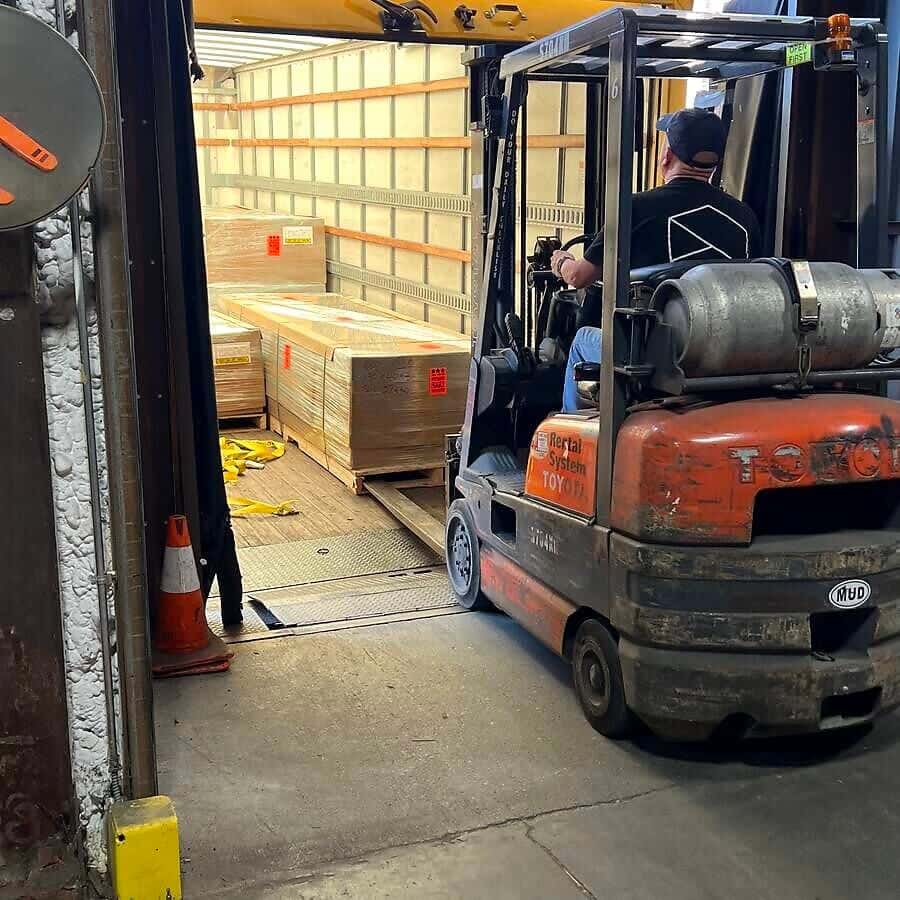
New Jersey warehouse delivery mostly means a distribution center along the New Jersey Turnpike: the Exit 8A cluster in Central Jersey, the Meadowlands, or the warehouses around Port Newark and Elizabeth. Getting unloaded on time comes down to three things: a booked appointment, correct paperwork and the right truck. From Miami the run is about 1,200 to 1,280 miles, a typical 2 to 3 days with a solo driver.
This guide is for shippers, brokers and dispatchers sending freight to New Jersey receivers, especially from Florida. It covers the delivery side that rate quotes skip: the freight areas, check-in and unloading, what the port rules really cover, and the road and toll rules for a box truck.
Key takeaways
- Large New Jersey DCs usually receive by appointment only. Book the slot against the PO or load number, and put that number on the tender and the BOL.
- Lumpers are common at retail and grocery DCs. Agree in writing who pays before dispatch, and keep the receipt.
- The Port Newark–Elizabeth terminals are set up for container drayage. Box-truck freight usually delivers to the warehouses around the port, not the terminal gates.
- A 26 ft box truck is a Class 2 vehicle on the Turnpike, and it is barred from the Garden State Parkway north of Interchange 105.
Where are New Jersey's main warehouse areas?
New Jersey's warehouse market follows the Turnpike. Port-area buildings handle imports, Exit 8A and Burlington County run big regional DCs, and the Meadowlands and Edison serve the New York City market. For any New Jersey warehouse delivery, the cluster tells you a lot about the dock before the truck arrives.
| Area | Turnpike exits and highways | Typical receivers | Dock notes |
|---|---|---|---|
| Exit 8A / Exit 7A, Central Jersey (Cranbury, Monroe, South Brunswick, Robbinsville) | Interchange 8A; 7A for I-195 | Large retail, e-commerce and 3PL distribution centers | Appointment-only, guard-shack check-in, lumpers common, long yard lines at busy hours |
| Burlington County (Florence, Bordentown, Burlington) | Interchanges 6 and 7, Pennsylvania Turnpike connector | Regional DCs and 3PLs | Similar to 8A: big buildings, scheduled docks |
| Edison and the I-287 corridor | Interchanges 9 and 10, I-287 | 3PLs, wholesalers, mid-size B2B receivers | Mix of older and newer buildings; some ground-level doors |
| Port Newark–Elizabeth area (Newark, Elizabeth, Carteret, Linden) | Interchanges 12, 13, 13A and 14, I-78 | Import transload, cross-dock and container freight buildings | Strict gate check-in, heavy container traffic during terminal hours |
| Meadowlands (Secaucus, Carlstadt, East Rutherford, Kearny) | Western spur 15W–18W, eastern spur 15X–17, NJ 3 | Older multi-tenant warehouses serving North Jersey and NYC | Tighter yards and shorter docks; good box-truck territory |
When a tender just says "Cranbury" or "Secaucus," look up the building before dispatch. A unit in a multi-tenant Meadowlands building and a giant DC off Exit 8A are very different deliveries.
How New Jersey warehouse delivery appointments work
A warehouse delivery appointment is a reserved time at a dock door, booked against a purchase order, load number or ASN. At most New Jersey DCs, no appointment means no unload. The process usually runs like this.
- Booking. The shipper, broker or carrier requests a slot through the receiver's scheduling contact or online portal. You will need the PO or load number, pallet or carton count, and often the carrier name. Book as soon as the pickup date is firm, because popular morning slots at large DCs fill early.
- Confirmation. The receiver issues an appointment or confirmation number. Put it on the rate confirmation and the BOL, and send it to the driver.
- Check-in. At the gate or receiving window, the driver gives the appointment number, PO, BOL and seal number if the load is sealed. The guard assigns a door or sends the truck to wait in the yard.
- Unload and count. The receiver or a lumper crew unloads, counts and checks the freight against the PO.
- Sign-out. The receiver signs the BOL, which becomes the proof of delivery. Shortages, overages and damage get written on it at the dock, not later.
What to have ready at check-in:
| Item | Why the dock asks for it |
|---|---|
| Appointment or confirmation number | Proves the slot is yours |
| PO or load number | Matches the freight to what the receiver ordered |
| Bill of lading | Piece count, weight and the receiver's signature line |
| Seal number, if sealed | The receiver checks it before the doors open |
| Lumper payment method | So unloading isn't held up at the window |
Late arrivals. Some DCs allow a short grace window, and some won't take a late truck at all. A late truck may be worked in if a door opens up, or rescheduled to another day. Call the receiver as soon as the driver knows they'll miss the slot. An early call saves the appointment far more often than a silent late arrival.
Detention. The detention clock usually starts after a set amount of free time past the appointment, and only if the truck arrived on time. Yard waits at busy DCs are common, so put detention terms on the rate confirmation. See freight accessorial charges for detention, layover and redelivery.
Unloading at New Jersey DCs: lumpers, floor-loaded freight and pallet rules
Many large retail and grocery distribution centers don't let drivers unload. They use a contracted crew, called a lumper, and charge a fee to unload. Each receiver sets its own price, so ask the receiver or broker ahead of time.
Federal law is clear about who is responsible. Under 49 U.S.C. 14103 on loading and unloading (opens in a new tab), a shipper or receiver that requires a driver to be assisted must provide that help or pay the trucker's costs for it. The same section makes it unlawful to coerce a carrier into loading, unloading or paying people to do it. In practice, the money usually moves like this:
- The broker or shipper confirms the lumper in the rate confirmation and provides payment, often as an electronic payment code.
- The driver pays at the receiving window and gets a lumper receipt showing the facility, date, amount and PO.
- The carrier bills the receipt back with the invoice. No receipt, no reimbursement, so drivers should never leave without one.
Floor-loaded vs palletized freight. Floor-loaded cartons take much longer to unload than pallets, and lumper services often charge more for them. If your freight ships floor-loaded, tell the receiver when you book, since some DCs give floor loads longer or separate appointment slots.
Pallet rules. Large DCs often publish routing guides with their own rules: pallet type and condition, maximum height, stretch-wrap, labels and whether they exchange pallets. A pallet that breaks the guide can be refused or reworked at your cost. Ask for the receiver's routing guide when you book.
POD exceptions. Count and inspect before signing, and write any shortage, damage or refused pieces on the BOL. A clean signature followed by a claim a week later is hard to win.
Delivering near Port Newark and Elizabeth
Port Newark and the Elizabeth marine terminal make up the core of the Port of New York and New Jersey's container business. The gate rules are written for container drayage rigs.
The Port Authority's marine terminal tariff (FMC Schedule PA-10) (opens in a new tab) requires every drayage truck seeking entry to a Port Authority terminal to be registered in the Drayage Truck Registry (DTR) before it arrives. It also sets engine model-year limits for those trucks. The same tariff requires anyone who needs unescorted access to secure areas to display a Transportation Worker Identification Credential (TWIC), the federal ID card for port workers.
The point most guides miss: the tariff defines a drayage truck as an on-road vehicle with a gross vehicle weight rating over 33,000 lb. A 26 ft box truck under 26,000 lb isn't the vehicle those gate rules describe. That isn't a free pass, because the tariff still limits who may enter terminal areas. Container terminals are built to swap boxes on chassis, not to receive pallets off a box truck.
So in practice, box-truck freight in the port area goes to the buildings around the terminals: transload warehouses, cross-docks, container freight stations and DCs in Newark, Elizabeth, Carteret and Linden. That is what Port Newark–Elizabeth warehouse delivery usually means. If a consignee address points at a marine terminal, confirm the receiving building before you book.
For timing, expect heavy container traffic around the port during terminal gate hours, and leave margin on the approaches to Interchanges 13A and 14, which also serve Newark Liberty International Airport. Port-area buildings often want ID and the appointment number at the gate, and some ask for the driver's name in advance.
Tolls and roads: the NJ Turnpike and Garden State Parkway for trucks
NJ Turnpike truck tolls. Turnpike tolls are set by vehicle class and the distance between entry and exit interchanges. The NJ Turnpike Authority's vehicle class definitions (opens in a new tab) put a two-axle, dual-tire vehicle in Class 2. That covers a typical 26 ft box truck with dual rear wheels. A tractor pulling a 53 ft trailer usually runs five axles, which is Class 5. Check the Authority's toll calculator for current rates, and make sure the E-ZPass account carries the right class.
| Vehicle | Axles | NJ Turnpike class |
|---|---|---|
| 26 ft box truck, dual rear wheels | 2 | Class 2 |
| Tractor with a 53 ft trailer (typical) | 5 | Class 5 |
Lane rules. The Authority's rules at N.J.A.C. 19:9-1.9 (opens in a new tab) keep vehicles over 10,000 lb GVWR out of the far-left lane on three-lane stretches of the Turnpike, out of the two left lanes where there are four or more, and out of any lane signed "Cars Only." A 26 ft box truck's GVWR is well over that limit.
Garden State Parkway. The same rule bars commercial vehicles over 10,000 lb GVWR from the Parkway north of Interchange 105 in Monmouth County, unless they hold a special permit. A 26 ft box truck is a commercial vehicle rated well over 10,000 lb, so North Jersey deliveries use the Turnpike, I-287, I-78 and other truck-legal roads. Car navigation apps often route through the Parkway, so use truck routing.
New Jersey's large-truck network. NJDOT's truck routing rules (opens in a new tab) require large trucks to use the National Network, which is mostly Interstates, the Turnpike and the Atlantic City Expressway. They can leave it for food, fuel, rest or repairs, or to reach a terminal by the shortest route. The rules apply to double-trailer combinations and "102-inch-wide standard trucks."
That second category is often misread. The N.J.A.C. 16:32-2.1 definitions (opens in a new tab) describe it by width, over 96 and up to 102 inches, plus a length condition from state law, not by whether the truck pulls a trailer. The same section counts a distribution center as a "terminal." For a box truck, check the body width on the spec sheet against the definition. When in doubt, plan as if the rules apply: highway to the nearest exit, then the most direct legal route to the dock. Posted weight limits and local "No Trucks" signs apply to every truck either way.
When a 26 ft liftgate box truck beats a 53 ft trailer in New Jersey
Big DCs off Exit 8A are built around 53 ft trailers, and a full truckload of 20-plus pallets belongs in one. A box truck still backs into the same doors, and the dock leveler usually bridges the height difference. But plenty of New Jersey freight never goes to a mega-DC. A 26 ft box truck carries up to 12 standard pallets, weight permitting, and it wins in these cases:
- Smaller receivers. Retail stores, showrooms, distributors and light-industrial units in older North Jersey buildings, often with a ground-level door instead of a dock.
- No dock at all. A hydraulic liftgate lowers each pallet to the ground. See our liftgate delivery service for what the site needs.
- Tight urban yards. Meadowlands and port-area buildings with short aprons are hard work for a 70-plus-foot rig. A box truck turns in and out easily.
- Partial loads. Six or eight pallets don't need a full trailer, and the box truck runs direct with no cross-dock.
- Mixed New Jersey and New York City drops. A box truck can unload in Secaucus and then cross into the boroughs, where a 53 ft trailer faces strict route and length limits. Our guide to NYC truck delivery rules covers truck routes, curbs and tolls on that side of the river.
How Cobra US Cargo runs Florida ⇄ New Jersey
New Jersey warehouse delivery is core work on our I-95 corridor, and we run Florida ⇄ New Jersey in both directions. Our fleet of 26 ft liftgate box trucks, plus a growing owner-operator program, covers Exit 8A, Burlington County, Edison, the Meadowlands and the port-area warehouses. From South Florida, the typical Florida to New Jersey freight transit time is 2 to 3 days. Freight stays in one box from pickup to the New Jersey dock, with updates at pickup, in transit and at delivery, and a signed POD at the end. Our trucks are fully insured to industry standard.
For receivers inside New York City, the same trucks run our Miami to New York freight target lane. For pickup areas, distances and the southbound leg, see the Florida to New Jersey freight lane page. If the same freight moves every week, set it up as one of our dedicated lanes for brokers.
Sources
- Port Authority of NY & NJ — Marine Terminal Tariff FMC Schedule PA-10 (effective March 10, 2026) (opens in a new tab)
- U.S. Code (GovInfo) — 49 U.S.C. 14103, Loading and unloading motor vehicles (opens in a new tab)
- New Jersey Turnpike Authority — Vehicle Class Definitions (opens in a new tab)
- N.J.A.C. 19:9-1.9 — Limitations on use of Roadway (Turnpike and Parkway), via Cornell LII (opens in a new tab)
- NJDOT — Truck Routing (N.J.A.C. 16:32 large truck rules) (opens in a new tab)
- N.J.A.C. 16:32-2.1 — Definitions (Truck Access), via Cornell LII (opens in a new tab)