
NYC truck delivery rules come down to five things. The truck stays on designated truck routes and leaves them only to reach its stop. It pays the Congestion Relief Zone toll in Manhattan at or below 60th Street. It fits city size limits, which rules out 53 ft trailers. It parks only where commercial vehicles may. And it arrives inside the receiver's window.
This guide is for shippers, receivers and brokers sending freight into the five boroughs. It is current as of October 2026, after the October 4 truck route change and September's off-hour delivery funding.
Key takeaways
- NYC's redesigned truck route network took effect October 4, 2026. DOT plans a new printed map in 2027.
- A box truck pays $14.40 to enter the Congestion Relief Zone at peak with E-ZPass, or $3.60 overnight.
- 53 ft trailers can't leave the through interstates to deliver. Box trucks and straight trucks fill that gap.
- In parts of Midtown and the Financial District, vehicles 33 ft or longer face weekday time bans. Many 26 ft box trucks are that long bumper to bumper.
- Receivers that take freight between 7 p.m. and 6 a.m. can apply for a share of a new $5 million incentive fund.
What are the NYC truck delivery rules?
For city traffic rules, a truck is any vehicle built to carry property that has two axles and six tires, or three or more axles. A 26 ft box truck with dual rear wheels qualifies, even under 26,000 lb and without a CDL, so it follows the same routing rules as a tractor-trailer. The NYC DOT trucks and commercial vehicles page (opens in a new tab) collects the rules and the current map for a route network of nearly 1,000 miles.
| Rule | What it means for a box truck delivery | Where it applies |
|---|---|---|
| Truck routes | Stay on designated routes, and leave them only to reach your stop | All five boroughs |
| Bill of lading | Driver carries a BOL or similar document showing origin and destination | All five boroughs |
| Parkways | Closed to commercial vehicles, except one Grand Central Parkway segment | Citywide |
| Congestion Relief Zone toll | $14.40 peak or $3.60 overnight with E-ZPass | Manhattan at or below 60th Street |
| Size limits | Single unit up to 35 ft long, 8 ft wide, 13 ft 6 in high | Citywide |
| 53 ft trailers | Through interstates only, with no city-street deliveries | Citywide |
| Vehicles 33 ft or longer | Weekday time bans in set areas | Garment District, Midtown core, Financial District |
| Parking | 3-hour limit, and no parking on residential streets overnight | Citywide, unless signs say otherwise |
| Idling | 3 minutes maximum, or 1 minute next to a school or park | Citywide |
How do NYC truck routes work (local vs through routes)?
NYC truck routes come in two main types. Through Truck Routes are mostly expressways and major arterials. A truck with no origin or destination in a borough must stay on them while it crosses that borough. Local Truck Routes serve trucks with a pickup, delivery or service stop in the borough. Staten Island also has Limited Local Truck Routes open only to trucks with two axles and six tires.
The last-mile rule is precise. Leave the truck route at the intersection nearest your destination that gives the most direct path. Follow street directions and turn restrictions, then return to the nearest truck route by the most direct route. If you have more stops close by, you can drive straight from one to the next, as long as you don't have to cross a truck route to get there.
The driver must also carry a bill of lading or similar document showing the trip's origin and destination, and show it to police on request. That paper proves a side-street stop is legitimate, so put the full delivery address on the BOL. Enforcement doesn't need signs, and posted height limits apply on every street. Use a commercial truck GPS, not a car app.
What changed in NYC truck routes in October 2026?
NYC DOT adopted an amendment to the citywide truck route rule (34 RCNY 4-13) in September 2026, effective October 4, 2026. The adopted rule on the NYC Rules site (opens in a new tab) carries out the network redesign that Local Law 171 of 2023 required. It rewrites the route lists in every borough. The changes that matter most for deliveries:
- Manhattan's Limited Truck Zones are gone. The zones in Chelsea, Chinatown, Greenwich Village, Little Italy and the Lower East Side are deleted. Standard local truck route rules now apply there.
- Flatiron moved from Broadway to 5th Avenue. Broadway from 17th to 31st Street is off the local route list, and 5th Avenue from 31st Street down to 14th Street is on it. For a receiver on Broadway in the 20s, approach on 5th Avenue and use the nearest cross street.
- Chinatown access changed. East Broadway from Pike Street to Chatham Square is now a local truck route.
- Routes were added and removed in every borough. The redesign aims to move heavy trucks onto highways and into industrial areas, and off residential streets.
- Some proposals were dropped. After strong community opposition, DOT pulled the proposed additions on 3rd Avenue from 65th to 86th Street and on 86th Street in Bay Ridge.
- Manhattan's 33 ft rules stayed. The length limits covered below were left in place.
DOT says a new printed truck route map is coming in 2027. Until then, check routes near the changes against DOT's current map, because GPS databases lag.
How much is the congestion pricing toll for a box truck?
The MTA Congestion Relief Zone toll (opens in a new tab) covers Manhattan at or below 60th Street. It excludes the FDR Drive (closed to trucks anyway), the West Side Highway (Route 9A) and the Hugh L. Carey Tunnel connections to West Street. MTA bills non-articulated trucks, such as a 26 ft box truck, as small trucks. Tractor-trailers are large trucks.
| Vehicle class (E-ZPass) | Peak toll | Overnight toll | Peak tunnel credit, up to |
|---|---|---|---|
| Small truck (26 ft box truck, straight truck) | $14.40 | $3.60 | $7.20 |
| Large truck (tractor-trailer) | $21.60 | $5.40 | $12.00 |
| Passenger vehicle, for comparison | $9.00 | $2.25 | $3.00 |
Peak hours run 5 a.m. to 9 p.m. on weekdays and 9 a.m. to 9 p.m. on weekends. Overnight rates are 75% lower. A truck entering at peak through the Lincoln, Holland, Queens-Midtown or Hugh L. Carey tunnel with E-ZPass gets a credit of up to $7.20. Without a valid E-ZPass, it pays the higher Tolls by Mail rate. These are phase-one rates: MTA's schedule raises the toll in 2028, when the passenger peak rate goes from $9 to $12.
On the quote, the zone toll is a pass-through cost, like bridge and tunnel tolls. Ask whether it's built into the rate or billed separately. MTA publishes a once-a-day cap only for passenger vehicles, so budget a toll for every truck entry, including a second delivery attempt.
Why 53 ft trailers can't deliver in NYC (and what that means for your freight)
Under the NYC DOT size and weight rules (opens in a new tab), trucks with 53 ft trailers may run only on the stretches of I-95, I-695, I-295 and I-495 that cross the city between the Bronx-Westchester line and the Queens-Nassau line. They can't come off those interstates to make a pickup or delivery. The other limits: tractor-trailer combinations up to 55 ft overall, single-unit trucks up to 35 ft, and 8 ft wide and 13 ft 6 in high. Anything bigger needs a daily over-dimensional permit for each trip.
So freight that leaves Florida in a 53 ft van usually gets cross-docked in New Jersey, Long Island or upstate, then rides a smaller truck for the last mile. Each transfer adds handling, time and damage risk. A 26 ft box truck can run the whole trip, from the shipper's dock to a Manhattan curb, with no terminal transfer. See how many pallets fit in a 26 ft box truck.
The 33 ft rule in Manhattan
The October rule left these limits in place for any vehicle 33 ft or longer overall, counting load and bumpers. All apply Monday to Friday:
- Garment District (34th to 42nd Street, 5th to 9th Avenue): no entering, stopping or parking from 8 to 10 a.m. or from noon to 6 p.m. That leaves 10 a.m. to noon for deliveries.
- Midtown core (42nd to 59th Street, 3rd to 7th Avenue): no entry from noon to 6 p.m. without a DOT permit. Trucks passing through may use 57th Street and Lexington Avenue.
- Financial District (Broadway and Whitehall Street east to Water and Pearl Streets, south of Frankfort Street): no entry from 11 a.m. to 2 p.m. without a DOT permit.
With the cab and liftgate added, a 26 ft box truck can measure over 33 ft. Give the receiver the bumper-to-bumper length, not just "26 ft box," and book these areas for the morning.
Off-hour deliveries: the 7 p.m. to 6 a.m. option
NYC's Off-Hour Delivery program asks receivers to take freight between 7 p.m. and 6 a.m. On September 24, 2026, NYC DOT announced a $5 million off-hour delivery incentive (opens in a new tab), paid for by the MTA's congestion pricing mitigation program. It pays for quieter pallet jacks and backup alarms, security retrofits for unattended deliveries, and cameras. Up to 14 businesses share more than half a million dollars in the first phase. Any size business can apply, smaller ones are the focus, and applications are rolling.
Off-hours help the truck too: faster travel, easier curbs, and a $3.60 zone toll instead of $14.40. But on weekdays, 7 to 9 p.m. and 5 to 6 a.m. sit inside the off-hour window and still bill at the peak rate.
The catch is noise. Gate slams, backup alarms and idling engines draw complaints on residential blocks, and residents can file video complaints against idling trucks. Run a quiet stop: engine off, gate lowered gently, no radio. Running the engine to power a liftgate is exempt from the idling limit. Waiting with it on isn't.
A truck that reaches the city at 3 a.m. for a 6 a.m. window can't wait on a residential street. Either the receiver takes freight off-hours, or the driver stages outside the neighborhood.
Docks, curbs and liftgates: how NYC receivers take freight
NYC receivers usually fall into three types, and each needs different details before dispatch.
Buildings with a loading dock
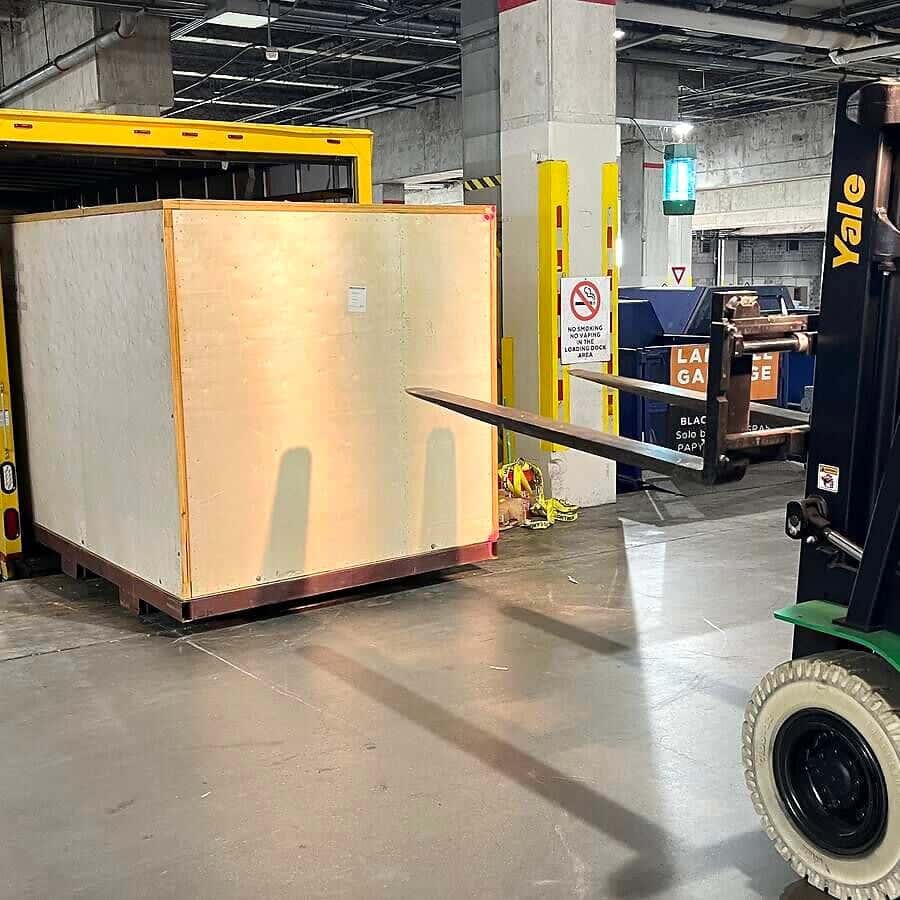
Office towers, hospitals, big-box stores and many newer mixed-use buildings have docks. Underground docks can have clearances under 13 ft, so ask for the posted dock clearance and compare it with the truck's height. Docks usually run on appointments set by a dock master. Many buildings won't admit a truck without a certificate of insurance on file, sometimes naming the building or its manager as holder. Send the COI the day before, not at the gate.
Curbside receivers with no dock
Ground-floor retail, restaurants and small showrooms take freight at the curb. Under the NYC311 parking signs and rules (opens in a new tab), commercial vehicles may double-park for quick pickups and deliveries only during posted hours. Unless signs allow more, they may not stay on any street over 3 hours, or park on residential streets from 9 p.m. to 5 a.m. These rules cover vehicles with commercial plates and the registrant's name on the side. Commercial vehicle parking in NYC is enforced hard, so read every sign.
Liftgate drops
A curbside stop with pallets needs a liftgate truck, a pallet jack and a smooth path from the gate to the door. Check each pallet's weight against the liftgate rating. Confirm whether the receiver has staff and a pallet jack, or expects the driver to bring freight inside. Inside delivery is a separate service. For a full prep list, see what liftgate delivery involves and how liftgate delivery is quoted.
How to book an NYC delivery that actually happens
NYC truck delivery rules decide how the truck gets there. The receiver's details decide whether it unloads. Send the carrier these with the tender:
| Detail | Why it matters |
|---|---|
| Full address, cross streets and the receiving entrance | Many buildings receive on a side street, not at the front address |
| Dock or curb, plus dock clearance height | Sets the truck choice and the liftgate need |
| Receiving hours and appointment number | Docks turn away trucks without a booked slot |
| COI requirements, with the certificate holder's exact name | Without a COI on file, the truck doesn't get into the dock |
| Pallet count, dimensions and weight per pallet | Checks the liftgate rating and the freight elevator limit |
| On-site contact name and mobile number | The driver can call 30 minutes out and on arrival |
| Off-hour receiving allowed (yes or no) | Opens the cheaper overnight toll and easier curb access |
| Accessorials expected: liftgate, inside delivery, wait time | Prevents surprise charges (accessorial charges explained) |
Build in slack. A first-slot appointment with the truck staged legally nearby beats one timed to arrive straight off I-95.
How Cobra US Cargo handles NYC deliveries
Our unit is a 26 ft dry box truck with a hydraulic liftgate and e-track, under 26,000 lb GVW. It's a single-unit truck, so it can leave the interstates for local truck routes and reach curbs and docks that a 53 ft trailer can't. On the Miami to New York freight lane, about 1,280 miles on I-95, typical transit is 2 to 3 days, not guaranteed. Before dispatch we confirm the appointment, the dock or curb, and the COI requirements, and we send updates at pickup, in transit and at delivery. Return loads run on the New York to Miami lane.
Sources
- NYC DOT — Trucks and Commercial Vehicles (opens in a new tab)
- NYC Rules — DOT Adopted Rule: Citywide Truck Routes (34 RCNY 4-13) (opens in a new tab)
- MTA — About the Congestion Relief Zone toll (opens in a new tab)
- NYC DOT — Size and Weight Restrictions (opens in a new tab)
- NYC DOT — Incentives to Reduce Truck Deliveries During Busiest Hours (Sept. 24, 2026) (opens in a new tab)
- NYC311 — Parking Signs and Rules (opens in a new tab)