
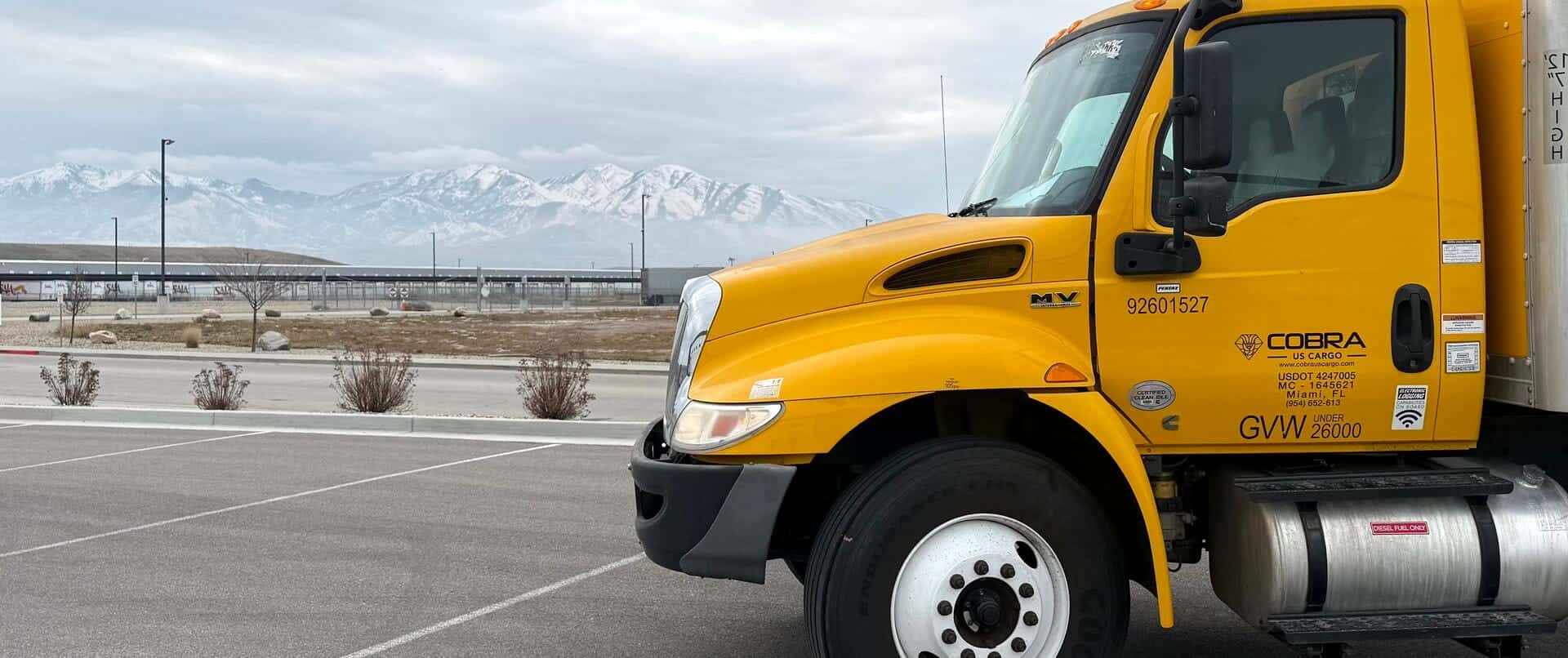
A box truck dispatch service finds and books loads for a truck that runs under your own MC authority, for a fee. Leasing on puts the truck under a carrier's authority instead: the carrier's dispatch books the loads, and its authority and insurance filings cover the truck under dispatch. The real choice is whose authority, insurance and compliance the truck runs under, and what each one costs you.
This guide is for owners of a 16 to 26 ft straight truck who can't keep it busy, and for new owners deciding how to start. It's written by a carrier that leases on box trucks and doesn't sell dispatch.
Key takeaways
- A dispatcher works on your authority. You still hold the MC, the insurance, the safety record and every compliance duty. A lease-on moves most of those to the carrier.
- Under FMCSA's 2023 final guidance, a dispatch service that books the same kind of freight for several carriers and chooses which one gets each load needs broker authority.
- No federal rule sets what a dispatch contract must say. A lease-on is covered by Truth-in-Leasing rules (49 CFR 376.12) that force pay, chargebacks and insurance into writing.
- Compare the two by what's left of the gross after every line item, not by the dispatcher's percentage or the lease's split.
What does a box truck dispatcher actually do?
A box truck dispatcher is a contractor who books freight for your company. A typical box truck dispatch service searches load boards, calls brokers, negotiates the rate, sends your carrier setup packet, and books the load in your company's name. Many also plan routes around your hours of service. One caution: FMCSA's guidance treats a dispatcher that takes payment from the broker or factoring company, or touches the money between them, as a sign of brokering.
What a dispatcher can't do:
- It can't give you authority. Every load moves under your USDOT and MC numbers, so the broker vets your company, not the dispatcher's.
- It can't carry your risk. The rate confirmation names your company as the carrier. Cargo claims, insurance and safety violations stay with you.
- It doesn't control the freight. If brokers won't onboard a new authority or your insurance falls short of their contract, a dispatcher can't fix it. Our guide on how to find box truck loads covers why brokers say no.
How do box truck dispatchers charge?
Box truck dispatchers commonly charge in one of three ways: a percentage of each load's gross, a flat fee per week, or a flat fee per load. Some add a setup fee. We know of no public, verified dataset of dispatcher rates, so distrust any "standard" percentage. Get the fee schedule in writing and ask:
- A percentage of what? Linehaul only, or also fuel surcharge, detention and lumper reimbursements?
- Do loads you find yourself count? Some agreements charge the fee on every load the truck hauls.
- Is there a weekly minimum? It keeps running when the truck sits.
- How do they get paid? They should invoice you. Taking a cut out of the broker's or factoring company's payment is one of FMCSA's signs of brokering (next section).
- How do you cancel? Find the notice period and any exit fee.
Truth-in-Leasing rules cover equipment leases, not dispatch agreements. 49 CFR 376.12 (opens in a new tab) makes a carrier's lease state your pay, itemize every chargeback with how it's calculated, and pay you within 15 days after you submit the delivery documents. A dispatch contract gets only the protections you negotiate.
Does a box truck dispatch service need broker authority?
It depends on what the dispatcher does. Under 49 CFR 371.2 (opens in a new tab), a bona fide agent works for a carrier under a preexisting, continuing agreement that leaves it no discretion in allocating traffic between the carrier and others. Anyone who arranges transportation by an authorized motor carrier for pay is a broker, unless it is the carrier itself, the carrier's employee or a bona fide agent.
In its 2023 final guidance on brokers and bona fide agents (opens in a new tab), FMCSA said a dispatch service that arranges transportation for several carriers and allocates traffic among them isn't a bona fide agent and must get broker authority. "Allocating traffic" means any choice about which carrier gets a load. A dispatcher for one carrier makes no such choice. One that books the same kind of freight for several carriers, with no split by region or freight type, does.
| Points to a legitimate dispatch agent | Points to unregistered brokering |
|---|---|
| A written contract appoints it as your agent and sets insurance and liability duties | No written contract with the carrier |
| It books through brokers and doesn't solicit shippers | It deals or negotiates directly with shippers |
| You pay it under the contract, on a 1099 or as an employee | It takes pay from the broker or factoring company, or touches the payment between them |
| It tells brokers it is booking for one specific carrier | It accepts a load before it has a truck, then shops it around |
| It never hands your load to another carrier | It's named on the shipping contract or offers loads to the open market of carriers |
These factors come from the guidance, and no single one decides it.
Why this matters to you, not just the dispatcher
Under 49 U.S.C. 14916 (opens in a new tab), anyone who knowingly authorizes, consents to or permits unregistered brokering is liable for a civil penalty of up to $10,000 per violation and, to the injured party, for all valid claims. That reaches the company's officers, directors and principals personally, and the statute isn't limited to the dispatcher. Whether it touches your arrangement is a legal question for a transportation attorney. In practice, an unpaid carrier can bring a claim, but it may be chasing a company with no bond.
A registered broker must keep a $75,000 surety bond or trust fund under 49 CFR 387.307 (opens in a new tab), which can pay carriers when the broker doesn't. A "dispatcher" handling freight money without broker authority has no such bond behind it.
Dispatch service vs lease on: who holds the authority, insurance and compliance?
This is the core of the box truck dispatch service vs lease on decision. With a dispatcher, you are the carrier. On a lease-on, the carrier is.
| Item | Your authority + a dispatch service | Leased on to a carrier |
|---|---|---|
| Operating authority (MC) and USDOT on the door | Yours | The carrier's |
| Public liability insurance and its FMCSA filing | You buy it and your insurer files it. The federal minimum is $750,000 for nonhazardous freight in an interstate for-hire truck of 10,001 lb GVWR or more | The carrier keeps it. The lease must say so |
| Cargo, physical damage and non-trucking coverage | You buy them. Brokers commonly require cargo coverage | The lease must say who provides each one and what any chargeback costs |
| Who books the loads | The dispatcher, in your company's name | The carrier's dispatch, in the carrier's name |
| Broker setups (carrier packets) | Your company, one broker at a time | The carrier's existing setups |
| Billing and collections | You invoice, or use factoring | The carrier bills, and must pay you within 15 days after you submit delivery documents |
| Driver qualification file, ELD and hours-of-service records | Yours | Kept by the carrier, which often sets which ELD you use |
| Safety record and new-entrant audit | Yours, including new-entrant safety monitoring and a safety audit | The carrier's |
| What protects your pay | The dispatch contract you negotiated | 49 CFR 376.12 plus the written lease |
| Choice of loads and lanes | Wide. You can turn down what the dispatcher finds | Limited to the carrier's freight and the lease's terms |
| Leaving | End the dispatch contract. Your authority stays | End the lease on its terms and remove the carrier's identification. Final pay can be held until you do |
The liability minimum is from 49 CFR 387.9 (opens in a new tab), and brokers often ask for more. For the lease side in detail, including escrow and chargebacks, see our guide to the box truck lease on.
Box truck dispatch service vs lease on: a side-by-side example
Example only, with hypothetical numbers. This is not a quote, not a market average and not a Cobra US Cargo rate or pay structure. Assumed inputs: the same truck grosses $5,000 in a week under both models, a 10% dispatcher fee, a 3% factoring fee, and on the lease a 20% carrier share plus $100 of chargebacks (for example non-trucking liability or an ELD fee). Insurance and compliance costs are round guesses. Fuel, maintenance, physical damage coverage and the truck payment are treated as equal in both columns and left out.
| Line item (assumed, weekly) | Own authority + dispatcher | Leased on |
|---|---|---|
| Gross load revenue | $5,000 | $5,000 |
| Dispatcher fee | −$500 | None |
| Factoring fee | −$150 | None |
| Liability and cargo insurance | −$400 | Assumed on the carrier's policy |
| ELD, compliance and admin costs | −$100 | Assumed in the chargebacks |
| Carrier's share under the lease | None | −$1,000 |
| Chargebacks listed in the lease | None | −$100 |
| Left before fuel, maintenance and truck payment | $3,850 | $3,900 |
The totals are close because the inputs were chosen that way, and one changed assumption flips the answer. A dispatcher's percentage looks small next to a lease split, but the split often covers costs you'd pay yourself on your own authority.
The break-even test: the lease leaves you more money when
carrier share + lease chargebacks < dispatcher fee + factoring + your own insurance + your own compliance costs
Fill the right side from real quotes (your agent's premium, your factoring agreement, the dispatcher's fee schedule) and the left side from the carrier's written lease. If the right side is bigger, leasing on comes out ahead on paper, before you count the risk. Have an insurance agent quote the own-authority coverage, and ask a tax professional how each setup affects your taxes.
Two things the example hides. The gross isn't really the same: a strong dispatcher might find better-paying loads, or a new MC might find fewer loads. Risk isn't in the table: on your own authority, a cargo claim, an insurance lapse or a bad audit hits your company.
To run your own version, ask the carrier for a sample settlement sheet and the dispatcher for a sample weekly invoice. On percentage pay, the lease must give you a copy of the rated freight bill at or before settlement. Our guide to owner-operator percentage pay shows how to read one.
Red flags when you hire a box truck dispatcher
Walk away from a dispatcher if you see any of these:
- Upfront "membership" or "network access" fees before a single load is booked.
- Guaranteed weekly income. No dispatcher controls freight volume or rates.
- Requests for your ELD login, your bank login or your FMCSA portal password. A dispatcher doesn't need them to book freight.
- No written agreement, or one with no fee schedule, no cancellation terms and no insurance and liability terms.
- Your money routed through them. Settlements should go from the broker or factoring company to you, never through the dispatcher.
- Rate confirmations you never see. You should see each one, with the broker's name and the full rate.
- It offers loads to the open market of carriers with no broker authority. Look up its MC number first.
The same diligence works in reverse. Before you lease on, look up the carrier in FMCSA's SAFER Company Snapshot: authority active, insurance on file. Get the full written lease before the first load.
Which model fits your situation?
- You already run your own MC, brokers already approve you, and you want to keep control of your lanes. A good dispatcher can fill the truck and save you hours, under a written agreement that passes the FMCSA factors above.
- You have a new MC and brokers keep saying no. A dispatcher can't fix authority age or insurance. Leasing on can put the truck to work under an established authority, and you may not have to give up your MC to do it. See how to lease on with your own authority and keep the number.
- You just bought a box truck and have no authority yet. Compare the cost of building a company (authority, insurance filings, compliance) with leasing on first.
- You're still shopping for a truck. Talk to the carrier you'd lease on to before you buy. Its equipment rules should shape what you buy.
- You don't own a truck yet. Driving for a carrier teaches you the freight first. See our box truck driver jobs.
How Cobra US Cargo handles this
Cobra US Cargo LLC is a Miami-based interstate carrier with its own authority (MC-1645621, USDOT 4247005), fully insured to industry standard. Owner-operators lease on to our MC, and our dispatch, in English and Spanish, finds and books the loads. We want to be the first carrier partner for box truck owners: we also help you get the right insurance in place, support ELD and compliance, offer a fuel card with fuel discounts, give new owners startup guidance and pay weekly.
The only truck requirement is a 26 ft box truck, 2018 or newer, and owner-operators anywhere in the US are welcome. Fleet owners can put a hired driver in the truck if that driver meets our driver requirements. The figure we share is $6K–$10K a week in gross. Gross revenue before fuel, insurance and other expenses. Results vary by truck, availability and lanes. For pay structure, settlements, deductions, the insurance split or leasing on while you hold your own MC, contact us for details. You don't need trucking experience to start the conversation, and if you haven't bought a truck yet, talk to us before you buy. See how leasing on with Cobra works.
Sources
- Federal Register — FMCSA final guidance, Definitions of Broker and Bona Fide Agents (June 16, 2023) (opens in a new tab)
- eCFR — 49 CFR 371.2, Definitions (broker, bona fide agent) (opens in a new tab)
- GovInfo (U.S. Code) — 49 U.S.C. 14916, Unlawful brokerage activities (opens in a new tab)
- eCFR — 49 CFR 387.307, Property broker surety bond or trust fund (opens in a new tab)
- eCFR — 49 CFR 387.9, Financial responsibility, minimum levels (opens in a new tab)
- eCFR — 49 CFR 376.12, Lease requirements (opens in a new tab)