
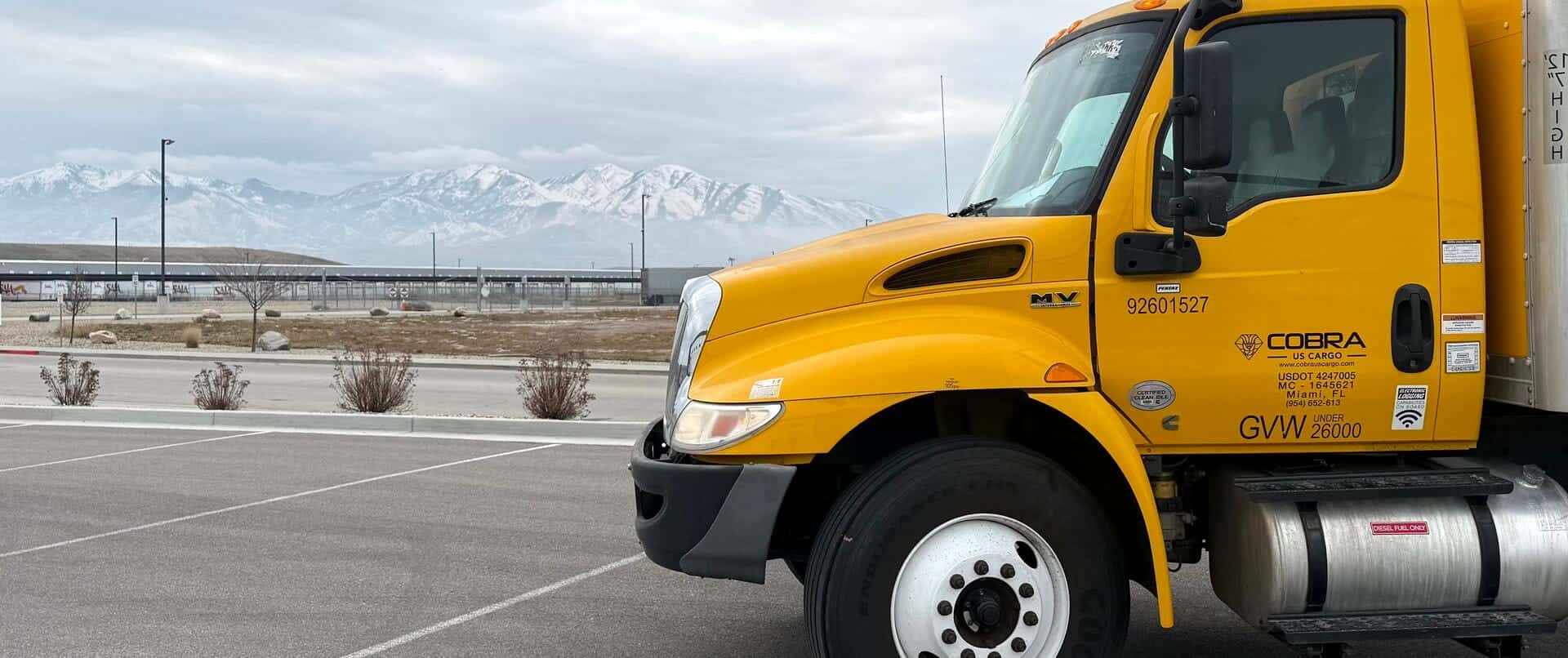
To start a box truck business, you set up a company, buy a truck whose weight rating fits your license, decide whose operating authority you will run under, insure it, get compliant and line up freight. The biggest early choice is the path: drive for a carrier first, buy a truck and lease on to a carrier, or buy and run your own MC authority.
This guide on how to start a box truck business is for people who don't own a truck yet, or just bought one, and want a for-hire freight business with a 16 to 26 ft straight truck. It is written by a carrier that leases on box trucks, so it focuses on what carriers and brokers actually check. It gives no invented income or profit figures, because real results depend on your truck, costs and lanes. It is general information, not legal, tax or insurance advice.
Key takeaways
- There are three real ways to start: drive first, buy and lease on, or buy and run your own authority. They differ in cash, risk and how fast you get to a paid load.
- The weight rating on the door label decides whether a CDL is needed, not the "26 ft" in the ad. At 26,001 lb or more, the driver needs a CDL.
- A box truck rated 10,001 lb or more is still a commercial motor vehicle in interstate commerce, so the medical card, hours-of-service and inspection rules apply.
- Most two-axle box trucks at 26,000 lb or less don't need IFTA fuel tax decals, and Form 2290 starts at 55,000 lb.
- You don't need your own MC number to start. Leasing on lets you haul under a carrier's authority while you learn.
What does a box truck business actually haul?
A for-hire box truck business hauls commercial freight for shippers and brokers: palletized and crated dry freight, retail store deliveries, e-commerce and warehouse overflow, trade show freight, building materials, and furniture and fixtures for businesses. Much of it goes to places a 53 ft trailer can't reach easily: stores, job sites, city streets and buildings without a dock.
That is why the equipment matters as much as the license. A hydraulic liftgate opens up deliveries with no dock, and e-track or logistics posts let you strap loads so they don't shift. Brokers post loads by equipment type, weight and pallet count, so the truck you buy decides which freight you can accept.
Three ways to start a box truck business: which path fits you?
Most guides jump straight to "get your MC number." That is one path, and the riskiest for a new owner. Here are all three side by side.
| Drive for a carrier first | Buy a truck and lease on | Buy a truck and run your own authority | |
|---|---|---|---|
| Cash up front | None for a truck | The truck, setup and whatever insurance the lease puts on you | The truck, authority filings, full insurance and cash to cover weeks before brokers pay |
| Whose MC and USDOT | The carrier's | The carrier's, for the length of the lease | Yours |
| Who finds the freight | Carrier dispatch | Carrier dispatch | You, a dispatcher or load boards |
| Time to a paid load | As soon as you're hired | Once the truck and driver pass the carrier's checks and the lease is signed | Longest: authority, insurance and process-agent filings, then broker setups. Some brokers won't load new authorities |
| Main risk | Lowest | Truck payment, repairs and downtime are yours | All of it: repairs, insurance, compliance, collections and finding every load |
| What you learn | Docks, BOLs and PODs, logs, lanes | How freight pays and what your truck really costs to run | Running every part of a trucking company |
If you have never worked in freight, the first two paths let you learn before you bet everything. You can start as a company driver on a box truck and buy later, or buy a truck and lease it on so a carrier's dispatch keeps it loaded. Our guide to box truck lease on agreements explains what the lease must say under federal rules.
What are the box truck business requirements for a non-CDL truck?
The rules follow the truck's weight rating and the work it does, not its length. Under 49 CFR 390.5 (opens in a new tab), a truck used in interstate commerce is a commercial motor vehicle (CMV) when its weight rating or actual weight is 10,001 lb or more, whichever is greater. Nearly every 16 to 26 ft box truck clears that line. Under 49 CFR 383.5 (opens in a new tab), a single truck needs a CDL driver when its weight rating or actual weight is 26,001 lb or more, or when it hauls placarded hazmat.
Here is how the main rules land on a typical two-axle box truck rated 26,000 lb or less, hauling dry freight across state lines with no placarded hazmat:
| Rule | Applies? | What it means for you |
|---|---|---|
| CDL | No | As long as the weight rating and the loaded weight both stay at 26,000 lb or less |
| DOT medical card | Yes | Required for drivers of interstate CMVs of 10,001 lb or more |
| Hours of service and ELD | Yes | The driving limits apply, and logs on an ELD are required unless the driver or truck fits an exception, such as the 150 air-mile short-haul rule |
| Annual inspection | Yes | A periodic inspection every 12 months, with proof on the truck |
| USDOT number and MC authority | Only on your own authority | When leased on, the truck runs under the carrier's |
| Federal liability minimum | Only on your own authority | $750,000 for for-hire, non-hazmat property in trucks of 10,001 lb or more |
| UCR registration | Usually only on your own authority | Leased-on trucks are normally covered under the carrier |
| DOT drug and alcohol testing (Part 382) | No federal requirement | It covers CDL drivers; many carriers still test under their own policy |
| IFTA and IRP | Usually no | A two-axle truck qualifies only when its gross or registered weight is over 26,000 lb |
| Form 2290 heavy vehicle use tax | No | Starts at a taxable gross weight of 55,000 lb |
The liability minimum comes from the table in 49 CFR 387.9 (opens in a new tab). States can add their own rules on top: some charge their own highway-use or weight-distance taxes, so check every state on your route. The driver side, including age, English proficiency and the medical exam, is covered in our guide to non-CDL box truck driver requirements.
How to start a box truck business in 6 steps
Step 1: Set up the business
Pick a legal structure first. The SBA's guide to choosing a business structure (opens in a new tab) explains the tradeoff: a sole proprietorship is simple, but your personal assets aren't separate from the business, while an LLC protects them in most cases. A truck on the road carries real liability, so many owners choose an LLC. Rules, fees and taxes vary by state, so check with an accountant or attorney before you file.
Then, in this order:
- Form the LLC with your state, if you choose one. In Florida that is the Division of Corporations (Sunbiz).
- Get an EIN from the IRS. It is free, and the IRS EIN application page (opens in a new tab) says to form an LLC with the state before you apply. Ignore websites that charge for it.
- Open a business bank account and run every truck dollar through it.
- Set up bookkeeping from the first receipt.
- Write a one-page box truck business plan: which freight you will haul, which path you are taking, what the truck costs you each week, and how many weeks of expenses you can carry before the first payment arrives.
Step 2: Buy the right truck
"26 ft" in a listing is the box length. The weight rating is on the certification label on the driver's door or door pillar, and that number decides CDL or non-CDL. Some 26 ft boxes sit on heavier chassis rated above 26,000 lb, and those need a CDL driver. Read the label before you pay.
Check the box, floor and roll-up door for damage and leaks, test the liftgate, and ask for maintenance records. Our guide to buying a used box truck for freight has the full pre-purchase checklist. Carriers that lease on trucks usually set a model-year cutoff and their own equipment rules, so ask the carrier you plan to work with before you buy, not after.
Step 3: Decide whose authority you run under
This is the choice from the table above. On your own authority, you apply to FMCSA for a USDOT number and operating authority (an MC number), name process agents on a BOC-3, and have your insurer file proof of liability coverage before the authority goes active. Then you spend a new-entrant period under closer FMCSA monitoring and a safety audit.
On a lease-on, the carrier holds the authority and the filings, and a written lease spells out your pay, every deduction and who pays for which insurance.
Step 4: Get insured before the first load
With your own authority, your insurer files proof of at least the federal liability minimum, and brokers usually ask for higher limits plus cargo coverage. You will also want physical damage coverage on the truck itself. On a lease-on, the written lease must say who provides each coverage, and many leases put physical damage and off-dispatch (non-trucking) liability on the owner. Either way, get quotes from a licensed insurance agent before you commit to a truck, and ask the agent what each policy actually covers. A quote for a new venture can change your whole budget.
Step 5: Get compliant
Use the requirements table above as your checklist: medical card, driver qualification file, ELD and logs, annual inspection, and a plan for drug testing if your carrier or customers require it. On your own authority, all of it is yours. On a lease-on, the carrier keeps the file and the safety record, and you keep the truck and driver ready.
Step 6: Line up freight
On your own authority, you will use load boards, brokers and direct shippers, and each broker vets your authority age, insurance and equipment first. Our guide on how to find box truck loads walks through those channels and the setup packet. On a lease-on, the carrier's dispatch books the freight, and your job is to be on time, every time.
What most box truck guides get wrong
Many pages on how to start a box truck business repeat the same errors. These are the ones that cost new owners money.
- "You need a CDL." Not for a box truck rated 26,000 lb or less, unless it hauls placarded hazmat or the loaded weight goes over. The CDL line is 26,001 lb, and the "26 ft" in the ad tells you nothing about it.
- "You'll need IFTA and Form 2290." A two-axle truck at 26,000 lb or less is usually outside IFTA, and the IRS Form 2290 (opens in a new tab) tax applies only at 55,000 lb or more.
- "Guaranteed weekly income." No honest carrier or broker can guarantee your income. Weekly figures in ads are usually gross revenue, and fuel, insurance, repairs and the truck payment come out of that number. Ask what any figure includes, and run your own cost per mile.
- Invented statistics. Failure rates and average profits with no source aren't data. Build your plan from your own quotes.
What makes a new owner ready to lease on?
From a carrier's side of the desk, a new owner is ready when the truck, the paperwork and the driver all check out on the first call. Have these ready:
- The truck: title or registration in your name or your company's, the door label showing the weight rating, and a current annual inspection.
- The business: your LLC or sole proprietor details, EIN and a completed W-9.
- The driver: a valid license, a current DOT medical card and a driving record you have already pulled, whether you drive or hire someone.
- Insurance quotes: for whatever coverage the lease will put on you, so there is no surprise at signing.
- A cash reserve for repairs and the weeks before your first settlements.
- A smartphone for dispatch and photos of every BOL and POD.
Then ask each carrier to show you the full written lease before the first trip, and read it line by line.
How Cobra US Cargo handles this
Cobra US Cargo LLC is a Miami-based interstate carrier with its own authority (MC-1645621, USDOT 4247005), fully insured to industry standard. We run our fleet of 26 ft box trucks plus a growing owner-operator program, and we want to be the first carrier partner for people starting out. If you'd like to start your box truck business with a carrier behind you, you lease on to our MC, and we provide dispatch that finds and books the loads, help getting the right insurance in place, startup guidance, ELD and compliance support, a fuel card and fuel discounts, and weekly pay.
The only truck requirement is a 26 ft box truck, 2018 or newer, and owner-operators anywhere in the US are welcome. Fleet owners can put a hired driver in the truck, as long as that driver meets our driver requirements. Dispatch speaks English and Spanish. The figure we share is $6K–$10K a week in gross (gross revenue before fuel, insurance and other expenses; results vary by truck, availability and lanes). For pay structure, deductions and the insurance split, contact us for details. No trucking experience is needed to start the conversation. If you haven't bought a truck yet, talk to us before you buy, and we'll walk you through it. Dispatch is reachable by phone or WhatsApp at (754) 288-7569, Mon–Fri, 8 am–6 pm ET.
Sources
- SBA — Choose a business structure (opens in a new tab)
- IRS — Get an employer identification number (opens in a new tab)
- eCFR — 49 CFR 383.5, Definitions (commercial motor vehicle for CDL purposes) (opens in a new tab)
- eCFR — 49 CFR 390.5, Definitions (commercial motor vehicle) (opens in a new tab)
- eCFR — 49 CFR 387.9, Financial responsibility, minimum levels (opens in a new tab)
- IRS — About Form 2290, Heavy Highway Vehicle Use Tax Return (opens in a new tab)